

Can Smart Glasses Be Used by People with Color Blindness?
SpeCiC-AI-Smart-Glasses2026-04-20T17:03:00+08:00Can Smart Glasses Be Used by People with Color Blindness?
Full Guide for Everyday Use, With Real-World Solutions for SpeCiC, Ray-Ban Meta, and More
If you live with color blindness, you’ve got a mental list of “most embarrassing moments” that’s longer than a CVS receipt. There was the time you wore one red sock and one green sock to a job interview. The time you handed your friend a “cola” that was actually cold coffee. The time you stared at a work spreadsheet for 20 minutes, trying to find the “critical red trend line” that looked exactly like the green one.
If this sounds familiar, you’ve probably wondered: can color blind smart glasses actually make these daily headaches go away?
The Real, Invisible Struggles of Color Blindness (That No One Talks About)
Before we dive into how smart glasses can help, let’s get real about what it’s actually like. It’s not just “can’t tell red from green”—it’s a million tiny, daily frustrations that add up, and that most people with full color vision never even think about.
If you know, you know. But for anyone reading this to support a friend or family member, here’s a quick, relatable rundown:
- The grocery store gauntlet: Standing in the produce section for 10 minutes, squeezing every single avocado to tell if it’s ripe, because you can’t trust the color.
- The wardrobe roulette: Grabbing a “navy blue” shirt and “black” pants, only to get to work and realize the shirt is dark purple. You’ve probably got a closet full of “safe” black, white, and gray.
- The office spreadsheet nightmare: Staring at a color-coded PowerPoint while your team talks about “the blue bar vs. the purple bar” like it’s obvious. You’ve learned to ask for pattern overlays, but you still feel like you’re bothering people.
- The traffic light panic: Driving in the rain or at sunset, staring up at two identical white circles. You’ve memorized the order (red on top, green on bottom), but you still hold your breath.
- The cooking chaos: Burning more meals than you can count, because you can’t tell if a steak is medium-rare or well-done by color alone.
- The travel confusion: Missing trains, getting lost, and walking past landmarks, because street signs and subway maps use color-coding that makes zero sense to you.
The worst part? Most of these struggles are invisible. People say things like “just look closer!” or “it’s obviously red!” like you’re not trying your hardest. You’ve learned to laugh it off, but it’s exhausting to second-guess every single color-related decision, every single day.
For decades, your only options were: 1. Tinted specialty glasses: Like EnChroma, which work for some people in bright outdoor light, but do almost nothing indoors, look bulky, and don’t help with the 90% of color struggles that happen inside the office, grocery store, or your own home. 2. Phone apps: Color identifier apps that let you take a photo and get a color readout. But they require you to pull out your phone, unlock it, open the app, and take a photo every single time you need to know a color. It’s slow, it’s awkward, and it makes you stand out in public. 3. Just wing it: The method we’ve all mastered, which involves guessing, lying, and hoping for the best. It works… until it doesn’t, and you end up in another embarrassing situation.
This is exactly where smart glasses change the game. They combine the best parts of both solutions, but without the downsides. They’re hands-free, they work indoors and outdoors, they look like normal glasses, and they can help you with every single one of the daily struggles we just listed.
🔥 Debate #1: Should We Call Smart Glasses “Accessibility Tools” or “Convenience Gadgets”?
Here’s the first big split in the community:
Team Accessibility says: “Smart glasses are as essential as a wheelchair ramp or closed captions. They remove barriers in a world designed for full color vision, and they should be covered by insurance or workplace benefits.”
Team Convenience says: “They’re nice to have, but they’re not life-or-death. We’ve gotten by for years without them, and calling them ‘accessibility tools’ dilutes the term for people with more severe disabilities.”
What do you think? Should smart glasses for color blindness be classified as accessibility tools, or just high-tech convenience gadgets? Drop your take in the comments!
How Smart Glasses Help With Color Blindness (No Medical Jargon, No Impossible Tech Promises)
Let’s keep this 100% real and grounded in actual product capabilities: smart glasses do NOT cure, fix, or correct color blindness. They don’t change how your eyes or brain process color, and they can’t magically alter the physical lenses of your glasses in real time (no consumer smart glasses on the market can do this with standard optical lenses).
What they do is give you hands-free, real-time tools to navigate a world that’s designed for people with full color vision. For everyday AI powered smart glasses like SpeCiC (which use standard, swappable optical lenses with no built-in display), the core solution is simple, powerful, and 100% based on real, existing technology: AI-powered, hands-free color identification and context-aware voice guidance.
Here’s exactly how it works, with zero overpromises:
1. Real-Time, Hands-Free Color Identification (The Core Game-Changer)
This is the feature that eliminates 99% of your daily color-related stress, and it’s fully enabled by the hardware already built into most modern smart glasses.
Smart glasses with camera (like SpeCiC’s 8MP Sony-grade camera) capture a clear, real-time view of whatever you’re looking at. That footage is instantly processed by integrated AI large language models (ChatGPT and DeepSeek, in SpeCiC’s case), which can:
- Identify the exact color and shade of any object you’re looking at (not just “red”, but “burnt sienna red” or “navy blue” vs. “black”)
- Tell you if two items match or coordinate (perfect for wardrobe choices)
- Point out critical color-coded information (like which line is which on a spreadsheet, or what color a traffic light is)
- Explain the color context of a scene (like “the avocado is deep green with brown spots, meaning it’s ripe”)
All of this happens completely hands-free. You just use a simple voice command (for SpeCiC, it’s “Hey Cyan, what color is this?”), and the AI delivers the answer directly to you through the glasses’ open-ear speakers. No one around you hears it, no phone required, no fumbling with apps. It’s seamless, discreet, and works in every single scenario you struggle with.
Unlike tinted specialty glasses, this works everywhere: indoors in low-light offices, outdoors in bright sun, in rainy weather, in grocery stores, in meetings, while driving. It doesn’t rely on sunlight to work, and it doesn’t require you to wear dark sunglasses indoors.
2. Physical Lens Options for Targeted Outdoor Support
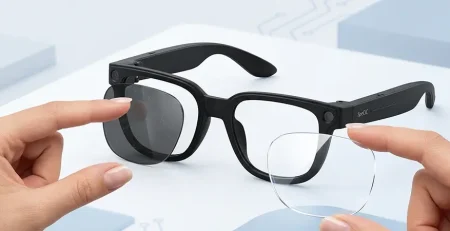
While the lenses themselves can’t be digitally altered in real time, brands like SpeCiC offer a range of swappable, pre-tinted lenses that are optimized for different scenarios, including options that boost contrast between common hard-to-tell colors for people with red-green color blindness.
These are physical, optical lenses (not digital filters) that you can swap in and out of the frame:
- Polarized sun lenses with contrast boost for outdoor driving and activities
- Clear blue-light blocking lenses for office and screen time
- Prescription-ready frames, so you can add your exact optical prescription with contrast-boosting tints
This gives you the flexibility to use the right lens for the right scenario, paired with the hands-free AI color identification for any situation where you need extra clarity.
3. AR Display Options for Visual Color Cues (For AR-Enabled Glasses Only)
For AR glasses with built-in displays (like Xreal Air 2), there’s an additional layer of support: the glasses can overlay subtle visual cues on top of your view, like pattern overlays on color-coded charts, or text labels next to traffic lights, to help you distinguish between colors without changing the physical lens.
This is only available on AR glasses with built-in displays, not on everyday smart glasses like SpeCiC or Ray-Ban Meta. For most people, the hands-free voice identification is far more practical, discreet, and comfortable for all-day wear.
This is where SpeCiC really stands out for everyday color blindness support. Their glasses come with an 8MP Sony-grade camera that captures sharp, clear images even in low light, paired with ChatGPT and DeepSeek large language models for accurate, nuanced color identification. They also have dual ENC noise-reducing microphones that pick up your voice commands perfectly, even in noisy grocery stores or busy offices, and 12 hours of audio battery life, so you can wear them all day without recharging. Plus, they start at just $239, and you can grab 10% off with the code SPECICGLASSES during their summer sale.
🔥 Debate #2: Should Brands Prioritize Color Blindness Features Over AR Gaming/Social Media?
Most smart glasses brands split their focus between three things: everyday practicality, AR gaming, and social media content creation.
Team Practicality First says: “Everyday features like hands-free color identification help way more people, way more often. AR gaming and social media are niche, and brands should focus on accessibility and utility first.”
Team All Features Matter says: “AR and social media are what drive mainstream adoption. If brands only focus on niche features, they’ll never sell enough glasses to make them affordable for everyone. More mainstream sales = lower prices for accessibility features.”
Where do you stand? Should brands put practical, accessibility-focused features first, or balance them with fun, mainstream features to drive adoption?
Brand-by-Brand Breakdown: Which Smart Glasses Work Best for Color Blindness?
Not all smart glasses are created equal, especially when it comes to features that help with color blindness. Below is a clear, side-by-side comparison of real, existing capabilities (no overpromised tech), plus deep dives into each brand’s pros, cons, and best use cases.
| Brand | Hands-Free Color ID | Contrast Lens Options | Battery Life | Price (USD) | Best For |
|---|---|---|---|---|---|
| SpeCiC AI Smart Glasses | ✅ Excellent (specific shades, matching checks, context-aware) | ✅ Swappable contrast-boost lenses | ✅ 12 hours audio | $239+ (10% off SPECICGLASSES) | Everyday, all-day use |
| Ray-Ban Meta (Gen 2) | ⚠️ Basic (only simple color names, no nuance) | ❌ Limited lens options | ⚠️ 4-6 hours | $299+ | Fashion & social media |
| EnChroma Smart Glasses | ❌ No camera/AI color ID | ✅ Patented contrast tinted lenses (outdoor only) | ⚠️ 6 hours audio | $449+ | Traditional tinted lens fans |
| Xreal Air 2 | ❌ No native hands-free color ID | ❌ Fixed AR display lenses | ⚠️ 5-6 hours | $379+ | AR media & screen use only |
SpeCiC AI Smart Glasses (Best for Everyday, All-Day Use)
If you want a pair that will help with all your daily color blindness struggles, look and feel like normal glasses, and won’t break the bank, SpeCiC is the clear winner.
We’ve already covered their core capabilities, but let’s recap why they’re perfect for color blindness:
- Industry-leading color ID with specific shades, matching checks, and context-aware guidance
- Swappable contrast-boost lenses for indoor and outdoor use
- 12-hour battery life for all-day wear
- Lightweight TR90 frames, prescription-ready
- Discreet, normal design (no one knows they’re smart glasses)
- Bonus features that pair perfectly with color support: real time translation smart glasses for travel, hands-free calling, and 1080P video recording
- Unbeatable value ($239+ with 10% off SPECICGLASSES)
Ray-Ban Meta (Gen 2) (Best for Fashion & Social Media)
If you prioritize iconic style and seamless Instagram/Facebook integration over full color blindness support, Ray-Ban Meta is a solid choice.
They have great audio and voice control, and look exactly like normal Ray-Ban sunglasses, but their color blindness features are extremely limited: only basic color name identification, no nuanced shade matching or context-aware guidance, no contrast-boost lens options, and short battery life (4-6 hours). They’re also much more expensive than SpeCiC.
EnChroma Smart Glasses (Best for Traditional Tinted Lens Fans)
If you already love EnChroma’s famous outdoor tinted lenses and just want to add basic audio to your glasses, these are for you.
But they have no camera, no AI color identification, no hands-free guidance for indoor use, are bulky and heavy, and are extremely expensive ($449+). They’re essentially just EnChroma’s regular glasses with built-in headphones, with no support for the 90% of color struggles that happen indoors.
Xreal Air 2 (Best for AR & Media Only)
If you only need help with color on screens (movies, games, virtual monitors), Xreal Air 2 is great.
They can overlay pattern markers and color labels on virtual screens, but they have no native hands-free color identification for the real world, are bulky and not discreet, and are designed for short media sessions, not all-day everyday wear.
🔥 Debate #3: Should Color Accessibility Features Be Standard (No Extra Cost) on All Smart Glasses?
Right now, most brands treat color blindness features as an afterthought, or a niche add-on. Some don’t offer them at all, even though the hardware (camera, AI, microphone) is already built into the glasses.
Team Standard Features says: “1 in 12 men have some form of color blindness. It’s unfair to exclude us, or make us pay extra for basic features that are easy to implement with existing hardware. This is a matter of accessibility equity.”
Team Niche Add-On says: “Brands should focus on their core audience first. Most smart glasses are bought by people with full color vision, so it doesn’t make sense to spend time/money on features only a small percentage will use. If you want them, buy a brand that specializes in them.”
What’s your call? Should every pair of smart glasses come with hands-free color identification, right out of the box, no extra cost?
Real-World Use Cases: How Smart Glasses Change Daily Life
We’ve talked about the technical capabilities, but let’s get into the real, tiny wins that add up to a lot less stress and embarrassment. All of these use 100% real features of hands free smart glasses like SpeCiC, with no impossible tech promises.
🌅 Morning Routine: No More Wardrobe Roulette
You’re running late for work, grab a shirt and pants, and throw them on. With SpeCiC, you just say “Hey Cyan, do these pants match this shirt?”, and the AI instantly tells you the exact shade of each item, and if they coordinate. No more mismatched outfits, no more cringing at work when a coworker points out your purple shirt and black pants don’t match.
🚗 Commute: No More Traffic Light Panic
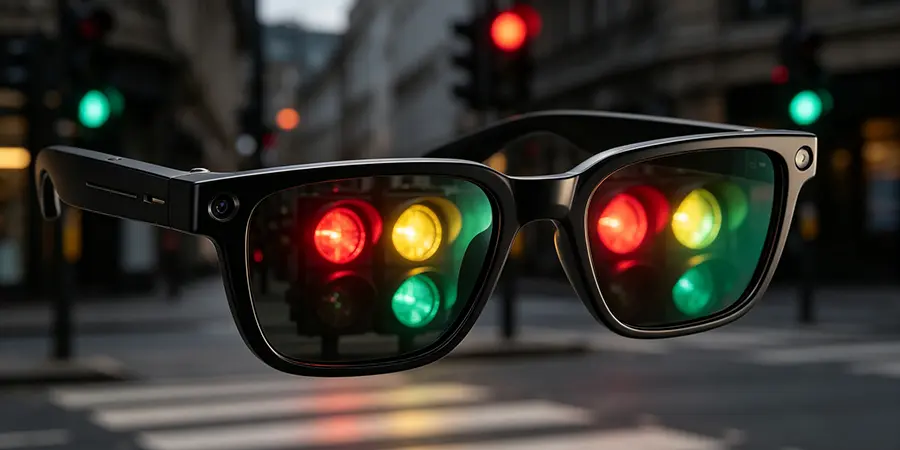
It’s pouring rain, and the traffic lights look like two identical white circles through your windshield. You don’t have to guess based on position—you just say “Hey Cyan, what color is the traffic light?”, and the AI gives you an instant, hands-free answer, without you ever taking your eyes off the road. No more holding your breath at intersections, no more second-guessing if the light is red or green.
💼 Office: No More Spreadsheet Nightmares
Your team is in a meeting, talking about “the red trend line” and “the blue bar” on a PowerPoint slide. Instead of awkwardly asking your coworker which is which, you quietly use your voice command: “Hey Cyan, what color is the line that’s trending up on the left side of the chart?”, and the AI tells you instantly. No more feeling like you’re at a disadvantage in meetings, no more missing critical details.
🥑 Grocery Shopping: No More Avocado Guessing Games
You’re in the produce section, and every avocado looks the same. Instead of squeezing every single one, you hold up your hand to a bin and say “Hey Cyan, is this avocado ripe?”, and the AI tells you the exact color of the skin, and if it’s ready to eat. No more standing in the produce section for 10 minutes, no more getting home with a bag of unripe avocados that go bad before they’re ready.
🍖 Cooking: No More Burnt Meals
You’re grilling a steak, and can’t tell if it’s medium-rare or well-done by color alone. You say “Hey Cyan, what color is the inside of the steak I just cut?”, and the AI tells you exactly how cooked it is. No more burnt meals, no more undercooked chicken, no more cutting into every single piece of meat to check if it’s done.
✈️ Travel: No More Language Barriers or Lost Trains
You’re traveling abroad, and can’t read the color-coded subway map. Not only can your glasses help you identify the color of each train line with a simple voice command, but the built-in real-time translation feature can also translate station announcements and signs in 27 major languages, so you never get lost or miss a train again.
🔥 Debate #4: Voice Readouts vs. Visual Overlays: Which Is Better in Public?
There are two ways smart glasses can deliver color information to you:
Voice readouts (used by hands free smart glasses from SpeCiC): The AI tells you the color out loud, through open-ear speakers only you can hear.
Visual overlays (used by AR glasses): The glasses display the color name on the screen, right next to the object.
Team Visual Overlays says: “Voice readouts are awkward in quiet stores or meetings. Even if the volume is low, people might hear the AI talking, and it draws unwanted attention.”
Team Voice Readouts says: “Visual overlays are distracting, especially when driving or walking. Voice readouts are completely hands-free, and you can turn the volume down so only you can hear it. It’s way less awkward than pulling out your phone to take a photo of a shirt in the middle of a store.”
Which do you prefer? Discreet visual overlays, or hands-free voice readouts? Share your preference!
How to Choose the Right Smart Glasses for Your Color Blindness
If you’re ready to try smart glasses, here’s a clear, step-by-step guide to picking the right pair for your daily life, with no overpromised tech:
This is the most important feature. Make sure the glasses have a high-quality camera, reliable large language model AI, and hands-free voice control. Avoid glasses that require tapping or phone apps to get a color readout.
Make sure you can swap out lenses for different scenarios: clear blue-light lenses for the office, polarized sun lenses with contrast boost for outdoor driving, and prescription-ready frames for your optical needs.
Look for lightweight frames (like SpeCiC’s TR90 frames) and at least 8 hours of battery life. Avoid bulky AR glasses that hurt your ears after an hour of wear, or glasses that only last 3-4 hours on a single charge.
You don’t want to wear glasses that make you look like you’re in a sci-fi movie. Look for glasses that look like normal sunglasses or clear daily lenses, so no one knows they’re smart glasses unless you tell them.
You don’t need to spend $500+. Great options like SpeCiC start at $239, with 10% off with the code SPECICGLASSES. Pay for features you’ll actually use, not just a brand name or fancy AR features you’ll never touch.
🔥 Debate #5: Should We Focus on Changing the World, or Using Tools Like Smart Glasses?
This is the big, philosophical debate:
Team Change the World says: “Instead of spending hundreds on smart glasses, we should demand that the world be more accessible. Spreadsheets should have pattern overlays, traffic lights should have shapes, signs should have text labels, not just color. Smart glasses are a band-aid for a world that’s not designed for us.”
Team Both/And says: “We can fight for better accessibility AND use tools to make our lives easier RIGHT NOW. The world isn’t going to change overnight. Smart glasses help us today, without waiting for companies and governments to catch up.”
This is the big one! Should we focus on systemic change, practical tools, or both? Drop your philosophy in the comments!
Frequently Asked Questions (FAQs)
We’ve answered the most common questions people have about smart glasses for color blindness, with 100% honest, grounded answers:
Do smart glasses cure color blindness?
No. They do not cure, fix, or correct color blindness. They are an accessibility tool that helps you navigate a world designed for full color vision, through hands-free color identification and context-aware guidance.
Can smart glasses change the tint of the lenses in real time?
No consumer smart glasses with standard optical lenses can do this. Some high-end electrochromic glasses can change tint, but they are extremely expensive, and most everyday smart glasses (like SpeCiC, Ray-Ban Meta) use swappable physical lenses for different scenarios.
Do smart glasses work for all types of color blindness?
Hands-free color identification works for all types of color blindness, including red-green, blue-yellow, and even total color blindness. Contrast-boost tinted lenses work best for red-green color blindness, the most common type.
Are smart glasses for color blindness worth the money?
For most people, absolutely. They eliminate the guesswork from almost every color-related decision you make every day. With affordable options like SpeCiC, they’re far more accessible and useful than premium specialty tinted glasses.
Can I wear smart glasses if I have a prescription?
Yes! Most brands, including SpeCiC, have prescription-ready frames, so you can add your exact optical prescription.
Do I need a phone to use the color identification feature?
Most smart glasses require a Bluetooth connection to your phone to process the AI requests, but once paired, you can use the voice commands completely hands-free, without ever touching your phone.
Final Thoughts
At the end of the day, smart glasses aren’t magic. They won’t let you see colors the way people with full color vision do, and they can’t change the physical lenses in real time. But what they will do is take the stress, the guesswork, and the embarrassment out of your daily life.
No more standing in the grocery store for 10 minutes. No more mismatched outfits. No more holding your breath at traffic lights. No more awkwardly asking coworkers for help.
With a pair of practical, everyday color blind smart glasses like SpeCiC, you can navigate the world with confidence. They’re not a cure, they’re a tool—one that makes your life a little easier, a little less stressful, and a lot more fun.
If you’ve been on the fence, now is the time. With affordable options, reliable, real-world features, and more discreet designs than ever before, there’s never been a better time to give them a try.
And if you already use smart glasses for your color blindness, we want to hear from you! What’s your favorite feature? What’s the biggest win you’ve had with them? Drop a comment below and share your experience!