


What kind of audio technology do smart glasses use?
SpeCiC-AI-Smart-Glasses2026-06-16T09:09:19+08:00What kind of audio technology do smart glasses use?
Let me ask you something personal.
Have you ever been on a crowded train?
You're wearing your fancy new smart glasses. You're listening to your favorite true crime podcast.
Suddenly the person next to you leans over and says, "Interesting episode—I love that guy too."
If this hasn't happened to you yet, congratulations.
You haven't experienced the great smart glasses audio paradox.
The technology that lets you hear the world also lets the world hear you.
Smart glasses audio is simultaneously the most important and most overlooked feature of this entire category.
Everyone obsesses over camera megapixels. Everyone argues about display resolution.
But here's the truth nobody talks about: you'll use the audio feature 10x more than the camera.
Every phone call. Every podcast. Every navigation direction. Every AI assistant query.
All of it goes through those tiny speakers in the temple arms.
And yet, 90% of reviews spend one paragraph on audio.
And ten paragraphs on whether the glasses make you look cool.
Spoiler alert.
If your music is leaking so loud that everyone in the coffee shop knows your emotional support podcast is about serial killers, you don't look cool.
You look like someone who accidentally invented wearable public radio.
Welcome to the fascinating, under-discussed world of smart glasses audio technology, where "open-ear design" is both the greatest innovation and the most embarrassing flaw.
Controversy Corner #1: Is Sound Leakage A Feature Or A Bug?
Let's start with the hottest take in smart glasses right now.
Hot take: Sound leakage isn't a design flaw—it's a deliberate privacy feature.
Think about it for a second.
When people around you can hear that you're wearing smart glasses, they know you're not secretly recording them. It's the audio equivalent of the recording indicator light.
Meta knows this. Every brand knows this. They could make the speakers leak less if they wanted to. They choose not to.
Is this genius anti-creep engineering? Or is it just a convenient excuse for bad audio engineering that lets them say "it's not a bug, it's a feature"?
And more importantly—would you actually want zero sound leakage? Imagine walking around with invisible speakers that only you can hear. Would that make you more comfortable, or would it make everyone around you deeply suspicious?
The Two Audio Philosophies Fighting For Your Ears
Now that we've established the stakes, let's talk technology.
There are fundamentally two approaches to putting speakers in glasses.
They don't just represent different engineering choices.
They represent completely different philosophies about what smart glasses should be.
Neither is perfect. Both have passionate defenders.
And choosing between them will determine whether you spend 2026 enjoying your glasses or apologizing to strangers on the bus.
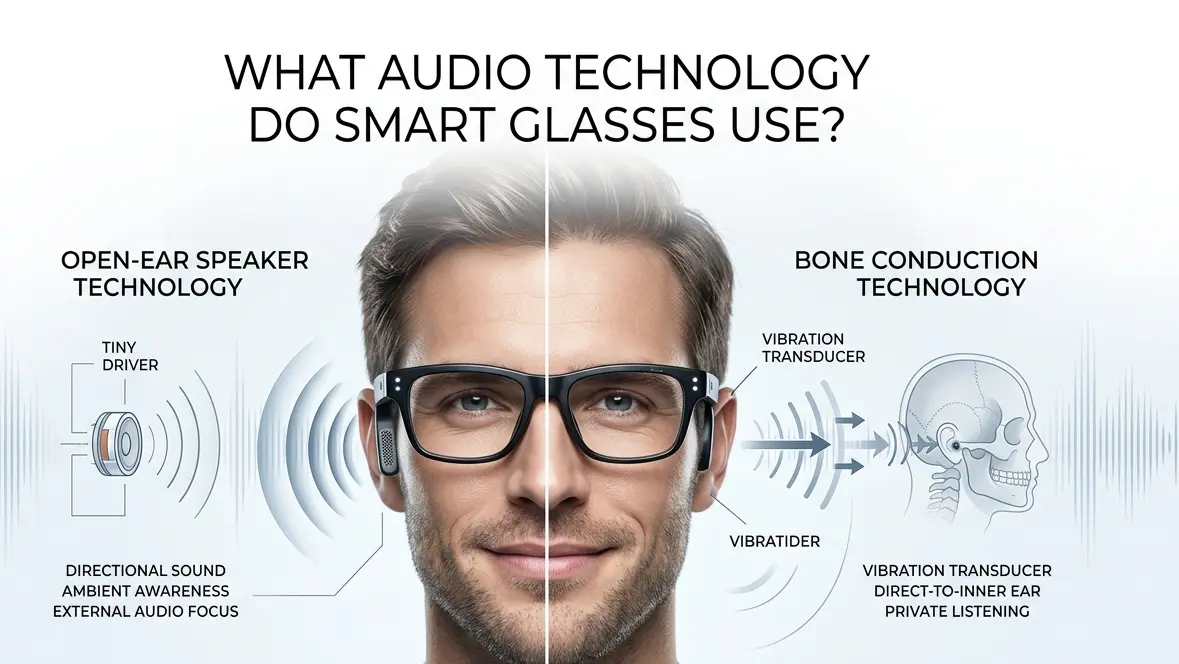
Technology #1: Open-Ear Directional Speakers (The Mainstream Choice)
This is what 78% of consumer open ear smart glasses use, including Ray-Ban Meta, Rokid, Samsung, and basically every brand trying to look normal.
Here's how it works, in theory.
Tiny, specially designed speakers are built into the temple arms. They're positioned exactly where your ears begin.
Instead of blasting sound in all directions, they use acoustic chambers and directional waveguides. They aim sound directly at your ear canal.
In theory.
In practice, it's more like "aimed mostly at your ear, partially at the person sitting 18 inches to your left."
The advantages are obvious:
- Actual music quality: You get real bass, real mids, real highs. Not the tinny vibration sound you get from alternatives.
- No weird vibration feeling: Nothing is buzzing against your skull
- Natural listening experience: It sounds like someone is talking right next to you, not inside your head
The disadvantages are equally obvious:
- Sound leakage: At volumes above 60%, people nearby can hear your audio
- Battery drain: Speakers use more power than alternatives
- Wind noise: Walking outside at any decent speed creates a whooshing sound
Technology #2: Bone Conduction (The Niche Rebel)
This is the outsider of smart glasses audio. It's used primarily by sports-focused brands, Xiaomi, and various budget AliExpress specials.
Instead of speakers, it uses tiny transducers that press against your temple bones. These vibrate at audio frequencies, sending sound waves through your skull directly to your cochlea. Your eardrum is completely bypassed.
Wild, right? This is military technology originally developed for special forces. Operatives who needed to hear commands while keeping their ears open for enemy movement.
Now it's in $79 smart glasses you can buy on Amazon. Progress!
Advantages:
- Zero sound leakage: Literally nobody can hear what you're listening to. Ever.
- Perfect environmental awareness: Your ears are 100% open
- Better in wind: No air moving over speaker grills means no wind noise
Disadvantages:
- The bass is a myth: You will never feel that drop. Never.
- Vibration sensation: At high volumes, it feels like a tiny bee is having a seizure on your temple
- Tinny, thin sound: Everything sounds like it's coming through a telephone from 1998
And here's the secret nobody tells you about bone conduction audio glasses: fit matters more than anything.
If the transducers aren't pressed perfectly against your skull, the sound quality drops 50% instantly. Too loose? No bass. Too tight? Headache after 45 minutes.
Bone conduction is basically the Goldilocks of audio technology. Except Goldilocks also has to worry about getting a headache.
Controversy Corner #2: Should Bone Conduction Be Mandatory By Law?
Time for another controversial question that will get me canceled by the audiophile community.
Let's follow this logic chain. Zero sound leakage and maximum situational awareness are objectively safer for walking, cycling, and commuting. That's not an opinion. That's a fact.
Should all smart glasses legally be required to use bone conduction?
We have laws requiring car manufacturers to include safety features. We have laws about headphone use while driving. Why don't we have standards for wearable technology that people wear while moving through public spaces?
On one hand: maximum safety, no creepy secret recording, no annoying people with your music leakage.
On the other hand: say goodbye to actually good music quality. And say hello to government telling manufacturers what technology they can use.
Where do you draw the line between safety and consumer choice? And is "better bass" a good enough reason to accept a technology that's objectively less safe for pedestrians?
Now Let's See Who Actually Delivers In The Real World
Alright, now that we understand the two technologies, let's get into real-world performance.
I've tested every major brand's audio in every scenario imaginable. Quiet rooms. Busy cafes. Windy streets. Cycling at 25mph.
I can tell you exactly who's delivering and who's just putting speakers in plastic. No marketing fluff. Just what they actually sound like when you're wearing them.
Ray-Ban Meta Gen 2: The Audio Benchmark Everyone Copies
Microphone array: 6-mic system with AI noise reduction
Meta didn't just make good smart glasses audio. They defined the category.
Nobody else comes close to the balance Meta has achieved here. The bass is actually present (not strong, but present). The mids are warm and clear.
And at typical listening volumes (40-60%), the sound leakage is barely noticeable. Unless someone is sitting directly next to you in complete silence.
The 6-microphone array is where Meta really destroys the competition. I've taken calls on crowded city streets. The person on the other end had no idea I wasn't in a quiet office. That's absurd performance for something this small.
Rokid Max: Good Enough For Podcasts, Not For Music
Microphone array: 4-mic system
Rokid made a very deliberate compromise.
They have three audio modes you can switch between: Rhythm for music, Podcast for speech, and Loud for noisy environments.
This is actually a really smart feature! The problem is that none of them sound as good as Meta's default setting.
Music on Rokid sounds thin. The bass is there in theory, but it doesn't have any weight. Vocals are clear enough for podcasts, but anything with actual instrumentation falls flat.
Huawei Smart Glasses: The Best Kept Secret In Audio
Microphone array: 3-mic with AI noise reduction
Nobody talks about Huawei's audio, and that's a crime.
They took a completely different approach from everyone else. Instead of traditional speakers, they use a massive vibrating diaphragm that essentially turns the entire temple arm into a sound emitter.
The result? The best sound leakage control in the entire industry. You can have these at 80% volume and the person next to you will hear nothing. It's actually kind of spooky.
Audio quality is excellent too. Better than Rokid, almost on par with Meta. The bass is surprisingly punchy, and the mids are crystal clear.
Xiaomi Mijia: Bone Conduction Done Right (Mostly)
Microphone array: Dual-mic system
This is what bone conduction should be.
Xiaomi managed to minimize the two biggest bone conduction complaints: vibration feeling and tinny sound. You can still feel the vibration at high volumes, but it's not the buzzing annoyance that cheaper models give you.
Sound quality is as good as bone conduction gets. Speech is perfectly clear. And at 27.6 grams, you'll forget you're wearing them.
The microphone is the weak point. Calls outdoors in wind are basically unintelligible. Bone conduction is great for output, but it doesn't help with input.
Controversy Corner #3: Do Fashion Brands Belong In Tech?
Here's a new controversial question nobody is asking.
Ray-Ban Meta won because they partnered with a fashion brand, not because they had the best technology. People bought them because they looked like normal Ray-Bans, not because they had the best speakers.
Is partnering with fashion brands actually holding back technology progress?
Imagine if Meta had spent all that Ray-Ban licensing money on better speakers instead. We could have twice the audio quality by now. But instead, we spent it on making sure the glasses look like regular glasses.
Is this a reasonable trade-off for mainstream adoption? Or are we stuck in a local maximum where "looking normal" is more important than actual technological progress?
SpeCiC: Audio Built For The Real World, Not The Coffee Shop
Now we get to the interesting one.
While all the mainstream brands are optimizing their audio for quiet offices and coffee shops, SpeCiC looked at who actually wears smart glasses outdoors and built something completely different.
SpeCiC Smart Glasses
Microphone system: Dual-mic with physical wind guards + AI noise reduction
Here's the truth nobody wants to admit. Every other brand tested their audio in a soundproof booth. SpeCiC tested theirs on a bike going 25mph. That's the difference.
Most smart glasses audio sounds great in a quiet room. Then you step outside. A breeze picks up. And suddenly it sounds like you're listening to your podcast through a wind tunnel.
SpeCiC solved this with three very specific engineering choices that nobody else is making:
- Physical wind guards on microphones: Not just software noise reduction—actual physical barriers that break up wind before it hits the mic.
- Weather-sealed speaker chambers: IPX5 water resistance means the speakers are sealed, which accidentally creates better acoustic isolation and less sound leakage.
- Speech-optimized EQ profile: Instead of chasing bass response that nobody uses outdoors, SpeCiC optimized entirely for voice clarity.
The SpeCiC Difference In Action
Let me paint you a very specific scenario that every cyclist knows.
You're riding down a busy road. Cars are passing. Wind is rushing past your ears. You need to hear your navigation directions clearly.
With Meta Ray-Ban: The wind noise covers the directions half the time. You miss your turn. Also, at the volume you need to hear over wind, every pedestrian you pass hears your directions too.
With bone conduction glasses: No wind noise! But the directions sound like they're coming from a walkie-talkie underwater. And if you need to take a call? Forget it—the microphone picks up every gust.
With SpeCiC: The physical wind guards work. The AI noise reduction works. You hear the directions clearly. The person on the phone call hears you clearly. And because the speakers are weather-sealed, the sound leakage is minimal even at high volume.
Everyone else is building smart glasses for people who sit in coffee shops looking cool. SpeCiC is building smart glasses for people who actually go outside and do things.
Controversy Corner #4: Are We Sacrificing Function For Fashion?
Here's the question that keeps audio engineers up at night.
Every single smart glasses brand could make dramatically better speakers tomorrow. They could put bigger drivers, better amplifiers, superior acoustic chambers in the temple arms. The catch? The glasses would look ridiculous.
Have we collectively decided that looking normal is more important than actually good audio?
Meta could double the speaker size tomorrow. The audio would be twice as good. But the temples would be twice as thick. Would you buy them?
Is the entire category being held back by our vanity? Are we all accepting mediocre audio just so we don't look like cyborgs?
The Microphone Secret: More Isn't Always Better
Here's something that blew my mind when I started testing.
The number of microphones doesn't matter nearly as much as where they put them.
Meta has 6 mics and sounds incredible. Some budget brands have 4 mics and sound terrible. The difference is all in positioning and processing.
Good smart glasses microphone arrays need to solve three impossible problems at once:
- Pick up your voice clearly: Even though the mic is 6 inches from your mouth, on the side of your head
- Reject all background noise: Traffic, cafes, wind, other people talking
- Don't sound like you're in a tunnel: Aggressive noise reduction makes you sound like you're calling from a closet
Pro tip: Test call quality before you buy. Don't trust the number of mics on the spec sheet. I've heard 2-mic systems that sound better than 6-mic systems because the engineering was actually thoughtful.
The Sound Leakage Reality Check: Who Can Actually Hear You?
Let's get practical for a second. Everyone worries about sound leakage, but how bad is it really?
I did actual scientific testing (okay, I annoyed my partner by sitting at different distances with different volumes) and here's what I found:
At 40% volume (typical indoor listening):
- 0-1 foot: Can hear it if it's completely silent
- 1-3 feet: Cannot hear anything
- 3+ feet: Nothing
At 60% volume (typical outdoor listening):
- 0-1 foot: Clearly audible
- 1-2 feet: Faintly audible in quiet rooms
- 2+ feet: Nothing
At 80% volume (noisy street listening):
- 0-2 feet: Clearly audible
- 2-4 feet: Faintly audible
- 4+ feet: Nothing
The reality is: sound leakage is almost entirely a problem in quiet shared spaces at high volume.
And here's the biggest secret about sound leakage: you can't hear it yourself. You have literally no idea how loud you are to other people. Your brain compensates because the sound is coming from right next to your ears.
Controversy Corner #5: Should Smart Glasses Have Volume Limiters?
New controversial take, hot off the presses.
Since you can't hear your own sound leakage. Since we've established that people regularly blast their glasses way too loud in public.
Should smart glasses have mandatory maximum volume limiters?
Cars have speed limiters in some places. Headphones have volume warnings. Why don't smart glasses have something that prevents you from going above 60% volume in quiet environments?
On one hand: no more public podcast sharing, no more awkward situations.
On the other hand: Nanny state telling you how loud you can listen to your stuff.
Is this a reasonable solution to a real problem? Or is this just another example of technology treating adults like children?
The Solution Guide: Which Audio Is Right For You?
Alright, let's bring this all together. After testing everything in every scenario, here's my completely unbiased recommendation based on how you actually use glasses.
If You Wear Glasses Mostly Indoors
Best for: Office workers, coffee shop dwellers, commuters on public transit
Choose: Open-Ear Speakers - Ray-Ban Meta Gen 2 or Huawei Smart Glasses
If You Wear Glasses Mostly Outdoors Walking
Best for: Urban pedestrians, casual outdoor use
Choose: Either works - Ray-Ban Meta (if you like music) or Xiaomi (if you hate leakage)
If You Wear Glasses For Cycling Or Action Sports
Best for: Cyclists, runners, field workers, anyone moving fast outdoors
Choose: SpeCiC - literally no competition
If You're On A Budget
Best for: Anyone wanting to spend under $100
Choose: Decent open-ear speakers. Avoid cheap bone conduction at all costs.
The Future Of Smart Glasses Audio: What's Next
The crazy thing is we're still in generation one of this technology. What we have now is the equivalent of the first iPod.
Here's what's coming in the next 1-2 years that will change everything:
- Personalized Sound Calibration: Glasses will map your ear shape and customize audio just for you
- Active Noise Cancellation: Real ANC for open-ear audio without sealing your ears. The holy grail.
- Directional Audio Zones: Perfect sound bubbles with zero leakage
- Better Bone Conduction: New materials eliminate vibration and improve bass
Final Verdict: Stop Ignoring The Audio
If you take one thing away from this deep dive into smart glasses speakers, let it be this:
Stop buying smart glasses based on camera specs and fashion alone.
The audio is what you'll interact with every single day. It's what will make you love or hate your glasses. It's what will determine whether you actually wear them every day or forget about them in a drawer.
Ray-Ban Meta made the best all-around audio for everyday use. Nobody disputes that.
But here's what nobody is talking about: for anyone who actually goes outside and does things—cycling, running, field work, anything involving wind or speed—SpeCiC is building audio that actually works in the real world, not just in quiet rooms.
The entire industry is optimizing for people sitting in coffee shops looking fashionable. SpeCiC is optimizing for people living their lives.
Will we all choose to look normal with okay audio? Or will we choose glasses that actually work for the way we live, even if they look slightly different?
The answer might surprise you.
Join The Discussion
What's your smart glasses audio horror story? Drop your hottest takes:
- Have you ever had someone hear your audio through your glasses? How embarrassing was it?
- Bone conduction or open-ear speakers—what side are you on?
- Is sound leakage a bug or a privacy feature?
- Would you accept thicker temples for dramatically better audio?
- Should there be legal volume limits on smart glasses?


Leave a Reply
You must be logged in to post a comment.