

Audio-First: How AI Glasses Are Redefining How We Listen and Interact With the World
SpeCiC-AI-Smart-Glasses2026-05-30T23:59:00+08:00Audio-First: How AI Glasses Are Redefining How We Listen and Interact With the World
Let me start with a confession. I used to be that person who wore earbuds everywhere. Not just on the subway or at the gym, but while walking down the street, while grocery shopping, even while having lunch alone. I justified it by telling myself I was being productive. But here's the thing I didn't want to admit: I was slowly becoming disconnected from reality. Then I tried a pair of Specic AI glasses. And everything changed.
The Great Earbud Fatigue Epidemic No One's Talking About
If you're reading this, chances are you've experienced earbud fatigue at some point. That dull ache in your ear canals after wearing in-ear headphones for more than a couple of hours. The way they fall out when you're running or sweating. The constant battle to find the perfect tip size that's not too big and not too small. The paranoia that someone is going to steal your $200 AirPods while you're distracted.
But beyond the physical discomfort, there's a bigger problem with traditional headphones: they create a bubble. A soundproof barrier between you and the world around you. We've all seen the statistics about pedestrian accidents involving people wearing headphones. We've all been that person who has to yank out an earbud every time someone talks to us, fumbling with the case and trying not to drop anything.
And don't even get me started on the social awkwardness. Have you ever tried to have a conversation with someone who's wearing one earbud? You never know if they're actually listening to you or just pretending while their favorite song plays in the other ear. It's like talking to someone who's constantly checking their phone under the table.
Controversial Question #1: Are earbuds making us socially isolated by design?
Think about it: the entire purpose of in-ear headphones is to block out the world. They send a clear social signal that says "don't talk to me." But is this constant state of isolation actually good for our mental health? And are we trading genuine human connection for the convenience of private audio?
For years, we've accepted these trade-offs because there was no better alternative. Bone conduction headphones promised to solve the problem, but they came with their own set of issues—tinny sound quality, vibration that feels like someone's tapping on your skull, and the fact that everyone around you can hear what you're listening to at full volume.
Then came the first generation of smart glasses. Google Glass tried to be everything to everyone, with a camera, a display, and bone conduction audio. But it was bulky, expensive, and socially awkward. People called "Glassholes" those who wore them in public, worried about being secretly recorded. Other brands followed, but most made the same mistake: they tried to cram too much technology into too small a space, resulting in products that were heavy, uncomfortable, and had battery life measured in hours rather than days.
Why Audio-First Is the Smart Glasses Revolution We've Actually Been Waiting For
Here's the secret that most tech companies took way too long to figure out: the killer app for smart glasses isn't a camera or a display. It's audio.
Think about it. When you're wearing something on your face all day, the last thing you want is information constantly popping up in your field of vision. That's distracting, annoying, and potentially dangerous. But audio? Audio is different. It's non-intrusive. It works in the background. It doesn't require you to look at anything.
The audio-first approach to smart glasses flips the script on everything we thought we knew about wearable technology. Instead of trying to replace your smartphone, audio-first glasses complement it. Instead of bombarding you with visual information, they deliver exactly what you need, when you need it, through sound.
And the best part? They keep your ears open.
That might sound like a small thing, but it's actually revolutionary. With open-ear audio, you can listen to your favorite podcast while still hearing the traffic around you. You can take a work call while walking your dog and still respond when your neighbor says hello. You can enjoy music at the gym without missing the trainer's instructions or the fire alarm going off.
This isn't just about convenience—it's about safety and connection. It's about being present in the world while still staying connected to your digital life. It's about having the best of both worlds without having to choose.
Controversial Question #2: Is the "open-ear" revolution actually making us ruder?
Here's a thought experiment: if you can listen to music or take calls without anyone knowing, does that make it more acceptable to be partially present in social situations? Is it rude to have your AI glasses on during a dinner with friends, even if you're not actively listening to anything? And who gets to decide these new social norms anyway?
The Evolution of Open-Ear Audio Technology (And Why It Finally Works)
To understand why audio-first glasses are finally having their moment, we need to take a quick detour into the world of acoustics. For years, open-ear audio faced two major challenges: sound quality and sound leakage.
Early open-ear devices used bone conduction technology, which works by vibrating the bones in your skull to send sound directly to your inner ear. While this keeps your ear canal completely open, it has some significant drawbacks. The sound quality is often thin and lacking in bass, and the vibration can be uncomfortable for long periods of time. Most importantly, bone conduction devices are notorious for sound leakage—everyone within a few feet can hear exactly what you're listening to.
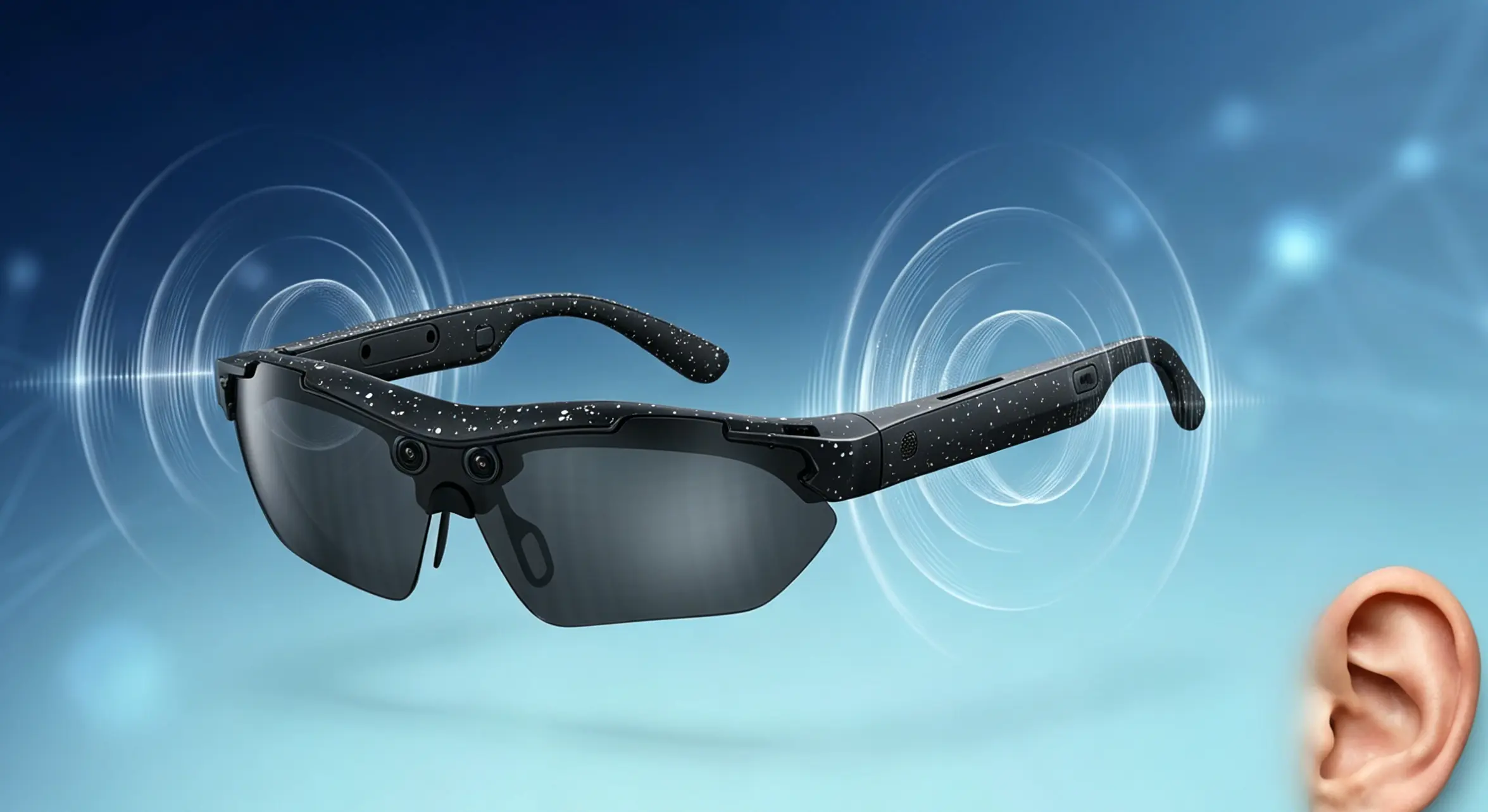
Then came directional air conduction technology, which is what most modern audio-first glasses use today. Instead of vibrating your skull, directional air conduction uses tiny speakers positioned just in front of or behind your ears to beam sound directly into your ear canal. This results in much better sound quality with richer bass and clearer highs, and significantly less sound leakage.
But even directional air conduction had its limitations. Early models still had noticeable sound leakage at higher volumes, and the sound quality couldn't compare to traditional headphones. That's where companies like Specic have been pushing the boundaries.
Specic's proprietary SoundWave technology uses a combination of phase cancellation and acoustic chamber design to deliver impressive sound quality while minimizing sound leakage. The speakers are precisely angled to direct sound into your ear canal, while phase cancellation waves cancel out any sound that would otherwise escape into the environment.
The result? You get rich, immersive audio that only you can hear, even at moderate volumes. People sitting next to you on the subway won't be able to hear your music or your calls, but you'll still be able to hear everything happening around you.
It's a delicate balance, and one that Specic has spent years perfecting. Their engineering team has tested hundreds of different speaker configurations and acoustic designs to find the sweet spot between sound quality, privacy, and situational awareness.
Specic's Audio-First Solution: Two Models, One Philosophy
Specic offers two main models of audio-first AI glasses: the Specic Lite and the Specic Pro. Both follow the same audio-first philosophy, but they're designed for different use cases and budgets. Let's break down what makes each one unique.
The Specic Lite: Everyday Audio for Everyone
The Specic Lite is the entry-level model, designed for people who want to experience the benefits of audio-first glasses without breaking the bank. It weighs just 34 grams—about the same as a regular pair of sunglasses—so you can wear it all day without even noticing it's there.
The Lite features dual directional speakers with Specic's SoundWave Lite technology, which delivers clear audio for calls, podcasts, and music. While it doesn't have the same bass response as the Pro model, it's more than sufficient for everyday use. I've used the Lite for everything from taking work calls to listening to audiobooks during my commute, and I've been consistently impressed with the sound quality.
One of the things I love most about the Lite is its simplicity. There are no complicated controls or unnecessary features. The right temple has a touch-sensitive area that lets you play/pause music, skip tracks, adjust volume, and answer calls with simple taps and swipes. And of course, you can control everything with your voice using the Hey Cyan AI assistant.
The battery life is another standout feature. The Lite lasts up to 8 hours of continuous audio playback on a single charge, and the charging case provides an additional 24 hours of battery life. That means you can go an entire week without having to charge the case—something that's almost unheard of in the wearable technology space.
The Lite is also prescription-ready, so you can easily add your own prescription lenses without having to buy a separate pair of glasses. This is a game-changer for people who wear glasses full-time, as it eliminates the need to switch between regular glasses and smart glasses throughout the day.
The Specic Pro: Premium Audio for Power Users
If you're looking for the best possible audio experience from your smart glasses, the Specic Pro is the way to go. It features upgraded dual superlinear speakers with Specic's full SoundWave Pro technology, which delivers richer bass, clearer highs, and even better sound isolation.
The difference in sound quality between the Lite and the Pro is immediately noticeable. The Pro has a much wider soundstage, making music feel more immersive and three-dimensional. The bass is deep and punchy without being muddy, and the vocals are crisp and clear. I've been using the Pro for several months now, and I've found myself using it instead of my regular headphones for most activities.
The Pro also features an upgraded microphone system with four beamforming microphones and advanced noise cancellation technology. This makes it perfect for taking calls in noisy environments like coffee shops or airports. The microphones are able to isolate your voice from background noise, so the person on the other end can hear you clearly even if there's a lot going on around you.
Another great feature of the Pro is its IP54 water and dust resistance rating. This means you can wear it while running, hiking, or even in light rain without worrying about damaging it. The Lite, by comparison, is only splash-resistant, so it's not recommended for intense workouts or heavy rain.
The Pro has a slightly shorter battery life than the Lite—about 6 hours of continuous audio playback—but the charging case still provides an additional 24 hours of battery life. And with fast charging, you can get 2 hours of playback from just 15 minutes of charging.
Like the Lite, the Pro is prescription-ready and features the same intuitive touch controls and Hey Cyan AI assistant. It also comes in a wider range of frame styles and colors, so you can find a pair that matches your personal style.
Side-by-Side Comparison
| Feature | Specic Lite | Specic Pro |
|---|---|---|
| Weight | 34 grams | 38 grams |
| Audio Technology | SoundWave Lite | SoundWave Pro |
| Battery Life (per charge) | Up to 8 hours | Up to 6 hours |
| Total Battery Life (with case) | 32 hours | 30 hours |
| Microphones | 2 beamforming mics | 4 beamforming mics |
| Water Resistance | Splash-resistant | IP54 |
| Prescription-ready | Yes | Yes |
| Frame Styles | 3 styles, 2 colors | 5 styles, 4 colors |
Audio-First in Action: How It Transforms Your Daily Routine
To really understand the power of audio-first AI glasses, you have to experience them in your daily life. Here are just a few of the ways Specic glasses have transformed my routine over the past six months.
Commuting: From Isolation to Productivity
I used to hate my morning commute. I'd put in my earbuds, turn up the volume to drown out the noise of the subway, and spend the entire ride in my own little bubble. But with Specic glasses, my commute has become one of the most productive parts of my day.
I can listen to my favorite podcast or audiobook while still being aware of my surroundings. I can hear the train conductor making announcements. I can hear people asking for seats. I can even have a conversation with the person sitting next to me without having to take off my glasses or pause my audio.
And when I'm walking to the office, I don't have to worry about missing my stop or walking into traffic. I can follow turn-by-turn navigation directions from Google Maps directly through my glasses, while still hearing everything happening around me. It's like having a personal assistant whispering directions in your ear without anyone else knowing.
Working From Home: Focus Without Isolation
Like many people, I work from home most days. And like many people, I struggle with distractions. My dog barking. The doorbell ringing. My neighbor mowing the lawn. It's easy to get pulled away from my work by the slightest noise.
With Specic glasses, I can create a focused work environment without isolating myself completely. I can listen to instrumental music or white noise to block out distractions, but I can still hear when my dog needs to go outside or when a package is delivered.
The call quality is also a game-changer for video meetings. I no longer have to wear a headset for hours on end, which used to give me headaches. The Pro's four beamforming microphones pick up my voice clearly even if I'm walking around the room, and the open-ear design means I can hear myself speak naturally, which makes conversations feel more authentic.
And when I need to take a quick break, I can just say "Hey Cyan, play my focus playlist" and get back to work without having to touch my phone. It's a small thing, but it adds up to a lot of saved time and increased productivity over the course of a day.
Exercising: No More Falling Earbuds
I've tried every type of headphone for working out, and they all have the same problem: they fall out. No matter how many different ear tips I try or how tight I adjust the headband, they always seem to slip out when I'm running or doing high-intensity interval training.
Specic glasses solve this problem completely. They stay securely on your face no matter how much you move around. I've worn them for long runs, spin classes, and even yoga sessions, and they've never once fallen off or felt uncomfortable.
The open-ear design is also perfect for exercising. I can listen to my workout playlist while still hearing my trainer's instructions. I can hear cars approaching when I'm running outside. I can even have a conversation with my workout buddy without having to pause my music.
And with the Pro's IP54 water resistance rating, I don't have to worry about sweat or rain damaging my glasses. I've worn them in pouring rain during a morning run, and they worked perfectly the entire time.
Traveling: One Device for Everything
Traveling used to be a nightmare for me when it came to audio. I'd have to pack multiple pairs of headphones—one for the plane, one for walking around, one for working out. I'd constantly be worried about losing them or having them stolen. And I'd always end up with a headache from wearing in-ear headphones for hours on end.
Now, I just bring my Specic glasses, and that's all I need. They work perfectly on planes, trains, and automobiles. I can watch movies on my phone or tablet with great sound quality without having to wear uncomfortable headphones. I can take calls from work while I'm waiting for my flight. I can listen to a travel guide while I'm exploring a new city.
And the best part? I don't have to take them off when I'm going through security. No more fumbling with headphones and cases while I'm trying to get through the airport quickly. I just walk through the metal detector with my glasses on, and I'm good to go.
Social Situations: The Surprising Benefit
This might be the most surprising benefit of audio-first glasses: they actually improve social interactions, rather than hindering them.
With traditional headphones, wearing them in public is a clear signal that you don't want to be disturbed. But with Specic glasses, no one can tell that you're listening to something unless you tell them. They just look like regular glasses.
This has completely changed how I interact with people in public. I can be listening to music while waiting in line at the grocery store, but if the person behind me starts a conversation, I can just pause my audio with a quick tap and respond naturally. There's no awkward fumbling with earbuds or having to say "wait, let me take out my headphones" before I can talk to someone.
I've had more spontaneous conversations with strangers in the past six months than I had in the previous six years. And it's all because I'm not hiding behind a pair of headphones anymore.
Controversial Question #3: Are we creating a world where constant audio stimulation is the norm?
Before audio-first glasses, there were natural breaks in our audio consumption. We'd take out our earbuds when we got home, when we met friends for dinner, or when we went to bed. But with glasses that are comfortable enough to wear all day, those breaks disappear. Is it healthy to have audio playing in our ears from the moment we wake up until the moment we go to sleep?
Hey Cyan: The AI Voice Assistant That Actually Understands Context
Of course, no audio-first AI glasses would be complete without a great AI assistant. And that's where Hey Cyan really shines.
Hey Cyan is Specic's proprietary AI assistant, designed specifically for audio-first interactions. Unlike other AI assistants that are primarily designed for smartphones or smart speakers, Hey Cyan is optimized for hands-free, voice-only use.
What sets Hey Cyan apart from other AI assistants is its context awareness. It doesn't just respond to commands—it understands the context of what you're doing and can provide relevant information without you having to ask.
For example, if you're walking past a restaurant, you can just say "Hey Cyan, what's good here?" and it will pull up reviews and recommendations for that specific restaurant. If you're at a conference and you meet someone new, you can say "Hey Cyan, take a note" and it will record what they're saying and transcribe it for you later. If you're traveling in a foreign country, you can say "Hey Cyan, translate this conversation" and it will provide real-time translation between two languages.
Hey Cyan also integrates seamlessly with all your favorite apps and services. You can use it to send text messages, make phone calls, set reminders, check the weather, control your smart home devices, and much more—all without ever touching your phone.
One of my favorite features is the ability to create custom voice commands. For example, I've created a command called "commute mode" that automatically plays my favorite commute podcast, starts navigation to the office, and sends a message to my team letting them know I'm on my way. I just say "Hey Cyan, commute mode" and it does all of that for me.
Another great feature is the continuous conversation mode. Unlike other AI assistants that make you say the wake word every time you want to ask a question, Hey Cyan can carry on a natural conversation with you. You can ask a question, get a response, and then ask a follow-up question without having to say "Hey Cyan" again. It makes interacting with the AI feel much more like talking to a real person.
And the best part? Hey Cyan is constantly learning and improving. Specic regularly pushes out updates that add new features and improve the AI's accuracy and understanding. I've been using Hey Cyan for six months now, and it's already significantly better than it was when I first started using it.
Controversial Question #4: Are we becoming too dependent on AI assistants whispering in our ears?
If we have an AI assistant that can answer any question, remember any fact, and handle any task for us, what happens to our own cognitive abilities? Will we forget how to navigate without turn-by-turn directions? Will we lose the ability to remember important dates and appointments? And what happens when the technology fails us?
Privacy and Social Acceptance: Addressing the Elephant in the Room
When most people hear the words "smart glasses," the first thing that comes to mind is privacy concerns. And rightfully so. The first generation of smart glasses had cameras that could record people without their knowledge or consent, which led to a significant backlash.
Specic has taken a very different approach to privacy. Both the Lite and Pro models have cameras, but they're designed with privacy as a top priority. The camera has a physical indicator light that turns on whenever it's recording, so everyone around you knows when you're taking a photo or video. And you can easily disable the camera completely if you don't want to use it.
But here's the thing: because Specic glasses are audio-first, most people don't even realize they have a camera. They just look like regular glasses. I've been wearing mine for six months now, and only a handful of people have asked me if they're smart glasses. And when I tell them they are, the first question they ask is usually about the audio, not the camera.
This is a huge shift from the early days of smart glasses, where the camera was the main selling point and the biggest source of controversy. With audio-first glasses, the camera is just an added bonus, not the primary feature. Most people use it occasionally to take hands-free photos or videos, but it's not something they use all the time.
Specic also takes data privacy very seriously. All voice processing is done on the device whenever possible, so your voice data never leaves your glasses unless you explicitly choose to send it to the cloud. And you can easily delete your voice history at any time through the Hey Cyan app.
As for social acceptance, I've found that most people are much more comfortable around audio-first glasses than they were around the first generation of smart glasses. Because they look like regular glasses and the camera is not the main focus, people don't feel like they're being watched or recorded. I've worn mine to restaurants, movie theaters, concerts, and even weddings, and no one has ever complained or asked me to take them off.
Of course, there are still some situations where it's appropriate to take off your smart glasses, just like there are situations where it's appropriate to turn off your phone. But for the most part, audio-first glasses have been widely accepted by the people around me.
Controversial Question #5: Should there be laws regulating smart glasses in public spaces?
Right now, there are almost no laws specifically governing the use of smart glasses. Should there be restrictions on wearing them in certain places like courtrooms, hospitals, or changing rooms? And who should be responsible for enforcing these rules—the government, private businesses, or individual users?
The Future of Audio-First AI Glasses: What's Next?
We're still in the early days of the audio-first revolution, but the future looks incredibly promising. Here are just a few of the developments we can expect to see in the coming years.
Even Better Sound Quality
As acoustic technology continues to improve, we can expect audio-first glasses to deliver sound quality that rivals even the best over-ear headphones. Specic is already working on the next generation of SoundWave technology, which promises even richer bass, clearer highs, and virtually no sound leakage.
Longer Battery Life
Battery life is already one of the biggest advantages of audio-first glasses over display-based smart glasses, but it's only going to get better. Advances in battery technology and power efficiency will allow future models to last for days or even weeks on a single charge.
More Advanced AI Capabilities
Hey Cyan is already impressive, but it's just the beginning. Future AI assistants will be even more context-aware and proactive. They'll be able to anticipate your needs before you even ask for them. For example, they could remind you to take your umbrella when it's going to rain, or suggest a good restaurant when you're in a new city and looking for somewhere to eat.
Seamless Integration With Other Wearables
Audio-first glasses will become the central hub for all your wearable technology. They'll integrate seamlessly with smartwatches, fitness trackers, and even smart clothing, providing a unified audio experience across all your devices.
New and Innovative Use Cases
As audio-first glasses become more mainstream, we'll see new and innovative use cases emerge. For example, they could be used for real-time language translation in business meetings, or for hands-free training in industrial settings. They could even be used to provide audio descriptions for people with visual impairments, helping them navigate the world more independently.
Controversial Question #6: Will audio-first glasses eventually replace smartphones?
Smartphones have been our primary computing device for over a decade now. But as audio-first glasses become more powerful and more capable, could they eventually replace our phones entirely? Would you be willing to give up your smartphone if you could do everything you need to do with just a pair of glasses?
Conclusion: A New Way to Listen and Interact With the World
Six months ago, I couldn't imagine life without my earbuds. Now, I can't imagine life without my Specic glasses. They've completely transformed how I listen to audio, how I interact with technology, and how I engage with the world around me.
Audio-first AI glasses aren't just another gadget. They're a paradigm shift in how we think about wearable technology. They prove that technology doesn't have to be intrusive or isolating. It can be subtle, helpful, and even enhance our connections with the people and world around us.
The best part? This is just the beginning. As technology continues to improve and more companies embrace the audio-first approach, we'll see even more innovative products that make our lives easier, safer, and more connected.
So if you're tired of earbud fatigue, tired of being disconnected from the world, or just tired of fumbling with your phone every time you want to listen to something or take a call, I highly recommend giving audio-first AI glasses a try. Specic offers a 30-day money-back guarantee, so you have nothing to lose.
Who knows? You might just find that, like me, you never want to go back to wearing earbuds again.
The future of wearable technology isn't about putting more screens in front of our faces. It's about giving us the information we need, when we need it, through the most natural and non-intrusive medium possible: sound. And that future is already here, sitting right on the bridge of your nose.