

What is the difference between smart glasses and AR glasses?
SpeCiC-AI-Smart-Glasses2026-06-04T09:04:19+08:00What is the Difference Between Smart Glasses and AR Glasses?
Let’s be honest: walking down the street talking to your eyewear used to be a surefire way to get people to cross to the other side of the road. Today? You’re just another tech enthusiast trying to navigate an unfamiliar city, reply to a hands-free message, or film a flawless first-person view of a morning bike ride.
But as the market floods with high-tech specs, a massive cloud of confusion has rolled in. Tech companies, marketers, and influencers are tossing around terms like "Smart Glasses" and "Augmented Reality (AR) Glasses" as if they are interchangeable. Worse, many brands deliberately blur the lines to charge premium prices for basic features, leaving consumers wondering what they’re actually paying for.
Spoiler alert: they aren't. Buying smart glasses when you actually wanted AR is like buying a sleek digital watch when you actually wanted a holographic sci-fi communicator. And the stakes are higher than you might think—choosing the wrong one could mean wasting hundreds of dollars on a device that doesn’t solve your actual problems.
So, what exactly is the difference? Grab a cup of coffee, sit back, and let’s break down the battle for your face share.
The Core Definitions: Heads-Up vs. World-Altering
To truly understand the great divide, we need to look at what these devices actually do to your vision. The easiest way to separate them is by asking one simple question that cuts through all the marketing noise: Is the digital content aware of the physical space around you?
This single question reveals the fundamental philosophical difference between the two technologies. One aims to complement your reality, while the other aims to rewrite it.
Smart Glasses: The Elegant Digital Assistant
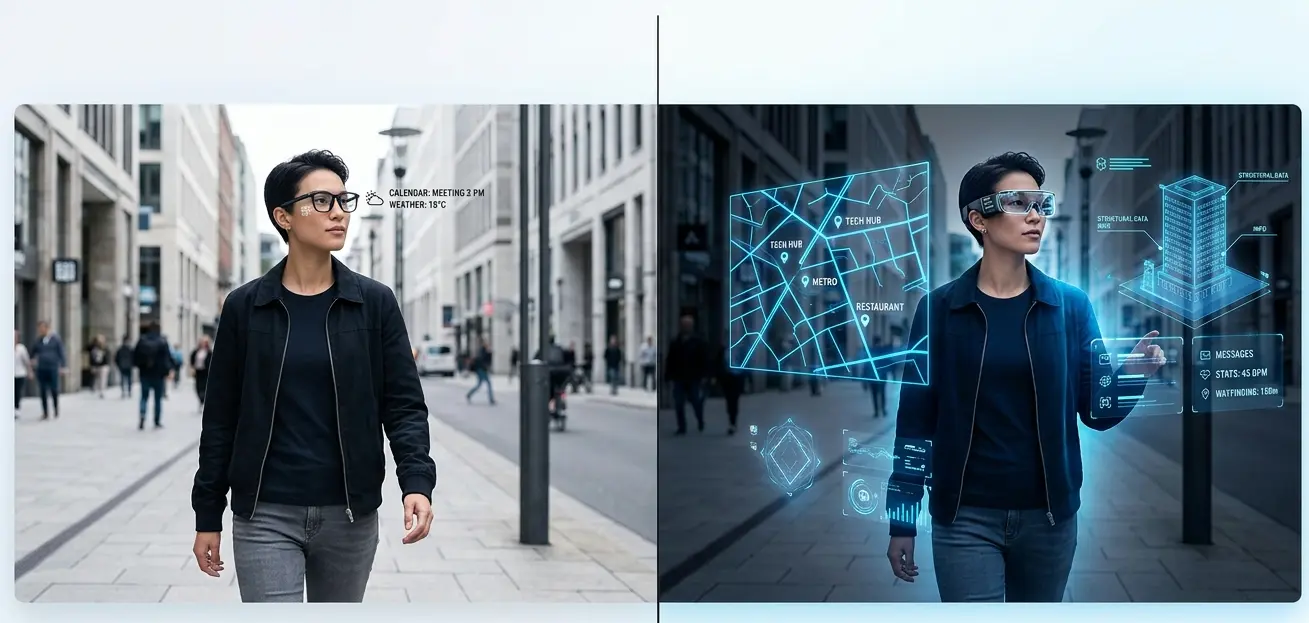
Think of smart glasses vs AR glasses as a hands-free, wearable extension of your smartphone. They don't try to change the physical world around you; they just want to make your life a little easier while you live in it.
Smart glasses focus primarily on three core functions: audio, basic connectivity, and point-of-view (POV) capture. They might have directional speakers tucked into the stems so you can listen to podcasts without blocking out ambient sound, microphones to take crystal-clear calls, or a camera embedded in the frame to snap photos and videos without fumbling for your phone.
If they do have a display, it’s usually a tiny, subtle "heads-up display" (HUD) in the upper corner of your lens—think of it like the dashboard of your car. It tells you the time, gives you a turn-by-turn text direction, or shows a text notification, but it stays firmly out of your way. Your reality remains 100% untouched, and you never lose sight of what’s happening around you.
AR Glasses: The Matrix in Your Living Room
Augmented Reality glasses are a completely different beast. Their ultimate mission is to blend digital 3D elements directly and interactively into your physical environment.
True AR glasses don't just show you a floating text notification in your peripheral vision; they place a virtual, three-dimensional pet dragon on your coffee table that stays there even when you turn your head. They use advanced optical engines—like complex waveguides—to project light directly onto the lenses, making digital objects look like they physically exist in the room with you.
Crucially, AR glasses "understand" the geometry of your surroundings through depth sensors and spatial tracking. If you throw a virtual ball, it will bounce off your actual, physical wall. If you walk around a virtual chair, you’ll see it from different angles, just like a real one. This is the magic of AR—and also its greatest limitation.
Hardware and Design: Sleek Specs vs. Cyberpunk Chic
Because their internal goals are completely different, the physical architecture of these two categories diverges dramatically. You can usually spot the difference just by looking at someone's face, and this difference has huge implications for how often you’ll actually wear them.
| Feature | Smart Glasses | AR Glasses |
|---|---|---|
| Weight | Lightweight (usually 40g – 60g) | Heavier (usually 75g – 80g+) |
| Aesthetics | Looks exactly like normal eyewear | Often bulkier, futuristic, or heavily tinted |
| Battery Life | Several hours to days (standby) | Highly demanding (often 1–3 hours) |
| Computation | Relies heavily on your phone | Requires massive onboard processing or a tether |
The Smart Glasses Blueprint
Because smart glasses don't need heavy optical prisms, multiple tracking cameras, or massive processing chips to render real-time 3D graphics, they can look incredibly normal. Brands can use classic, lightweight materials like TR90 frames, and design them to fit seamlessly into any wardrobe.
Unless someone looks closely at the tiny camera lens or notices the slightly thicker temple arms, they look just like standard fashion sunglasses or reading specs. This means you can wear them to a business meeting, a dinner date, or a morning run without drawing unwanted attention.
The AR Glasses Blueprint
AR glasses have an immense amount of heavy lifting to do. They need depth sensors, multiple cameras to track your hands and your environment, spatial audio speakers, and dual micro-LED displays. Packing all of that tech into a wearable frame means AR glasses are naturally bulkier.
While tech companies are working miracles to shrink them down, most true AR glasses still give off a distinct "sci-fi character" vibe that makes them hard to wear subtly in public. And even the most advanced models struggle with battery life—many can barely last a full workday on a single charge, let alone a weekend adventure.
The Great Tech Ideology Debate: Visual Intrusion vs. Auditory Privacy
Now that we understand the technical differences, we stumble right into a fierce philosophical debate dividing the tech community—a debate that will shape the future of wearable technology for decades to come.
The Big Question: Is the ultimate future of wearable tech meant to be visual or auditory?
This isn’t just a trivial argument about preferences. It’s a battle over how much technology should invade our most personal sense: sight.
On one side, AR purists argue that audio-only or simple HUD smart glasses are just a stopgap solution—a compromise made because we don't yet have the technology to build lightweight, affordable AR glasses. They believe that true ambient computing requires a full visual overhaul of our world, putting digital screens everywhere we look.
In their vision, every wall becomes a canvas, every table becomes a workspace, and every interaction is enhanced by floating digital information. They point to Apple’s Vision Pro and Meta’s Quest series as proof that this future is already here.
On the other side, a growing movement of developers and users argues that visual AR is fundamentally flawed for daily life. They ask a series of uncomfortable questions that AR advocates often avoid: Do we really want digital ads, email pop-ups, and virtual avatars cluttering our fields of view while we try to cross a busy intersection? Do we want to be constantly distracted by glowing graphics when we’re trying to have a conversation with a friend?
Instead, this camp advocates for auditory and AI-driven intelligence. They believe the less we see from a screen, the more we can experience real life. By keeping the tech focused on high-quality audio and voice-activated intelligence, you get all the benefits of a sci-fi digital assistant without isolating yourself behind a wall of glowing digital graphics.
Which side are you on? Do you want technology to show you the world, or tell you about it?
The Power of AI: Blurring the Lines and Rewriting the Rules
This philosophical shift is where the line between these categories gets beautifully blurred. The rise of Artificial Intelligence has proven that you don't necessarily need a heavy, battery-draining 3D holographic display to experience futuristic tech.
In fact, many industry experts now argue that AI is making traditional AR obsolete before it even reaches the mainstream. Why wear a bulky headset to project a virtual arrow on the road when an AI assistant can simply whisper directions in your ear? Why overlay translated text on a sign when the AI can read it to you instantly?
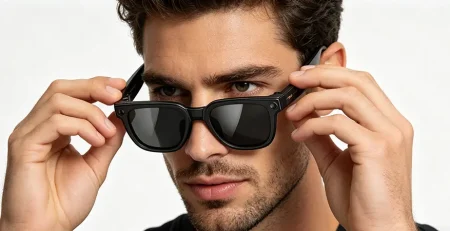
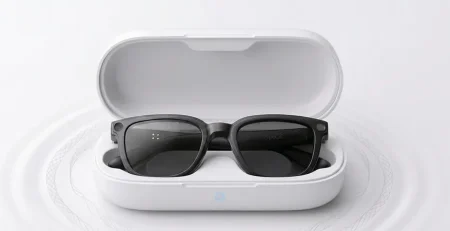
This is exactly where modern, AI-powered smart glasses are carving out a massive niche for themselves. Take a look at a brand like SpeCiC, for instance. Their SpeCiC Pro AI Smart POV Camera Sunglasses prove that smart glasses don't need to project a virtual world to be incredibly intelligent.
Instead of cluttering your vision with holographic pop-ups, these glasses use AI to act as a voice-activated companion. By integrating ChatGPT-ready voice assistance via a simple wake word ("HeyCyan"), the eyewear shifts the focus from visual distortion to cognitive utility.
Imagine hiking or cycling through a foreign country. You don't need a glowing AR arrow projected on the dirt path. You just need to ask your glasses a question, have them instantly translate a sign, or give you real-time environmental information directly into your ears. This AI-centric approach gives you the capability of an interactive assistant without the physical bulk, weight, or terrifying battery drain of full AR hardware.
This raises a provocative question: If AI can deliver 90% of the utility of AR glasses at a fraction of the cost and weight, do we really need AR glasses at all?
Different Scenarios, Different Solutions
To figure out which side of this technological divide you belong on, let’s look at three real-world scenarios and see how each category offers a unique solution to the exact same problem.
Scenario A: The Content Creator & Outdoor Adventurer
You love cycling, running, hiking, or just documenting your daily life for social media. You want to capture the world exactly as you see it, completely hands-free, without holding a clunky action camera or a phone stick.
- The AR Glasses Approach: Wearing a pair of heavy, delicate AR glasses on a mountain bike trail or a rocky hiking path is an uphill battle. The complex visual display will get washed out by the bright sunlight, the heavy battery will die before you hit your second milestone, and the spatial sensors will get confused by moving trees and dust. One wrong fall, and you could be out thousands of dollars.
- The Smart Glasses Solution: This is exactly where specialized POV camera glasses thrive. The SpeCiC Pro, for example, is engineered specifically for active, outdoor lifestyles. It features an IP54 weatherproof TR90 frame, 1080P HD video recording with a wide 120° POV angle, and an integrated 6-axis Gyro + Electronic Image Stabilization (EIS). You get ultra-smooth, professional-looking footage of your ride, hands-free open-ear music playback, and complete awareness of the traffic or wildlife around you—all wrapped in a rugged frame built to handle sweat and unexpected rain.
Scenario B: The Desktop Multi-Tasker & Digital Nomad
You work from coffee shops, airplanes, or tiny apartments, and you are completely sick of staring down at a tiny 13-inch laptop screen. You want a massive triple-monitor setup, but you also need it to fit inside a standard backpack.
- The Smart Glasses Solution: While a pair of smart glasses can play your favorite productivity podcasts or take your Zoom calls via built-in microphones, they cannot help you see your work any better. Without a spatial optical display engine, your eyes are still firmly glued to your physical monitor.
- The AR Glasses Solution: This is a home run for AR. Put on a pair of AR glasses, connect them to your laptop, and suddenly, three massive, crystal-clear virtual screens appear floating in the air right in front of you. You can look left to check your code, look center to write an article, and look right to keep an eye on your team chat. The physical space around you becomes your digital canvas, giving you an office-level setup anywhere in the world.
But here’s the catch: Do you really need three virtual screens all day, every day? Or is this a luxury that sounds cool but will quickly become tiring for your eyes?
Scenario C: The Explorer in a Foreign Land
You’ve just landed in a bustling city where you don't speak a word of the local language. You need to read street signs, order food, and talk to locals without constantly staring down at a translation app on your phone.
- The AR Glasses Approach: AR glasses will look at a physical sign and visually overlay the translated text directly over the foreign characters in real time. It looks like magic, but it requires substantial processing power, continuous camera tracking, and can make you feel disconnected from the actual environment you are trying to experience. You’ll spend more time looking at the translated text than at the city itself.
- The Smart Glasses Solution: Audio-driven AI glasses tackle this with pure efficiency. Using an app framework like "HeyCyan" on the SpeCiC Pro, you can engage in two-way, 139-language audio translation. You speak, the glasses translate out loud, the local responds, and the glasses whisper the translation back into your ear via Environmental Noise Cancellation (ENC) dual mics. It’s discreet, natural, and doesn't require you to look like a sci-fi extra while ordering lunch.
The Social Dilemma: Privacy vs. Progress
Before we crown a winner, we have to talk about the elephant in the room—one that has nothing to do with specifications or battery benchmarks. It’s the social acceptance and privacy dilemma that plagues both technologies, but in very different ways.
Smart glasses look normal, which makes them socially acceptable to wear in a restaurant or on a train. However, because they often include discreet POV cameras, they frequently trigger privacy concerns. Are you recording me? Are you live-streaming this conversation? These questions have led some businesses and public spaces to ban smart glasses entirely.
On the flip side, AR glasses are so glaringly obvious and futuristic that nobody will ever accuse you of secretly filming them. Instead, the social friction comes from the "glass wall" effect. When you converse with someone wearing bulky AR glasses, you never quite know if they are looking at you, or if they are secretly watching a YouTube video floating next to your head. This creates a barrier between people that can be deeply alienating.
This brings up an intense debate among tech fans that has no easy answer: Which is worse? The fear of being secretly recorded by a pair of sleek smart glasses, or the alienation of talking to someone whose eyes are locked behind an AR screen?
The Final Verdict: Which One Belongs on Your Face?
Choosing between smart glasses and AR glasses isn't about finding which technology is objectively "better"—it’s about figuring out what role you want technology to play in your daily life.
- Choose AR Glasses if you want to push the absolute boundaries of digital productivity, design 3D objects in physical space, or turn your living room into an interactive gaming arena. Just be prepared for a bit more weight, shorter battery life, a hefty premium price tag, and some curious stares from strangers.
- Choose Smart Glasses if you want a seamless, lightweight, and practical everyday companion. If your goals are capturing smooth POV adventures, enjoying private open-ear audio, utilizing custom prescription lenses (RX-Ready), and interacting with powerful AI assistants without losing touch with the physical world, smart glasses are the ultimate choice.
The great eyewear divide isn’t going away anytime soon. As AI continues to advance and AR technology becomes more affordable, the lines between these two categories will blur even further. But for now, the choice is clear: Do you want technology to enhance your world, or replace it?
Where do you stand on this debate? Would you rather have a fully holographic world at your fingertips, or a sleek, AI-powered audio assistant whispering in your ear? And do you think AR glasses will ever become as socially acceptable as smart glasses? Let’s talk about it in the comments below!