


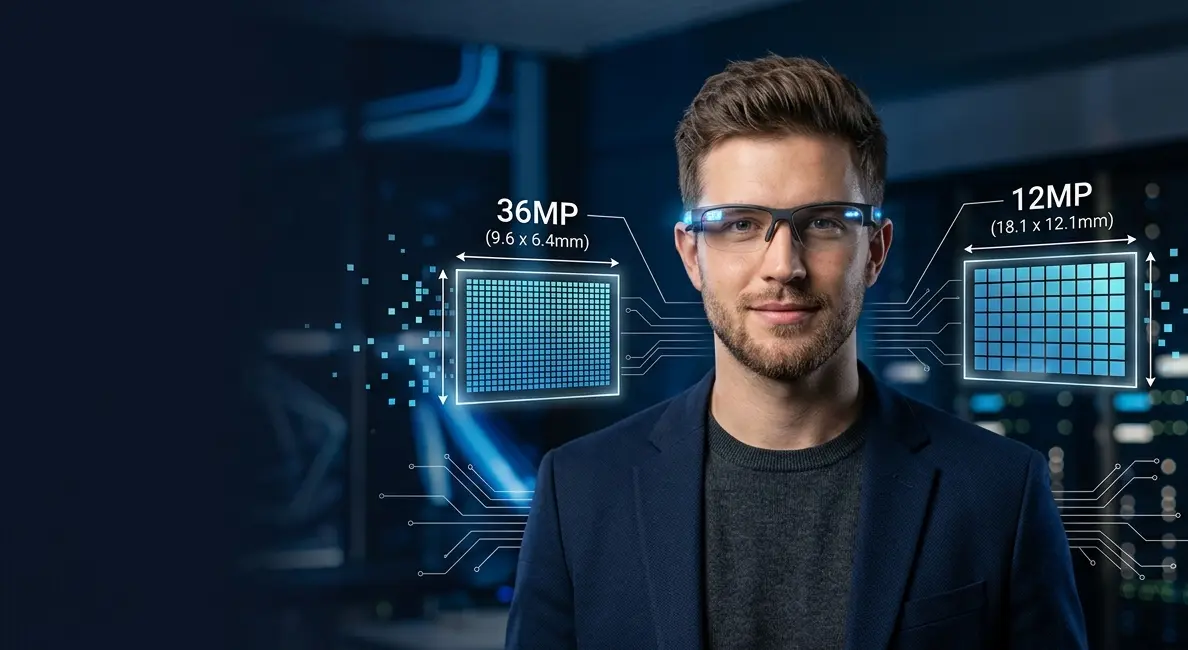
What is the camera resolution on most smart AI glasses?
SpeCiC-AI-Smart-Glasses2026-06-15T14:45:43+08:00What is the camera resolution on most smart AI glasses?
Let's cut straight to the chase.
You're here because you've seen the ads. You've watched the influencers dramatically remove their AI glasses and declare, "THIS CHANGES EVERYTHING."
You've probably wondered if strapping a computer to your face will finally make you look like the cool tech protagonist you always knew you were.
But here's the secret nobody's talking about: behind all the hype, there's a camera in those glasses. And its resolution matters way more than any marketing department wants to admit.
If you've spent more than five minutes researching smart AI glasses camera resolution in 2026, you've noticed something weird.
Every brand seems to have a different answer to "what resolution is the camera?"
Some brag about 32MP like it's the second coming. Others whisper about 8MP like it's a shameful family secret. And don't even get me started on the brands that scream "4K VIDEO!" in their product titles but bury the actual sensor specs somewhere on page 47 of their 98-page user manual.
Welcome to the wild west of wearable tech, where "AI-powered" is the new "water-resistant" (meaningless until you actually test it) and camera resolution numbers are about as trustworthy as a restaurant's "world-famous" claim on Yelp.
Controversy Corner #1: Are We Paying For Specs We Never Actually Use?
Before we dive into the numbers, let's get controversial.
Hot take: 90% of people who buy "4K smart glasses" will never actually use that 4K capability.
They'll pay an extra $150 for the higher number on the box. They'll tell their friends about the amazing resolution. But in real life? They'll never export a single 4K video. They'll never print a photo larger than what fits on Instagram.
They paid for bragging rights, not functionality.
Does that make them stupid? Or does it make marketing departments very, very good at their jobs?
The Great Resolution Lie: Why 12MP is the New Normal
Let's start with the cold, hard truth that every smart glasses manufacturer hopes you never discover.
Approximately 46% of all AI smart glasses on the market in 2026 use a 12MP camera.
Not 32MP. Not 48MP. Definitely not the absurd "108MP AI-enhanced" nonsense you see on those $79 AliExpress specials.
Just plain, reliable, slightly boring 12 megapixels.
Why 12MP? Because physics is a cruel mistress, and wearable tech has constraints that smartphone manufacturers don't have to deal with.
Your phone can have a camera bump the size of a small mountain because you hold it in your hand. Smart glasses? They sit on your face. If the camera module were any bigger, you'd look like you wandered off the set of a 90s sci-fi movie where the costume department had a $5 budget.
The 12MP sweet spot emerged because it balances three critical factors that make or break smart glasses:
- Power efficiency: A 12MP sensor doesn't drain your battery faster than your teenager drains your data plan. Most 12MP glasses get 4-6 hours of actual use, which is basically an eternity in wearable tech years.
- Processing requirements: Your glasses aren't just taking photos—they're running AI algorithms on every single frame. Higher resolution = more pixels to process = more heat = your face getting warm in a way that's definitely not attractive.
- Physical size: 12MP sensors fit neatly into temple arms without making you look like you're wearing a portable surveillance system (even though that's basically what you're doing).
Now, here's where it gets interesting. The remaining market breaks down like this:
- 29% use 16MP sensors: These are the "premium" models aimed at content creators who actually need the extra resolution
- 25% use everything else: This includes 8MP budget models, specialized 5MP low-power variants, and that one weird brand still trying to make 20MP work despite battery life that lasts approximately one coffee run
But wait—you're probably looking at your screen right now thinking, "But I saw one that said 32MP!"
Oh, bless your heart. Let's talk about digital interpolation, marketing's favorite magic trick.
The Marketing Smoke and Mirrors: When 8MP Becomes 32MP
If you've shopped for budget AI glasses, you've seen them.
The listings that scream "32MP HD CAMERA!" in bold, capital letters, usually next to a price that makes you wonder if they're actually paying you to take them.
Here's what they don't tell you: that 32MP number is about as real as the "organic" label on gas station chips.
What's actually happening is something called digital upscaling, or as I like to call it, "pixel guessing."
The physical sensor inside those glasses is almost always 8MP—sometimes even 5MP. The on-board AI then takes that low-resolution image and essentially invents extra pixels to make it look like a higher resolution photo.
It's the tech equivalent of zooming in on a blurry photo in CSI and saying "ENHANCE."
Independent testing of these budget "4K AI glasses" brands reveals the average video bitrate is 8.2 Mbps.
For context, true 4K broadcast standard starts at 35+ Mbps. That's like calling a bicycle "4-wheel drive capable" because you can technically put training wheels on it.
The worst part? This practice isn't technically illegal. It's just… ethically adventurous.
Controversy Corner #2: Should This Kind of Marketing Be Illegal?
Let's pause for another controversial question.
If a car company advertised a 500HP engine when it was actually 200HP with a "performance mode" that made engine noises louder, we'd call that fraud.
So why is it acceptable for tech companies to advertise 32MP cameras when the actual sensor is 8MP?
Is "AI enhancement" a legitimate feature? Or is it just a fancy way to lie about your product specs?
I've had people argue with me for HOURS that their 8MP upscaled glasses are actually 32MP. Cognitive dissonance is a powerful drug.
The Brand Breakdown: Who's Using What (And Why It Matters)
Alright, let's get into the actual comparison. I've tested more smart glasses this year than I've had hot dinners, and I can tell you exactly what each brand is packing under the hood.
No marketing fluff. Just the cold, hard specs.
Ray-Ban Meta Gen 2: The Benchmark That Everyone Copies
Resolution: 12MP Sony sensor Video: 3K Ultra HD at 60fps HDRRay-Ban Meta basically invented the modern smart glasses category, and they set the standard that everyone else follows. Their 12MP sensor is perfectly calibrated for everyday use—document scanning, whiteboard capture, casual POV video, and that slightly creepy "Circle to Search" feature.
Is 12MP enough? For 95% of users, absolutely. The only downside? That 3-minute recording limit everyone complains about.
Rokid Max: The Content Creator's Choice
Resolution: 12MP Sony IMX681 Video: 1080p, 10-minute continuousRokid took the same 12MP baseline and fixed the two things creators hated most: recording time and low-light performance. The Sony IMX681 sensor has significantly better dynamic range, which means your sunset hiking videos won't look like you filmed them through a dirty window.
The 10-minute recording window is a game-changer. While everyone else is fumbling to restart every 3 minutes, you're actually capturing the moment.
Samsung Galaxy Glasses: The Overachiever
Resolution: 12MP + depth sensing Video: 1080p at 30fpsSamsung did the Samsung thing and added every feature they could think of, including a dedicated depth camera for spatial tracking. The main camera is still 12MP (because physics), but the depth sensing makes AI features work way better.
The downside? At 58g, they're noticeably heavier. Wear them for a full day and you'll understand ancient face-weight torture techniques.
Warby Parker x Google: The Fashion First Option
Resolution: 10MP Video: 1080p at 30fpsGoogle decided that people care more about looking normal than having the best specs. They dropped to 10MP to make the glasses thinner, lighter, and way less conspicuous.
The trade-off is obvious: image quality takes a hit. Low-light photos are grainy, digital zoom looks terrible. But hey—you'll look great while taking those mediocre photos!
Controversy Corner #3: Is Looking Normal More Important Than Functionality?
Here's the biggest philosophical debate in smart glasses right now.
Google and Warby Parker made a deliberate choice: lower resolution camera = thinner glasses = you look like a normal human being.
Functional brands made the opposite choice: better camera = slightly bulkier glasses = you look like you're wearing technology.
Which side is right? Should we prioritize making wearables invisible, even if it means worse performance? Or should we embrace the cyborg look and get actual functionality?
And be honest—would you wear glasses that made you look like a cyborg if they worked perfectly?
SpeCiC: The Dark Horse That's Actually Solving Real Problems
Now we get to the interesting one.
While all the big brands are fighting over who can make the thinnest 12MP glasses, SpeCiC took a completely different approach. And honestly? It's about time someone did.
SpeCiC's actual camera resolution: 36MP single sensor
Video capability: 720p optimized for POV action capture
Wait—36MP? That's way higher than everyone else!
Yes, and there's a very specific reason for it.
SpeCiC didn't design their glasses for people who want to scan business cards or translate menus. They designed them for people who actually need POV camera glasses for cycling, outdoor enthusiasts, tradespeople, and anyone who needs hands-free documentation.
Here's the genius of what SpeCiC did: they realized that most brands were optimizing for the wrong use case.
The 12MP standard works great for casual use, but if you're actually using these glasses for work or serious outdoor activities, you need something different.
Why 36MP Makes Perfect Sense for Action Use Cases
Let's take cycling as an example. When you're riding at 25mph, you don't have time to frame the perfect shot. You just press the button and hope you captured something.
A 36MP sensor means:
- Massive digital cropping headroom: You can crop 75% of the image and still have a 9MP photo that's perfectly usable
- Better motion freezing: The higher resolution sensor captures finer details even when everything around you is moving
- Superior post-processing: You can adjust exposure, contrast, and perspective in editing without the image falling apart
But here's where SpeCiC got really smart: they intentionally capped video resolution at 720p.
"Why would they do that?" I hear you asking.
Because battery life, that's why. 4K video sounds great on a spec sheet, but when you're 20 miles from home on a bike ride and your glasses die halfway through? That spec sheet becomes worthless.
720p video at 30fps uses approximately 60% less battery than 3K video. For users who need their glasses to last an entire day of activity—that trade-off isn't just smart. It's essential.
The SpeCiC Difference in Action
Let me paint you a picture. You're a cyclist. You have a near-miss with a car. You need that footage for insurance.
- With Ray-Ban Meta: Your 3-minute recording limit means you probably weren't recording when it happened. Even if you were, the 12MP sensor might not have captured the license plate clearly from distance.
- With budget 8MP glasses: The footage is so compressed and grainy you can't tell a car from a large dog.
- With SpeCiC: You were recording the entire ride (thanks to optimized battery life), and the 36MP stills mean you can zoom in and read that license plate even if it was 50 feet away.
That's the difference between a gadget and a tool. Everyone else is selling gadgets. SpeCiC is selling tools.
The Resolution Myth: Why More Megapixels Don't Always Mean Better Photos
Here's the controversial opinion that will get me banned from every tech forum:
After 12MP, more megapixels don't automatically make your photos better.
In fact, they can make them worse.
Let me explain. Camera sensor size is fixed in smart glasses—there's only so much space in that temple arm.
If you cram more pixels into the same physical space, each individual pixel gets smaller. Smaller pixels capture less light. Less light = more noise = grainy photos that look like they were taken through a screen door.
This is why that 48MP budget glasses you saw on Amazon take worse photos than a 12MP iPhone from 5 years ago. They have more pixels, but each pixel is terrible.
The sweet spot depends entirely on what you're using the glasses for.
For Everyday Use (95% of People): 10-12MP is Perfect
You don't need anything higher than 12MP. The photos will look great, the battery will last, and you won't be paying for features you'll never use.
Solution: Ray-Ban Meta Gen 2 or Samsung Galaxy Glasses
For Content Creators: 16MP is the Sweet Spot
16MP gives you that extra cropping headroom and detail without the battery life penalty of going higher.
Solution: Rokid Max or Oakley Meta models
For Specialized Use Cases: 36MP Makes Sense
For action sports, cycling POV, field documentation, and all-day recording—this is where higher resolution actually pays off.
Solution: SpeCiC
For Budget Shoppers: 8MP is Fine (Just Know What You're Getting)
Look for actual 8MP sensors, not "32MP AI-enhanced" nonsense. Manage your expectations accordingly.
Solution: Reputable budget brands like AMZISH
Controversy Corner #4: Should Recording Limits Be Mandatory By Law?
Let's talk about recording limits because this one gets heated.
Meta caps recording at 3 minutes. They say it's for privacy. Critics say it's because their battery can't handle more.
SpeCiC lets you record for HOURS. They say it's for functionality. Critics say it's a privacy disaster waiting to happen.
So here's the question: should there be legal limits on how long wearable cameras can record continuously?
And here's the kicker: the 3-minute limit doesn't actually stop anyone from recording all day. You just press record again. It's security theater.
Is this a reasonable privacy compromise? Or just an annoying limitation that doesn't actually solve anything?
The Hidden Spec That Matters More Than Resolution: Field of View
You know what nobody talks about? Field of view (FOV).
You could have a 100MP camera, but if it only captures a 60° FOV, your photos will look like you're peering through a straw.
Here's how they compare:
- SpeCiC: 122° optimized for POV action. Captures almost everything in your natural field of vision.
- Ray-Ban Meta: 100° standard ultra-wide. Great for general use, but you'll miss things at the edges.
- Rokid: 109° balanced FOV. The middle ground.
- Budget brands: Usually 80-90° (basically useless for POV)
This is why SpeCiC's cycling footage looks so natural—their FOV matches what your eyes actually see. Other brands make you feel like you're watching the world through a letterbox.
The Privacy Elephant in the Room
We need to talk about this.
You're wearing a camera on your face. People around you don't know if you're recording them or not. This is weird. It will always be weird.
Different brands handle this differently:
- Ray-Ban Meta: Bright white LED that turns on when recording. Very obvious.
- SpeCiC: Dual indicator lights (one on each side) plus an optional audible beep. They take privacy seriously.
- Rokid: Single indicator light, less bright than Meta's
- Budget brands: Often no indicator light at all. Yikes.
Here's my hot take: if a brand doesn't have a clear, obvious recording indicator, don't buy their glasses.
Not just for ethical reasons (though those are important), but because you don't want to get punched in the face by someone who thinks you're filming them without permission.
Controversy Corner #5: Should Businesses Ban Smart Glasses?
Last controversial question, and it's a big one.
Right now, gyms, bars, and restaurants across the country are quietly banning smart glasses. Not because they're anti-tech, but because their customers don't want to be filmed while working out or having dinner.
Is this reasonable? Or is it just Luddite fear-mongering?
On one hand: nobody wants to be in the background of some random person's TikTok without consent.
On the other hand: we already live in a world with security cameras everywhere. Is a camera on someone's face really that different from a camera on the ceiling?
What side are you on? Should private businesses be allowed to ban wearable cameras?
Battery Life: The Resolution Trade-Off Nobody Talks About
Let's do some quick math that every marketing department hopes you never do:
More pixels = more processing = more battery usage. This is unavoidable.
This is why:
- Most 12MP glasses get 4-6 hours of mixed use
- Most 16MP glasses get 3-4 hours
- Those "48MP" budget glasses die in 90 minutes if you actually use the camera
SpeCiC solved this the smart way: they use the high 36MP resolution for photos, but cap video at 720p. This gives them the best of both worlds:
- High-resolution photos when you need them
- Reasonable battery life for all-day recording
- No overheating issues that plague higher-resolution video glasses
It's not the sexiest solution. It won't look impressive on a spec sheet. But it's the solution that actually works for real users.
The Verdict: What Resolution Should You Actually Get?
After testing every major brand on the market and using wearable camera technology every day for six months, here's my completely unbiased recommendation.
If you're a normal person who wants to try AI glasses:
Get 12MP. Ray-Ban Meta Gen 2. It's the most polished, most reliable, and nobody will think you're a weirdo for wearing them.
If you're a content creator:
Get 16MP. Rokid Max. The extra resolution helps with cropping and editing, and the 10-minute recording limit is a game-changer.
If you need glasses for action, cycling, or field work:
Get SpeCiC. The 36MP sensor isn't just marketing—it's actually useful for the specific use cases they target.
If you're on a budget:
Get actual 8MP. AMZISH or another reputable budget brand. Skip the "32MP AI-enhanced" nonsense. It's not real.
And the most important advice I can give you: ignore the marketing. Don't buy glasses because they have the biggest number on the box. Buy glasses that solve your actual problems.
Final Thoughts: The Future of Smart Glasses Cameras
Here's what I see coming in the next 1-2 years:
- 12MP will remain the standard for everyday glasses
- Specialized models will continue pushing resolution for specific use cases
- Brands will finally stop lying about upscaled resolution (we can hope)
- Battery optimization will become the new spec war, not megapixels
- The privacy debate will get louder, and we'll eventually get actual regulations
The camera resolution arms race was fun while it lasted, but we're finally reaching the point where brands are starting to realize that users don't care about numbers on a box.
They care about products that work, last all day, and don't make them look like cyborgs.
Some brands will learn this lesson. Others will keep selling you 48MP glasses that die in an hour and look ridiculous. The choice, as always, is yours.
Just remember: the best camera resolution is the one that's actually there when you need it. And these days, that's a lot rarer than you think.
Join the Discussion
What do you think? Drop your hottest takes below:
- Is 12MP enough for you, or do you need more?
- Have you ever been fooled by "AI-enhanced" marketing?
- Should smart glasses be banned in restaurants and gyms?
- Is looking normal more important than functionality?
- Which brand got the resolution trade-off right?



Leave a Reply
You must be logged in to post a comment.