


What can smart AI glasses do in daily life?
SpeCiC-AI-Smart-Glasses2026-06-01T14:11:17+08:00What can smart AI glasses do in daily life?
Table of Contents
- Introduction: From Gimmick to Game-Changer
- Controversy #1: Audio-First vs. AR Displays – Which Is the Real Future?
- Morning Routine: Starting Your Day Without Fumbling for Your Phone
- Commuting: Safer, Smarter, and Less Stressful Travel
- Work and Productivity: Your Personal Assistant That Never Sleeps
- Controversy #2: Do Smart Glasses Make Us More Connected or More Isolated?
- Language Barriers: Breaking Down Walls Around the World
- Shopping: Making Informed Decisions in Seconds
- Sports and Fitness: Your Personal Trainer on Your Face
- Controversy #3: Should We Be Worried About AI Always Listening?
- Travel and Exploration: Your Personal Tour Guide Everywhere
- Entertainment: Immersive Experiences Without Isolation
- Home Life: Making Chores Less Chore-Like
- Controversy #4: Will Smart Glasses Eventually Replace Smartphones?
- Privacy and Security: The Specic Difference
- The Future of AI Glasses: What's Coming Next?
- Conclusion: Are AI Glasses Worth the Investment?
Introduction: From Gimmick to Game-Changer
Let me start with a confession: I used to think smart glasses were just another overhyped tech gimmick. You know the type – looks amazing in sci-fi movies, makes you feel like Tony Stark for about 10 minutes, then becomes an expensive paperweight by lunchtime. I pictured bulky frames that slide down your nose, batteries that die faster than a politician's promise, and that cringeworthy moment when someone asks, "Wait, are you recording me right now?"
Then I tried a pair of Specic glasses.
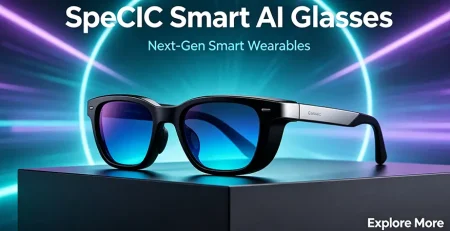
Suddenly, everything changed. These aren't the Google Glasses of yesteryear that made everyone look like a cyborg extra from a bad 90s movie. They're not the heavy AR headsets that leave indentations on your nose after 20 minutes. Specic took a completely different approach: they built audio-first AI glasses that look and feel exactly like regular eyewear. No distracting screens floating in your field of vision, no weird projections, just lightweight frames that you can comfortably wear from the moment you wake up until you go to bed.
In this article, I'm going to show you exactly what smart AI glasses can do in your daily life – not in some distant, hypothetical future, but right now, today. I'll share real-world scenarios where these glasses have transformed my routine, and how Specic's unique design philosophy solves the exact problems that made earlier generations of smart eyewear fail.
But I'm not just going to gush about how great they are. I'm also going to tackle the tough, controversial questions that everyone is asking but no one is really answering. Questions about privacy, social interaction, and the future of technology in our lives. Because if we're going to embrace this new technology, we need to have honest conversations about both its benefits and its risks.
THE GREAT DEBATE: Audio-First vs. AR Displays
Before we dive into the use cases, let's address the biggest controversy in the smart glasses world right now: should smart glasses have displays?
For years, the industry has been obsessed with AR displays – floating maps, virtual screens, digital overlays that turn the world into a computer interface. Companies like Meta and XREAL have poured billions into this vision, promising us the "Iron Man experience."
But here's the dirty secret no one is talking about: almost no one actually wears display-equipped smart glasses for more than a few hours a day. They're too heavy, too expensive, too socially awkward, and their batteries die way too fast.
Specic is betting big on audio-first smart glasses. They argue that for 90% of daily tasks, audio is simply more efficient, less distracting, and more socially acceptable than visual overlays. Their critics say they're playing it safe, missing out on the transformative potential of AR.
Who's right? Let's look at the evidence as we walk through a day in the life with smart glasses.
Morning Routine: Starting Your Day Without Fumbling for Your Phone
Let's walk through a typical morning with Specic glasses and see how they change the first hour of your day – that groggy period when even finding your phone feels like a Herculean task.
Your alarm goes off at 7 AM. You roll out of bed, reach for your Specic SPV03 glasses on the nightstand, and put them on. No fumbling for your phone, no squinting at a bright screen that makes your eyes hurt first thing in the morning.
"Good morning," you say.
Immediately, your glasses give you a personalized, concise briefing tailored to your day:
"Good morning! It's currently 65 degrees and sunny, with a high of 78 expected this afternoon. No rain in the forecast. You have two meetings today: one with the marketing team at 10 AM, and a client call at 2 PM. Your deadline for the project proposal is at 4 PM. You received three important emails overnight: one from your boss about the budget, one from the client confirming today's call, and one from your friend inviting you to dinner this weekend."
That's all the information you need, delivered in 30 seconds, without ever having to look at a screen. No scrolling through endless notifications, no getting distracted by social media before you even get out of bed.
As you head to the kitchen to make coffee, you remember you need to pick up groceries on the way home. "Add milk, eggs, bread, and avocados to my shopping list," you say. The glasses confirm immediately: "Added milk, eggs, bread, and avocados to your shopping list." No need to stop what you're doing, no need to dry your hands to type into your phone.
While your coffee brews, you decide to catch up on the news. "Play the top five news headlines," you command. Your glasses start reading the most important stories of the day. You can listen while you make breakfast, pack your bag, and get dressed – multitasking without the distraction of a screen.
Then comes the part that has saved me countless minutes: getting dressed. We've all stood in front of our closets for 10 minutes, staring blankly at our clothes, wondering what to wear. With Specic glasses, you can say, "What should I wear today?"
The AI considers the weather, your schedule, and even your personal style preferences to give you practical suggestions: "It's sunny and warm today. You have a client meeting this afternoon, so I'd recommend the navy blazer with the white button-down shirt and khaki pants. It's professional but comfortable for the weather. You wore that outfit to the conference last month and got several compliments."
No more fashion crises. No more second-guessing yourself. Just a helpful suggestion that gets you out the door faster.
As you're leaving the house, you have that familiar panic: did I turn off the coffee maker? Did I lock the front door? In the old days, you'd have to run back inside to check. Now, you just ask: "Is the coffee maker off? Is the front door locked?"
Your glasses, connected to your smart home system, respond instantly: "Yes, the coffee maker was turned off at 7:28 AM. All your lights are off, and the front door is locked. Your security system is armed."
Peace of mind, delivered in two seconds. That's the magic of smart glasses – they handle the small, annoying things so you can focus on what matters.
Now that we've seen how smart glasses transform your morning routine, let's look at how they make your commute safer and more enjoyable.
Commuting: Safer, Smarter, and Less Stressful Travel
Whether you drive, cycle, or take public transit, Specic glasses make your commute better. And in the case of driving and cycling, they can actually save your life.
Let's start with driving. We all know how dangerous it is to look at your phone while behind the wheel. Even a quick glance at a navigation app can take your eyes off the road for several seconds – enough time to travel the length of a football field at highway speeds.
With Specic glasses, you get turn-by-turn navigation delivered through crystal-clear audio. "In 500 feet, turn right onto Main Street," your glasses say. "Stay in the right lane – there's a slowdown ahead due to construction."
No need to look down at your phone or a dashboard screen. Your eyes stay on the road, your hands stay on the wheel, and you still get where you're going safely and efficiently.
Specic SPRO01: Built for the Outdoors
The SPRO01 model is particularly good for driving and cycling. It features enhanced wind noise reduction technology that blocks out road and wind noise while still letting you hear important sounds like sirens and car horns. It also has an extended battery life of up to 12 hours, perfect for longer commutes or road trips.
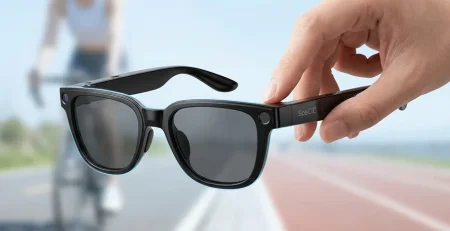
If you cycle to work, Specic glasses are a game-changer. Regular earbuds block out your surroundings, making cycling dangerous. With Specic's open-ear audio technology, you can listen to music or podcasts while still being fully aware of what's happening around you. You'll hear cars approaching, pedestrians talking, and bike bells ringing – all while enjoying your favorite tunes.
If you take public transit, Specic glasses make the ride much more enjoyable. You can listen to music, podcasts, or audiobooks without blocking out the world around you. You'll still hear announcements, traffic sounds, and people talking to you – something you can't say about noise-canceling earbuds.
And if you get a phone call, you can answer it completely hands-free. "Answer call," you say, and you can have a crystal-clear conversation without taking your phone out of your pocket. The dual-microphone system in Specic glasses filters out background noise, so the person on the other end hears you clearly, even on a noisy bus or train.
One of my favorite commuting features is the ability to dictate messages. If someone texts you while you're on the go, your glasses can read the message aloud. Then you can reply by speaking, and the glasses will transcribe your message and send it. No more typing with one hand while holding onto a pole. No more embarrassing typos from trying to text while walking.
Work and Productivity: Your Personal Assistant That Never Sleeps
This is where Specic glasses really shine. They transform the way you work, making you more productive, less stressed, and better able to focus on what matters.
Let's start with meetings – the bane of every office worker's existence. We've all been in meetings where we're trying to take notes and pay attention at the same time. It's impossible to do both well. Either you miss important points because you're writing, or your notes are incomplete because you're listening.
With Specic glasses, that problem is solved forever. Just say, "Start recording this meeting," and the glasses will capture everything that's said. After the meeting, you'll get a full transcript with speaker identification, so you know exactly who said what. The AI can even generate a summary of the key points and action items, organized by person and deadline.
This has been a game-changer for me. I used to spend hours after meetings transcribing my notes and organizing action items. Now, I can focus entirely on the conversation, knowing that I'll have a perfect record of everything that was discussed. I've actually become a better listener because I'm not distracted by taking notes.
The transcription feature isn't just for meetings. You can use it to capture ideas whenever they strike. Have a brilliant thought while walking down the street? "Note to self: the new marketing campaign should focus on the audio-first advantage of our product," you say. The glasses will transcribe your note and save it to your preferred app – Evernote, Notion, Google Keep, whatever you use.
No more forgetting great ideas because you didn't have a way to write them down. No more scribbling notes on napkins that you lose later. Your ideas are captured instantly, wherever you are.
Specic glasses also make it easier to stay organized. You can set reminders, check your calendar, and manage your to-do list all with voice commands. "Remind me to send the proposal to John at 2 PM," you say. At 2 PM sharp, your glasses will gently remind you. No more missed deadlines or forgotten tasks.
If you work in a field that requires a lot of research, Specic glasses can be your personal research assistant. Let's say you're reading a document and you come across a term you don't understand. Instead of stopping to look it up on your phone – which inevitably leads to 20 minutes of scrolling through social media – you can just ask, "What is quantum computing?"
The AI will give you a clear, concise explanation without interrupting your workflow: "Quantum computing is a type of computing that uses quantum-mechanical phenomena like superposition and entanglement to perform operations on data. Unlike classical computers, which use bits that can be either 0 or 1, quantum computers use qubits that can be 0, 1, or both at the same time. This allows them to solve certain types of problems much faster than classical computers."
Or if you're preparing for a presentation, you can use the glasses as a teleprompter. Upload your script to the Specic app, and the glasses will read it to you at a pace you control. You can practice your presentation anywhere, anytime, without needing a separate teleprompter or cue cards.
THE GREAT DEBATE: Connection vs. Isolation
Now that we've seen how smart glasses make us more productive, let's address the second big controversy: do smart glasses make us more connected or more isolated?
Critics argue that wearing smart glasses all the time creates a barrier between us and the people around us. They say we'll become so absorbed in our digital worlds that we'll miss out on real-life interactions. They point to the smartphone epidemic – how we're all glued to our screens instead of talking to each other – and warn that smart glasses will make this problem even worse.
Proponents of smart glasses argue the exact opposite. They say that by moving our digital interactions from our phones to our glasses, we'll actually be more present in the world around us. We won't have to look down at our phones constantly, so we'll make more eye contact and have more natural conversations.
My personal experience has been overwhelmingly positive. Since I started wearing Specic glasses, I check my phone far less often. I used to pull it out every time I had a free moment – waiting in line, walking down the street, even during conversations. Now, I can get the information I need without ever taking my phone out of my pocket.
But I'll admit there are awkward moments. Sometimes people will ask if I'm recording them. Sometimes I'll be talking to someone and get a notification, and they'll notice I'm slightly distracted. It's a learning curve, both for me and for the people around me.
Language Barriers: Breaking Down Walls Around the World
One of the most impressive features of AI glasses is real-time translation, and Specic does it better than anyone. It's like having a pair of real-time translation glasses with you at all times, ready to help you communicate with anyone, anywhere in the world.
Imagine you're traveling in Japan and you sit down at a small family restaurant where no one speaks English. The waiter hands you a menu full of Japanese characters. In the past, you'd be stuck pointing at pictures or using a clunky translation app on your phone, hoping you don't accidentally order raw octopus (not that there's anything wrong with raw octopus, but it's not for everyone).
With Specic glasses, it's easy. Just point your head at the menu and say, "Translate this menu." The glasses will read the menu aloud in English, describing each dish in detail:
"Tonkatsu: breaded and deep-fried pork cutlet served with shredded cabbage, rice, and miso soup. Ramen: wheat noodles in a savory pork broth with chashu pork, soft-boiled egg, green onions, and nori. Sushi platter: assortment of fresh nigiri sushi including tuna, salmon, yellowtail, and shrimp."
But it gets even better. When the waiter comes to take your order, you can speak in English, and the glasses will translate your words into Japanese and play them through the speaker. Then when the waiter responds in Japanese, the glasses will translate back to English for you.
It's not perfect – there's still a slight delay, and it struggles with very colloquial language – but it's good enough to have a natural, fluid conversation with someone who doesn't speak your language. I've used this feature in several countries now, and it's never let me down.
Specic glasses support over 50 languages, including all the major ones and many less common ones. The translation is fast and accurate, with minimal latency. And because it's audio-based, you don't have to hold up your phone like a tourist – you can have a normal conversation while looking the other person in the eye.
The translation feature isn't just for travel. It's also incredibly useful in the workplace. If you work with international clients or colleagues, you can use the glasses to translate conversations in real-time. No more waiting for a translator or struggling with language barriers. You can have natural, productive conversations with people from all over the world.
Shopping: Making Informed Decisions in Seconds
Shopping with Specic glasses is a revelation. No more standing in a store wondering if you're getting a good deal or if a product is right for you. No more pulling out your phone and searching through multiple websites while trying to hold a shopping basket.
Let's say you're shopping for a new laptop. You see one that looks good, but you're not sure about the specifications or the price. Just point your head at the laptop and say, "Tell me about this laptop."
The AI will recognize the product and give you all the information you need in seconds:
"This is the Dell XPS 13 laptop. It has a 13.4-inch 4K display, 12th generation Intel Core i7 processor, 16GB of RAM, and a 512GB SSD. It's currently priced at $1,299 at this store. You can get it for $1,199 at Amazon and $1,249 at Best Buy. Customer reviews are generally positive, with an average rating of 4.5 out of 5 stars. The main complaints are about battery life, which is around 6 hours with heavy use. If you're looking for something with better battery life, you might want to consider the MacBook Air M2, which has an 18-hour battery and is similarly priced."
In seconds, you have all the information you need to make an informed decision. No more scrolling through review sites. No more comparing prices on your phone. No more buyer's remorse because you didn't do your research.
The shopping feature works for almost anything: clothes, electronics, groceries, even furniture. If you see something you like, just ask your glasses about it.
Specic glasses also make grocery shopping easier. Remember that shopping list you added to earlier? As you walk through the grocery store, your glasses can remind you what you need to buy. "You need milk, eggs, bread, and avocados," they'll say when you pass the dairy section. No more forgetting items and having to make a second trip.
And if you're trying to eat healthier, you can ask about the nutritional information of any product. "How many calories are in this cereal?" you ask. The glasses will read the nutrition label aloud, telling you the calories, sugar content, fat content, and other important information.
Now that we've seen how smart glasses make shopping easier, let's look at how they enhance your sports and fitness routine.
Sports and Fitness: Your Personal Trainer on Your Face
Whether you're a casual walker or a serious athlete, Specic glasses can enhance your fitness routine. They're like having a personal trainer with you at all times, giving you real-time feedback and motivation.
Specic SPRO01: Designed for Action
The SPRO01 model is specifically designed for sports and outdoor activities. It's water-resistant (IP67 rating), so you can wear it in the rain or while sweating heavily. It has a secure, wrap-around fit that won't slip or fall off during intense workouts. And it has an extended battery life of up to 12 hours, so it can keep up with even the longest training sessions.
Let's say you're going for a run. Put on your SPRO01 glasses and say, "Start running workout." The glasses will track your distance, pace, time, and calories burned. They'll give you real-time updates as you run:
"You've run 1 mile in 8 minutes and 15 seconds. Your current pace is 8:15 per mile. Keep it up!"
"You're halfway through your 5K run. You're on track to finish in 41 minutes and 15 seconds, which is a personal best!"
If you're training for a race, the glasses can help you stay on pace. "You're 10 seconds behind your target pace. Try to speed up a little," they'll say. Or if you're going too fast and risking burnout: "You're 20 seconds ahead of your target pace. Slow down a bit to conserve energy for the end."
The glasses can also coach you on your form. If you're running, they can analyze your stride and give you tips to improve: "Your cadence is a bit low. Try taking shorter, faster steps to reduce impact on your knees." If you're doing yoga or weightlifting, they can watch your form and correct you if you're doing something wrong.
One of the best features for fitness is the ability to listen to music without blocking out your surroundings. With regular earbuds, you can't hear cars, bikes, or other people around you, which can be dangerous when you're running or cycling outdoors. With Specic's open-ear audio, you can listen to your favorite music or podcasts while still being aware of what's happening around you.
And if you get a phone call or a text while you're working out, you can handle it hands-free without stopping your activity. "Answer call," you say, and you can have a conversation while continuing to run or cycle.
THE GREAT DEBATE: The Always-Listening Dilemma
Now let's tackle the most controversial question of all: should we be worried about AI always listening to us?
Smart glasses have microphones that are always on, waiting for your wake word. This means they're constantly listening to everything you say and everything that's said around you. For many people, this is deeply unsettling.
The recent scandals involving Meta's Ray-Ban glasses have only amplified these concerns. Investigations revealed that Meta was sending intimate, unedited footage from users' glasses to human reviewers in Kenya to train their AI models. This footage included people in bathrooms, during intimate moments, and even showing their bank card information.
Companies like Specic argue that they take privacy very seriously. They say that all audio processing happens locally on the device whenever possible, and that only complex queries that require internet access are sent to their servers. They also say that they don't sell user data to third parties.
But critics say that even with these protections, the risk is too great. They argue that any device with microphones and cameras that's always on is a potential privacy nightmare waiting to happen. They point to the countless data breaches that have happened in recent years and warn that it's only a matter of time before smart glasses are hacked.
Travel and Exploration: Your Personal Tour Guide Everywhere
Traveling with Specic glasses is like having a personal tour guide who knows everything about everywhere. They turn every trip into an educational adventure, helping you discover hidden gems and learn about the places you're visiting.
Imagine you're walking through Rome and you see the Colosseum for the first time. Just point your head at it and say, "Tell me about this." The glasses will start telling you the history of the Colosseum in a clear, engaging way:
"The Colosseum, also known as the Flavian Amphitheatre, was built between 70 and 80 AD under the emperors Vespasian and Titus. It's the largest amphitheater ever built, with a capacity of up to 80,000 spectators. It was used for gladiatorial contests, animal hunts, executions, reenactments of famous battles, and dramas based on classical mythology."
As you continue walking, the glasses can point out other points of interest that you might have missed: "On your left is the Roman Forum, the center of political and social life in ancient Rome. Straight ahead is the Palatine Hill, where the emperors lived. If you turn right in 100 feet, you'll find a small gelato shop that's been family-owned since 1920 – it's a local favorite."
If you're looking for a place to eat, the glasses can recommend restaurants based on your preferences: "I found three Italian restaurants within a 5-minute walk that have 4.5-star ratings or higher. Trattoria Da Enzo is known for its homemade pasta and reasonable prices. Da Francesco has great wood-fired pizza. Osteria Da Fortunata is a bit more upscale but has excellent seafood and a romantic atmosphere."
And if you get lost, just say, "Take me to the Trevi Fountain." The glasses will give you turn-by-turn directions, guiding you there without you ever having to look at a map. No more wandering around aimlessly, no more getting lost in narrow streets.
The SPRO01 model is perfect for travel. Its water-resistant design means you can wear it in any weather. Its long battery life will last you all day as you explore. And its durable construction can handle the bumps and scrapes of travel.
Entertainment: Immersive Experiences Without Isolation
Specic glasses aren't just for productivity and utility – they're also great for entertainment. The open-ear audio technology delivers surprisingly good sound quality, making them perfect for listening to music, podcasts, audiobooks, and even watching movies and TV shows.
The bass is rich, the mids are clear, and the highs are crisp – better than many budget headphones. And because the audio is directed only at your ears, you can listen without disturbing the people around you.
When you're watching a movie or TV show on your phone, the audio plays through your glasses. It creates a personal surround sound experience that's much more immersive than your phone's speakers. You'll feel like you're in the middle of the action, without having to wear bulky headphones.
The glasses also work with gaming. If you're playing a mobile game, the audio plays through your glasses, making the game more immersive. And if you're playing a game that requires voice commands, you can use the glasses' built-in microphone to control the game hands-free.
One of my favorite entertainment features is the ability to listen to live sports. If you're at a game, you can listen to the commentary through your glasses while still hearing the crowd and the action on the field. It's like having your own personal commentator right there with you.
And if you're at a concert or a festival, you can use the glasses to protect your hearing while still enjoying the music. The SPRO01 model has a built-in hearing protection feature that reduces loud sounds to safe levels, preventing hearing damage.
Home Life: Making Chores Less Chore-Like
Even around the house, Specic glasses can make your life easier. They turn tedious chores into more enjoyable activities, and they help you get things done faster.
Let's start with cooking – the chore that everyone loves to hate. We've all been there: you're following a recipe, and your hands are covered in flour or oil. You need to check the next step, but you don't want to get your phone or cookbook dirty.
With Specic glasses, that problem is solved. Just say, "Read me the chocolate chip cookie recipe." The glasses will walk you through each step, one at a time:
"First, preheat the oven to 350 degrees Fahrenheit. Then, in a large bowl, cream together 1 cup of butter and 3/4 cup of granulated sugar until light and fluffy. Add 2 eggs, one at a time, beating well after each addition. Stir in 1 teaspoon of vanilla extract."
When you need to set a timer, just say, "Set a timer for 10 minutes." The glasses will count down and alert you when the time is up. No more burning cookies because you forgot to set a timer. No more washing your hands 10 times during the cooking process.
The glasses can also help you with home repairs. If you're trying to fix a leaky faucet or assemble a piece of furniture, you can ask for step-by-step instructions. "How do I replace a faucet washer?" you ask. The AI will give you clear, easy-to-follow instructions:
"First, turn off the water supply to the faucet. Then, remove the handle by unscrewing the screw under the cap. Use a wrench to remove the stem. Replace the old washer with a new one. Reassemble the faucet and turn the water supply back on."
And if you have kids, the glasses can be a great educational tool. If your child asks you a question you don't know the answer to, you can just ask your glasses. "Why is the sky blue?" your child asks. "The sky is blue because of a phenomenon called Rayleigh scattering," the glasses explain in simple terms that a child can understand.
THE GREAT DEBATE: The End of the Smartphone Era?
Finally, let's address the biggest question of all: will smart glasses eventually replace smartphones?
Many tech experts believe that smart glasses are the next big computing platform – the successor to the smartphone. They argue that within 10 years, most people will be wearing smart glasses instead of carrying smartphones.
Others are more skeptical. They say that smartphones are too versatile, too convenient, and too deeply ingrained in our lives to be replaced anytime soon. They point out that smart glasses still have many limitations – small batteries, limited processing power, and social acceptance issues.
My prediction is that smart glasses won't completely replace smartphones, but they will become the primary device for most daily tasks. We'll still carry smartphones for things like watching videos, browsing the web, and taking high-quality photos. But for quick tasks – checking the time, getting directions, sending messages, making calls – we'll use our glasses.
Specic is positioning itself perfectly for this future. By focusing on audio-first design, they're creating a product that people actually want to wear all day, every day. And as the technology improves, they'll be able to add more features without sacrificing comfort or battery life.
Privacy and Security: The Specic Difference
I know what you're thinking after reading that last controversy section: "If these glasses have microphones and cameras, what about my privacy?" It's a valid concern, and one that Specic takes very seriously.
Unlike some other companies that treat user data as a product to be sold, Specic has built its entire business model around privacy. Here's how they protect your data:
- Local processing first: All audio processing happens locally on the device whenever possible. That means your voice commands don't have to be sent to the cloud to be processed. Only complex queries that require internet access are sent to Specic's servers.
- Physical privacy controls: The camera on Specic glasses only activates when you explicitly tell it to. There's a physical indicator light that turns on when the camera is recording, so everyone around you knows when you're taking a photo or video. And you can easily disable the camera entirely with a physical switch if you want.
- No data selling: Specic doesn't sell your personal data to third parties. Period. Your data is yours, and yours alone.
- End-to-end encryption: All your data is encrypted both in transit and at rest. Even if someone intercepts your data, they won't be able to read it.
- Full data control: You can delete your data at any time, and you have full control over what information the glasses collect. You can turn off any feature that you're not comfortable with.
Specic is also constantly updating its security measures to protect against new threats. The glasses receive regular firmware updates that include security patches and new features. And they have a dedicated security team that works around the clock to keep your data safe.
Of course, no system is perfect. There's always some risk when you use any connected device. But Specic has done more than any other company in the smart glasses space to address privacy concerns. They've built privacy into every aspect of their product, from the hardware to the software to the business model.
The Future of AI Glasses: What's Coming Next?
We're still in the early days of AI glasses, but the potential is enormous. As the technology improves, we'll see even more amazing features that will transform our lives in ways we can't even imagine.
In the near future, Specic glasses will be able to recognize people and remind you of their names and how you know them. No more that awkward moment when you run into someone you should remember but can't place. "That's Sarah from the marketing department. You met her at the conference last month. She has a daughter named Lily who's 5 years old."
They'll also be able to translate sign language in real-time, making communication easier for deaf and hard-of-hearing people. And they'll be able to provide more detailed context about the world around you, like identifying plants and animals or explaining how things work.
Further down the line, we might see displays make a comeback – but not the bulky, distracting displays of the past. Future displays will be subtle, only appearing when you need them and disappearing when you don't. They'll be integrated into the lenses in a way that's almost invisible, providing information without breaking your focus.
But for now, the audio-first approach is the best option for daily life. It's comfortable, practical, and socially acceptable. And Specic is leading the way with their innovative designs and thoughtful features.
Conclusion: Are AI Glasses Worth the Investment?
After wearing Specic glasses every day for several months, I can say without hesitation that yes, they are absolutely worth it.
They've transformed the way I live, work, and play. They make me more productive, more informed, and more present in the moment. They eliminate the need to constantly check my phone, which has reduced my stress levels and improved my relationships.
The SPV03 model is perfect for everyday use. It's lightweight, comfortable, and has all the features you need for daily life. At 34 grams, it's about the same weight as a regular pair of prescription glasses. I've worn it for 12+ hours straight without any discomfort.
The SPRO01 model is great for people who are active outdoors or who need longer battery life. It's water-resistant, has a secure fit, and lasts up to 12 hours on a single charge. It's perfect for runners, cyclists, hikers, and anyone who spends a lot of time outside.
Of course, smart glasses aren't for everyone. If you never wear glasses, if you hate talking to AI assistants, or if you're extremely concerned about privacy, then they might not be right for you. But if you're tired of being glued to your phone, if you want to be more present in the world around you, if you want a personal assistant that's always there when you need it but never in the way, then you should give Specic glasses a try.
They're not just a tech gadget – they're a tool that can genuinely improve your life. And in a world where so much technology seems designed to distract us and pull us away from reality, that's a rare and wonderful thing.
So what are you waiting for? Put on a pair of Specic glasses and see what the future of daily life looks like. You won't be disappointed.
What do you think about smart glasses? Do you prefer the audio-first approach or AR displays? Are you concerned about privacy? Let us know in the comments below!