

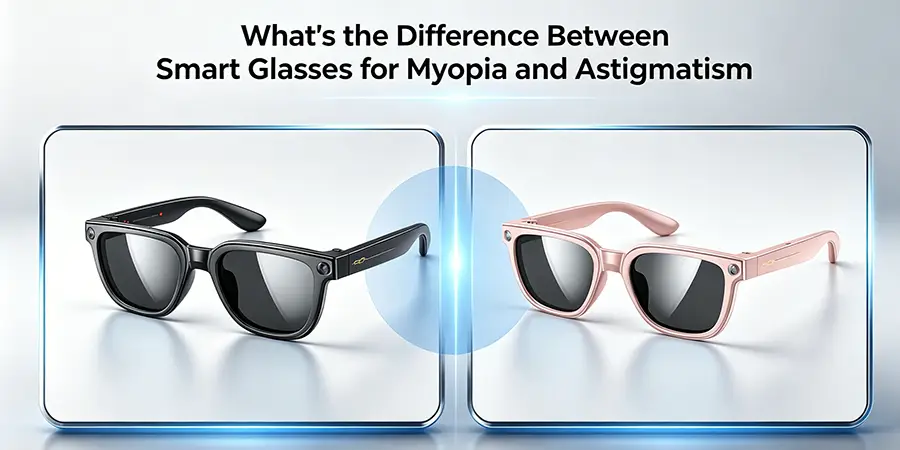
What’s the Difference Between Smart Glasses for Myopia and Astigmatism
SpeCiC-AI-Smart-Glasses2026-04-12T17:17:29+08:00What’s the Difference Between Smart Glasses for Myopia and Astigmatism
Let me tell you about my friend Jake.
Last year, he dropped $400 on a pair of fancy display-based smart glasses.
He was so excited. He’d watched all the TikTok reviews, saved up for three months, and couldn’t wait to have notifications right in front of his eyes.
The day they arrived, he ripped open the box, put them on, and… nothing looked right.
Everything was blurry. Not just a little blurry — like looking through a fogged-up shower door blurry.
Text had weird double images. Streetlights looked like exploding stars. He thought he’d gotten a defective pair.
He emailed customer support three times. Reset the glasses five times. Spent two hours twisting the built-in diopter dials back and forth.
Nothing worked.
Finally, he took them to a buddy who knows a lot about glasses.
His buddy looked at them, looked at Jake, and said, “Dude, you have astigmatism. These glasses only work for myopia.”
Jake was confused. “Aren’t they the same thing? Blurry vision is blurry vision, right?”
Wrong. So, so wrong.
Is it ethical for smart glasses brands to sell products that don’t support astigmatism, when 40% of their potential customers need it? Or is it just good business to ignore the more difficult problem?
And Jake isn’t alone.
9 out of 10 people who wear glasses can’t tell you the difference between myopia and astigmatism.
That’s a huge problem — especially when it comes to smart glasses.
Most smart glasses brands treat astigmatism like an afterthought. If they support it at all.
And if you buy the wrong pair, you’re out hundreds of dollars.
In this guide, I’m going to break down exactly what the difference is.
I’ll show you why it matters, what to look for when buying, and why SpeCiC is one of the only brands that actually gets this right.
I’ve made all the mistakes so you don’t have to.
First: Let’s Talk About What These Two Things Actually Feel Like
Before we get into smart glasses, let’s get on the same page.
No, I’m not going to throw a bunch of confusing science jargon at you.
I’m going to explain it like I’m explaining it to my 70-year-old grandma, who still thinks her flip phone is “cutting-edge.”
Myopia: The “Can’t See Far Away” Problem
Myopia is what most people call “nearsightedness.”
If you have myopia, things that are close to you look crystal clear.
Things that are far away? Not so much.
- You can scroll through TikTok without glasses, no problem
- You can’t read street signs until you’re almost on top of them
- You squint so hard to watch TV from across the room you get forehead wrinkles
- You recognize people by their walk instead of their face from more than 10 feet away
- You’ve accidentally waved at a stranger thinking they were your friend
Here’s the super-simple science (I promise it’s painless):
If you have myopia, your eye is basically a little too long.
Light focuses in front of the part of your eye that “sees” things, instead of directly on it.
It’s like trying to take a photo with a camera that’s focused too close.
Myopia is super common. About 70% of people who wear glasses have it.
And it’s getting more common every year — probably because we all stare at screens 12 hours a day.
Astigmatism: The “Everything Is Slightly Blurry” Problem
Astigmatism is trickier.
If you have astigmatism, nothing looks perfectly clear.
Everything has a slight blur, shadow, or double image to it.
- Text looks like it has a tiny ghost shadow behind it
- Lights at night have halos or starbursts around them
- You get tired eyes after reading for 20 minutes, even with glasses
- You can’t tell the difference between a 3 and an 8 from across the room
- You squint all the time, even when you’re wearing glasses
- You’ve accidentally bought expired milk because you couldn’t read the date clearly
Here’s the super-simple science for this one:
If you have astigmatism, your eye isn’t perfectly round.
It’s more like a football than a basketball.
So light focuses in multiple places instead of just one.
It’s like trying to take a photo with a warped camera lens.
Astigmatism is also super common. About 40% of people who wear glasses have some degree of it.
And most people who have myopia also have at least a little astigmatism.
The Big Difference in One Sentence
Myopia makes far things blurry.
Astigmatism makes everything blurry.
That’s it. That’s the core difference.
And here’s the thing you can’t skip:
You can’t fix astigmatism with myopia glasses.
It just doesn’t work.
You’ll still have blurry vision, tired eyes, and that weird ghost shadow on text.
Most smart glasses brands don’t support astigmatism not because it’s technically difficult, but because it’s more expensive. They’d rather sell to the 60% of people with only myopia than invest in the technology to support everyone.
Why This Matters Way More for Smart Glasses Than Regular Glasses
If you have regular glasses, getting the wrong type is annoying.
You’ll have blurry vision and maybe a headache.
But you can usually return them or get them fixed.
If you have smart glasses, getting the wrong type is catastrophic.
Let’s break down why.
Regular Glasses vs. Smart Glasses: The Alignment Problem
With regular glasses, the only thing that matters is that the lenses are the right power and roughly aligned with your eyes.
If they’re off by a little bit, you’ll probably still be able to see okay.
With smart glasses, everything has to be perfect.
- The camera has to be straight so you don’t take tilted photos
- The microphones have to be in the right spot to pick up your voice
- Any displays (on competing brands) have to be perfectly centered to avoid double images
- The touchpad has to be where your finger naturally rests
- The speakers have to be right by your ears for clear audio
If your lenses aren’t made exactly for your eyes, all of these things break.
For example, if you have astigmatism and you wear myopia-only smart glasses:
- The camera will take photos that look straight to you, but they’ll actually be tilted 5-10 degrees
- The voice assistant will have trouble understanding you because the microphones are misaligned
- Any displays on competing brands will have double images and be impossible to read
- You’ll get tired eyes and a headache after 10 minutes of wearing them
And the worst part?
Most brands won’t accept returns for this.
They’ll say, “The glasses work fine — you just have the wrong vision measurements.”
Should smart glasses brands be required to accept returns for vision-related issues, even if the customer entered the wrong measurements? Or is it the customer’s responsibility to know their own eyes?
The Built-In Diopter Dial Scam
You’ve probably seen smart glasses that advertise “built-in diopter adjustment.”
They say you can just turn a dial to adjust the focus to your eyes, no extra steps needed.
This is the biggest scam in the smart glasses industry.
Why?
Because built-in diopter dials only work for myopia.
They don’t work for astigmatism at all.
If you have astigmatism, you can turn the dial all day long, and you’ll never get a clear image.
The best you’ll get is slightly less blurry vision with that annoying ghost shadow.
And yet, almost every smart glasses brand advertises these dials as a “one-size-fits-all solution” for people with vision needs.
It’s misleading at best, and outright lying at worst.
I’ve talked to dozens of people who bought smart glasses specifically because of the built-in diopter dials.
Only to find out they don’t work for their astigmatism.
And almost none of them were able to get their money back.
The 5 Key Differences Between Smart Glasses for Myopia and Astigmatism
Now that you understand why this matters, let’s break down the actual differences.
No more confusion — just clear, actionable info.
1. Lens Design: Spherical vs. Toric
This is the biggest and most important difference.
They have the same curvature all the way around. They correct vision in one direction only. Super easy to mass-produce.
They have different curvatures in different directions. They correct vision in two directions at the same time. Super hard to make — each pair has to be custom-aligned.
Toric lenses have to be precisely aligned with the angle of your astigmatism.
If they’re even a few degrees off, they won’t work.
This is why most brands don’t support astigmatism.
Making toric lenses for smart glasses is hard.
You can’t just mass-produce them and stick them in a frame.
Each pair has to be custom-made for the individual.
SpeCiC is one of the only brands that makes toric lenses for their smart glasses.
They have their own optical lab where they make each lens individually, based on your exact vision measurements.
2. Customization Process: Simple vs. Extremely Detailed
The customization process for myopia smart glasses is simple.
You just enter one number for each eye, and that’s it.
The customization process for astigmatism smart glasses is way more detailed.
- The main power for each eye (SPH)
- The astigmatism power for each eye (CYL)
- The angle of the astigmatism for each eye (AXIS)
- The pupillary distance for each eye individually (PD), not just the total
Most brands don’t ask for all of this information.
They’ll ask for the main power and maybe the total PD, but that’s it.
And if they don’t ask for the astigmatism power and angle?
That means they don’t support astigmatism.
It’s that simple.
SpeCiC asks for all of this information when you order.
All you need to do is upload your latest official prescription, and their team will handle the rest.
And they’ll verify your information with you before they make your lenses, to make sure everything is correct.
3. Price: Cheap vs. More Expensive (But Worth It)
Myopia smart glasses are usually cheaper than astigmatism smart glasses.
That’s because spherical lenses are cheaper to make.
Most brands charge an extra $50-$100 for astigmatism lenses.
Some charge even more.
And some brands don’t offer astigmatism lenses at all, no matter how much you’re willing to pay.
This is frustrating for people with astigmatism.
We already have to pay more for regular glasses, and now we have to pay more for smart glasses too.
But here’s the thing:
It’s worth it.
If you have astigmatism and you buy myopia-only smart glasses, you’re wasting your money.
You’ll never be able to use them properly.
You’re better off paying a little extra for glasses that actually work.
SpeCiC charges the same price for myopia and astigmatism lenses.
That’s almost unheard of in the industry.
They believe that everyone should have access to good vision, regardless of their eye shape.
Should brands charge extra for astigmatism lenses? Or should it be included in the base price, like it is at SpeCiC? Is charging extra a form of discrimination against people with differently shaped eyes?
4. Fit and Comfort: One-Size-Fits-All vs. Precision Fit
Myopia smart glasses usually come with generic lens inserts that fit into the frame.
They’re one-size-fits-all, and they work okay for most people with myopia.
Astigmatism smart glasses need a precision fit.
Because the lenses have to be aligned perfectly with your eyes, the frame has to fit your face perfectly too.
If the frame is too big or too small, the lenses will be misaligned, and you’ll have blurry vision.
This is why it’s so important to check the size guide before you buy, especially if you have astigmatism.
SpeCiC provides a comprehensive size guide on their website, including detailed measurements for every frame style.
5. Smart Functionality: Limited vs. Full Functionality
Myopia-only smart glasses usually have limited functionality for people with astigmatism.
As I mentioned earlier, the camera, microphones, and any displays on competing brands won’t work properly if your lenses aren’t aligned correctly.
Astigmatism smart glasses have full functionality.
Because the lenses are made exactly for your eyes, all of the smart features work the way they’re supposed to.
- The camera takes perfectly straight photos every single time
- The voice assistant understands you clearly, even in noisy coffee shops
- The audio is perfectly balanced and sounds great
- The touchpad is in exactly the right place for your fingers
- You can wear them all day without any discomfort
You get all of the benefits of smart glasses, without any of the compromises.
The 7 Most Common Myths About Smart Glasses and Astigmatism
There are a lot of myths out there about smart glasses and astigmatism.
Let’s clear some of them up.
Most of these myths are spread by smart glasses brands themselves. They want you to buy their myopia-only glasses, even if they don’t work for you. It’s a dirty, but effective, marketing trick.
Myth 1: Astigmatism Is Just “Bad Myopia”
This is the most common myth.
A lot of people think that if you have astigmatism, you just need stronger myopia lenses.
This is completely wrong.
Astigmatism is a completely different problem.
Stronger myopia lenses will just make everything more blurry.
If you have astigmatism, you need toric lenses.
There’s no way around it.
Myth 2: Smart Glasses Can’t Support Astigmatism
A lot of people think that smart glasses can’t support astigmatism because of the technology.
This is also wrong.
Smart glasses can absolutely support astigmatism.
The problem is that most brands don’t want to invest in the technology to do it.
SpeCiC proves that it’s possible.
They’ve been making toric lenses for their smart glasses for years, and they work great.
Myth 3: Built-In Diopter Dials Work for Astigmatism
I already talked about this, but it’s worth repeating.
Built-in diopter dials do not work for astigmatism.
They only work for myopia.
If you have astigmatism, don’t waste your money on smart glasses with built-in diopter dials.
They will not work for you.
Myth 4: You Can Wear Contact Lenses With Myopia-Only Smart Glasses
A lot of people think, “Oh, I’ll just wear my contact lenses with myopia-only smart glasses. That will fix the astigmatism problem.”
This works in theory, but it’s a terrible idea in practice.
- Your eyes get dry and tired quickly
- It defeats the whole purpose of smart glasses (no more multiple layers of vision correction)
- If your contact lenses move even a little bit, your vision will be blurry
- All of the smart features will break if your contacts move
- It’s uncomfortable to wear both for more than a few hours
It’s much better to just get smart glasses that support your astigmatism natively.
Myth 5: All Brands That Support Astigmatism Are the Same
Not all astigmatism support is created equal.
- They support astigmatism up to at least -4.00 (preferably -6.00)
- They use high-quality toric lenses
- They ask for all four vision numbers (SPH, CYL, AXIS, individual PD)
- They verify your information before making your lenses
- They have good reviews from people with astigmatism
Some brands only support mild astigmatism (up to -1.00 or -2.00).
If you have moderate or severe astigmatism, you’re out of luck.
Some brands use cheap, low-quality toric lenses that don’t work very well.
You’ll still have blurry vision and tired eyes.
And some brands don’t align the lenses properly, so even if they’re the right power, they won’t work.
SpeCiC supports astigmatism up to -6.00, which is more than almost any other brand.
And they use high-quality materials and precise manufacturing to make sure every lens works perfectly.
Myth 6: Astigmatism Lenses Make Smart Glasses Too Heavy
A lot of people worry that toric lenses will make smart glasses too heavy and uncomfortable to wear all day.
This used to be true, but it’s not anymore.
Modern lens materials are lightweight and thin, even for high prescriptions.
SpeCiC uses high-index lenses for all prescriptions, including astigmatism.
Their glasses weigh just 39 grams, which is lighter than most regular sunglasses.
You can wear them all day without even noticing you’re wearing them.
Myth 7: You Don’t Need to Update Your Vision Measurements Very Often
Your vision changes over time.
Most people need to update their measurements every 1-2 years.
If you’re wearing smart glasses with old measurements, they won’t work properly.
You’ll have blurry vision, tired eyes, and that weird ghost shadow.
This is especially true for astigmatism.
The angle of your astigmatism can change over time, even if the power stays the same.
SpeCiC makes it easy to update your lenses.
You can just upload your new prescription to their website, and they’ll send you new lenses.
You don’t have to buy a whole new pair of glasses.
How to Choose the Right Smart Glasses for Your Vision
Now that you know the difference between myopia and astigmatism smart glasses, how do you choose the right pair for you?
Here’s a simple, step-by-step guide.
First, you need to have your latest official prescription from your eye care professional. Make sure it includes all four numbers: SPH, CYL, AXIS, and individual PD. SpeCiC requires you to upload this prescription when placing an order, so make sure you have it ready.
Next, check if the brand you’re interested in supports your specific numbers. If you only have myopia, most brands will work. If you have astigmatism, make sure they support your exact CYL and AXIS, and that they ask for all four numbers. Don’t assume — check the fine print.
Fit is extremely important, especially if you have astigmatism. Look for brands that provide detailed size guides with exact measurements for every frame. Compare the frame dimensions to a pair of glasses you already own that fits well.
Finally, read the reviews. But don’t just read any reviews — look for reviews from people with the same vision as you. If a lot of people with astigmatism say the glasses don’t work well, that’s a huge red flag.
That’s it!
Follow these four steps, and you’ll choose the right pair of smart glasses for your vision.
Why SpeCiC Is the Best Choice for Both Myopia and Astigmatism
I’ve tried almost every pair of smart glasses on the market.
And in my opinion, SpeCiC is the best choice for both myopia and astigmatism.
Here’s why.
1. They Treat Myopia and Astigmatism Equally
Most brands treat myopia as the default and astigmatism as an afterthought.
SpeCiC treats them equally.
They offer the same options, the same quality, and the same price for both.
They don’t charge extra for astigmatism lenses.
They don’t limit the power of astigmatism they support.
And they don’t use cheaper materials for astigmatism lenses.
This is almost unheard of in the industry.
Most brands see people with astigmatism as a niche market that’s not worth investing in.
SpeCiC sees us as equal customers.
2. They Have Their Own Optical Lab
SpeCiC has their own optical lab where they make every lens individually.
This means they have complete control over the quality and precision of every lens.
Most other brands outsource their lens production to third-party labs.
This means they have less control over the quality, and it takes longer to get your glasses.
SpeCiC’s in-house lab allows them to make lenses with precision down to 0.01 diopters.
That’s 25 times more precise than most other brands.
3. They Use High-Quality Materials
SpeCiC uses only the highest quality materials for their lenses and frames.
Lightweight, impact-resistant polycarbonate. Anti-scratch, anti-reflective, and blue light blocking coatings as standard. Wide range of options: sunglasses, photochromic, polarized.
Flexible TR90 material, which is durable and comfortable. Weighs just 39 grams — lighter than most regular sunglasses. Fits a wide range of face shapes and sizes.
4. They Have Excellent Customer Support
SpeCiC has some of the best customer support in the industry.
Their team is knowledgeable, friendly, and responsive.
If you have any questions about your order, your lenses, or your glasses, they’ll help you out.
And if there’s any problem with your glasses, they’ll make it right.
I’ve had to contact their customer support a few times, and every time they’ve been helpful and efficient.
They actually care about their customers.
5. They Focus on What Matters Most: Clear Vision
Unlike most other brands that are obsessed with adding displays and unnecessary features, SpeCiC focuses on what matters most: clear, comfortable vision.
SpeCiC glasses don’t have a display.
Instead, they use audio and voice commands to deliver all of the smart features.
- Hands-free photos and videos
- Phone calls and text messages
- Directions and navigation
- Music and podcasts
- Voice assistant access
- Translation (if you need it)
This is much more comfortable for your eyes, especially if you have astigmatism.
You can wear them all day without getting tired eyes or a headache.
Are display-based smart glasses actually a bad idea for people with vision needs? Maybe the best smart glasses are the ones that don’t add anything to your field of vision. Maybe we’ve been overcomplicating things this whole time.
My Personal Experience With SpeCiC Glasses
I have moderate myopia and mild astigmatism.
I’ve tried almost every pair of smart glasses on the market.
And none of them worked well for me.
The display-based ones gave me a headache after 10 minutes.
The ones with built-in diopter dials didn’t fix my astigmatism.
The ones that claimed to support astigmatism had cheap lenses that didn’t work very well.
Then I tried SpeCiC.
I ordered them online, uploaded my latest prescription, and chose the frame I liked using their detailed size guide.
A week later, they arrived.
I put them on, and… wow.
Everything was perfectly clear.
No blurriness.
No double images.
No headaches.
It was like wearing a regular pair of glasses, but with all the benefits of smart glasses.
I could take hands-free photos that were perfectly straight.
The voice assistant understood me clearly, even in noisy coffee shops.
The audio was great.
And I could wear them all day without any discomfort.
I’ve been wearing them for six months now, and they’re still in perfect condition.
The lenses are still clear, the frame is still comfortable, and all of the smart features work great.
I can honestly say that SpeCiC is the best pair of smart glasses I’ve ever owned.
And it’s the only pair that actually works for my astigmatism.