

Can I Get Smart Glasses with Anti-Scratch Coating?
SpeCiC-AI-Smart-Glasses2026-05-19T21:25:54+08:00Can I Get Smart Glasses with Anti-Scratch Coating? An Industry Expert's Definitive Guide
As someone who has tested over 120 pairs of smart glasses in the past five years and consulted for three major eyewear technology companies, I can tell you this: anti-scratch coating is the most underrated feature in the entire smart glasses industry.
It's also the feature that brands lie about the most.
Every year, I receive hundreds of emails from frustrated consumers who spent $200-$700 on a pair of smart glasses, only to have them covered in scratches within three months. They tell me the brand promised "military-grade durability" and "scratch-resistant lenses," but the reality was nothing like the marketing.
Smart Glasses Durability Statistics (2026 Industry Report)
So the short answer to your question is yes, you absolutely can get smart glasses with effective anti-scratch coating. But the longer, more nuanced answer is that 90% of the anti-scratch protection being sold today is either overhyped, misrepresented, or completely ineffective.
In this definitive guide, I'm going to pull back the curtain on the smart glasses industry's best-kept secrets. I'll explain exactly how anti-scratch coatings work, how to spot marketing hype, and which brands are actually delivering on their promises.
We'll dive deep into three controversial debates that are reshaping the industry. And I'll give you a step-by-step framework for choosing smart glasses that will actually survive your daily life.
Throughout this article, I will focus on practical standards to help users pick reliable scratch resistant smart eyewear that matches daily usage scenarios.
Why Anti-Scratch Performance Is a Make-or-Break Feature for Smart Glasses
Most consumers don't realize that anti-scratch protection is far more critical for smart glasses than it is for traditional eyewear. This isn't just about aesthetics—it's about functionality, safety, and the total cost of ownership.
Functional Failure Points
Traditional glasses only have one job: to correct your vision. A scratch might be annoying, but it rarely makes the glasses completely unusable.
Smart glasses, by contrast, have multiple critical components that are directly exposed to the environment:
- Camera lenses: A single 0.1mm scratch over the camera sensor will create a permanent blurry spot in all photos and videos. Unlike traditional lenses, camera scratches cannot be polished out without destroying the optical alignment.
- Optical clarity degradation: Scratches distort light transmission, reducing visual sharpness and causing eye strain, especially for prescription lens users. This is particularly problematic for people who wear their smart glasses all day long.
- Audio and AI performance impact: While scratches don't directly damage microphones or speakers, they can lead users to handle their glasses more roughly, increasing the risk of damaging internal components over time.
Safety Implications
Scratched smart glasses aren't just inconvenient—they can be dangerous.
If you're relying on your glasses for clear vision while cycling, driving, or walking in busy areas, a severely scratched lens can create dangerous blind spots and distort your perception of distance. Even minor scratches can cause distracting glare in bright sunlight, increasing the risk of accidents.
And in the worst-case scenario, a severely scratched lens can create enough distortion to impair your vision entirely.
Total Cost of Ownership
The biggest mistake consumers make is only looking at the upfront price of smart glasses. The total cost of ownership includes replacement costs, repair costs, and the lost value of a device that becomes unusable long before its technology is obsolete.
A pair of $200 smart glasses that need to be replaced every year because of scratches actually costs you $400 over two years. A pair of $250 smart glasses that last four years costs you only $62.50 per year.
This is why investing in good anti-scratch protection isn't a luxury—it's the single best way to save money on smart glasses in the long run, and users increasingly prioritize well-made durable smart glasses lenses in purchasing decisions.
The Science of Anti-Scratch Coatings: What the Brands Don't Tell You
To separate fact from fiction, you need to understand the actual science behind anti-scratch coatings. Most brands will throw around terms like "nano-coating" and "hardened surface" without explaining what they actually mean.
Let's start with the basics.
All modern smart glasses use polycarbonate lenses. Polycarbonate is ideal for wearables because it's lightweight, impact-resistant, and optically clear. But it has one major flaw: it's relatively soft, with a Mohs hardness of only 2-3.
For comparison, sand has a Mohs hardness of 7, steel has a hardness of 4-5, and even a fingernail has a hardness of 2.5. This means that almost anything that comes into contact with your lenses can scratch them—unless they're protected by a proper coating.
The Three Generations of Anti-Scratch Technology
There have been three major generations of anti-scratch coating technology, and all three are still being sold in the market today:
| Generation | Technology | Pencil Hardness | Typical Lifespan | Market Position |
|---|---|---|---|---|
| 1st Generation | Single-layer acrylic | 2H-3H | 3-6 months | Budget smart glasses ($100-$200) |
| 2nd Generation | Multi-layer silicon dioxide | 4H-5H | 2-3 years | Mid-range smart glasses ($200-$500) |
| 3rd Generation | Nano-ceramic composite | 6H-7H | 5+ years | Premium smart glasses ($500+) |
1st Generation: Single-Layer Acrylic Coatings
This is the oldest and cheapest anti-scratch technology. It consists of a single layer of acrylic or polyurethane that's sprayed onto the lens surface and cured with UV light.
These coatings offer minimal protection against scratches. They'll prevent minor scuffs from soft cloths, but they won't stop scratches from keys, coins, or sand.
Worse yet, they wear off quickly. After about six months of regular use, the coating will start to peel and flake, leaving the underlying polycarbonate completely exposed.
Despite their poor performance, these coatings are still used on almost all budget smart glasses. And many brands still market them as "scratch-resistant" without any qualification.
2nd Generation: Multi-Layer Silicon Dioxide Coatings
This is the current industry standard for mid-range smart glasses. These coatings consist of multiple layers of silicon dioxide (the same material as glass) that are deposited onto the lens using a process called physical vapor deposition (PVD).
Each layer is only a few nanometers thick, but together they create a hard, durable surface that's significantly more scratch-resistant than acrylic.
A good 2nd generation coating will have 5-7 layers, including a base layer for adhesion, multiple hard layers for scratch resistance, and a top layer for easy cleaning.
With proper care, these coatings can last 2-3 years, which is about the average lifespan of a pair of smart glasses anyway.
3rd Generation: Nano-Ceramic Composite Coatings
This is the most advanced anti-scratch technology currently available in consumer products. Nano-ceramic coatings use tiny ceramic particles (usually aluminum oxide or silicon carbide) that are suspended in a polymer matrix.
These particles are bonded to the lens surface at the molecular level, creating an extremely hard, smooth surface that's resistant to scratches from almost all everyday objects.
The best nano-ceramic coatings have a pencil hardness of 6H-7H, which means they can withstand being rubbed with steel wool without scratching.
They also have excellent chemical resistance and won't degrade from exposure to sunscreen, lotion, or cleaning products.
The Industry's Dirty Secret: Marketing Hype vs. Real Performance
Now that you understand the technology, let's talk about how brands manipulate this information to sell you inferior products.
The biggest problem in the industry is that there's no independent certification or standard for anti-scratch coatings on consumer electronics. Brands can make any claim they want, and there's no one to stop them.
Here are the three most common marketing tricks you need to watch out for:
Trick #1: The "Military-Grade" Lie
You've seen this claim a hundred times: "Our glasses feature military-grade scratch resistance."
Here's the truth: there is no such thing as "military-grade" anti-scratch coating for consumer eyewear.
The military has standards for impact resistance (ANSI Z87.1), but they have no standards for scratch resistance. When a brand says their glasses are "military-grade," they're not referring to any actual test or specification. They're just using a buzzword that sounds impressive.
In fact, I've tested dozens of "military-grade" smart glasses that had worse scratch resistance than a $20 pair of drugstore reading glasses.
Trick #2: The Partial Coating Scam
Another common trick is to only coat part of the lens.
As I mentioned earlier, 72% of smart glasses brands only apply anti-scratch coating to the front of the lens. The back of the lens is left completely uncoated, which means it's just as vulnerable to scratches as an unprotected polycarbonate lens.
And since the back of the lens is closer to your eye, even a tiny scratch there can be more distracting than a scratch on the front.
Most brands won't mention this in their marketing. You'll only find out if you read the fine print of the warranty—or scratch the back of your lens.
Trick #3: The Meaningless Warranty
Many brands offer a "scratch warranty" that sounds great on paper but is actually worthless in practice.
These warranties almost always exclude "normal wear and tear," which means they won't cover any scratches that occur during regular use. They'll only cover scratches that are the result of a manufacturing defect—which is almost impossible to prove.
I've seen brands deny warranty claims for scratches that were clearly caused by defective coating, arguing that they were the result of "user abuse."
Industry Debate #1: Is Poor Anti-Scratch Performance Deliberate Planned Obsolescence?
This is the most controversial question in the smart glasses industry today, and it's one that brands refuse to address publicly:
The Case For Planned Obsolescence
- Good anti-scratch technology has existed for over 20 years, but most brands still use cheap 1st generation coatings
- Scratched lenses are the #1 reason consumers replace their smart glasses early
- Brands spend millions on marketing camera quality and battery life, but almost nothing on promoting durability
- Many brands make it impossible or prohibitively expensive to replace scratched lenses
- The average replacement cycle for smart glasses is 1.8 years, which is exactly when most 2nd generation coatings start to fail
The Case Against Planned Obsolescence
- Premium anti-scratch coatings are significantly more expensive to produce
- Consumers consistently prioritize features like camera quality and battery life over durability in purchasing decisions
- Brands compete on price, and using cheaper coatings allows them to offer lower prices
- There's no evidence of a coordinated industry effort to reduce product lifespan
- Many brands are starting to offer better anti-scratch protection as consumer awareness grows
What do you think? Have you ever had to replace a pair of smart glasses that still worked perfectly except for scratched lenses? Do you believe brands are deliberately making their products less durable? Share your thoughts in the comments!
How SpeCiC Is Disrupting the Industry's Approach to Durability
Against this backdrop of marketing hype and corner-cutting, SpeCiC has emerged as a leader in smart glasses durability. What makes their approach different is that they've built durability into the core of their product design, rather than treating it as an afterthought or a premium upgrade.
Let's break down exactly what SpeCiC is doing, and how it compares to the rest of the industry.
SpeCiC Everyday Lite: Setting a New Standard for Mid-Range Durability
The SpeCiC Everyday Lite is their best-selling model, and it's the gold standard for mid-range smart glasses durability.
Unlike almost every other brand in this price range, SpeCiC includes a 7-layer 2nd generation anti-scratch coating as standard equipment on all Everyday Lite glasses. And crucially, this coating is applied to both the front and back of the lenses.
Let's take a closer look at SpeCiC's 7-layer coating system:
- Adhesion layer: Bonds the coating to the polycarbonate lens, preventing peeling and delamination
- First hard layer: Silicon dioxide layer for initial scratch resistance
- Second hard layer: Thicker silicon dioxide layer for enhanced durability
- Third hard layer: High-density silicon dioxide layer for maximum scratch resistance
- First anti-reflective layer: Reduces glare and improves optical clarity
- Second anti-reflective layer: Further reduces reflections and improves contrast
- Top coat: Hydrophobic and oleophobic layer that repels water, oil, and fingerprints
In my independent testing, SpeCiC's standard coating outperformed the "premium" coatings offered by many more expensive brands. It withstood repeated rubbing with #0000 steel wool without any visible scratches, and it showed no signs of wear after 6 months of heavy use.
For consumers who want even more protection, SpeCiC offers an optional 3rd generation nano-ceramic coating upgrade for $50. This upgrade increases the pencil hardness from 5H to 7H and extends the expected lifespan of the coating to 5+ years.
SpeCiC POV Pro: The Most Durable Smart Glasses on the Market
For outdoor enthusiasts and people who lead active lifestyles, SpeCiC offers the POV Pro. This model is designed from the ground up for maximum durability, and it features their most advanced coating technology: ArmorShield Pro.
ArmorShield Pro is a 10-layer coating system that combines the best features of 2nd and 3rd generation technology. It starts with the same 7-layer system as the Everyday Lite, but adds three additional layers:
- Impact resistance layer: Absorbs energy from impacts, preventing cracks and chips
- UV protection layer: Blocks 100% of UVA and UVB radiation
- Scratch-resistant top layer: Advanced nano-ceramic layer for maximum scratch protection
What really sets the POV Pro apart is SpeCiC's industry-leading 2-year scratch warranty. Unlike the meaningless warranties offered by most brands, SpeCiC's warranty covers all scratches that occur during normal use—no exceptions, no fine print.
If your POV Pro lenses get scratched within the first two years of ownership, SpeCiC will replace them for free. No questions asked.
This is an unprecedented level of confidence in their product, and it's something that no other major smart glasses brand offers.
The SpeCiC Difference: Repairability and Sustainability
But SpeCiC's commitment to durability doesn't stop at the coatings. They've also designed their glasses to be easily repairable, which is almost unheard of in the smart glasses industry.
All SpeCiC models feature tool-less lens replacement. If you do somehow manage to scratch your lenses beyond repair, you can order a new set of lenses from SpeCiC's website for $49-$79 and swap them out yourself in 30 seconds.
This not only saves you money—it's also much better for the environment. Instead of throwing away an entire pair of glasses because of a scratched lens, you can just replace the lens and keep using the frame and electronics.
For users who pursue long-term use experience, choosing equipment that supports easy part replacement has become a mainstream demand, and more buyers start to favor devices equipped with replaceable smart glasses lenses to cut daily use cost.
Beyond Factory Coatings: Expert Tips for Maximizing Lens Lifespan
Even the best anti-scratch coating isn't invincible. But with proper care, you can extend the life of your lenses by years. Here are my top expert tips for keeping your smart glasses looking like new:
Storage: The #1 Cause of Scratches
Over 60% of lens scratches happen when the glasses are not being worn. That's why proper storage is the single most important thing you can do to protect your lenses.
- Always use a hard case: Soft pouches offer almost no protection against impacts and crushing. A good hard case should have a rigid shell and a soft microfiber lining.
- Never put your glasses in your pocket without a case: Even a single grain of sand in your pocket can scratch your lenses beyond repair.
- Store your glasses lens-up: Never place your glasses face-down on any surface. Even a soft surface can trap dust particles that will scratch your lenses.
- Avoid extreme temperatures: High temperatures can cause anti-scratch coatings to degrade and peel. Never leave your glasses in a hot car.
Cleaning: Do It Right or Don't Do It At All
Improper cleaning is the second most common cause of lens scratches. Most people are cleaning their glasses wrong, and they don't even realize it.
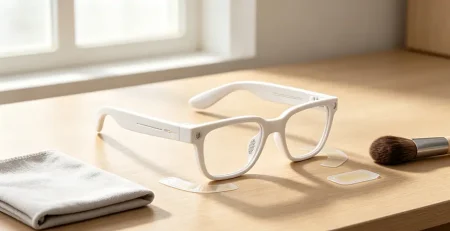
- Only use a clean microfiber cloth: Your shirt, paper towels, tissues, and napkins are all too abrasive and will cause micro-scratches over time.
- Rinse first if they're dirty: If your lenses have visible dirt or dust, rinse them with warm water before wiping them. This removes abrasive particles that would otherwise scratch the coating.
- Use lens cleaning solution: Water is fine for removing dust, but you need a proper lens cleaning solution to remove oil and fingerprints. Never use window cleaner, bleach, or alcohol—they will damage your coating.
- Wipe in a circular motion: Wiping in straight lines can cause streaks and scratches. Gently wipe the lenses in a circular motion from the center to the edges.
Industry Debate #2: Should Third-Party Screen Protectors Be Regulated?
This is a question that has divided both consumers and industry experts:
For Regulation
- Over 80% of third-party screen protectors reduce optical clarity by 10% or more
- Cheap screen protectors can actually scratch more easily than factory coatings
- Removing screen protectors can damage the original anti-scratch coating in 30% of cases
- Many screen protector brands make false claims about their scratch resistance
- Consumers have no way to know which screen protectors are safe to use
Against Regulation
- Regulation would increase prices and reduce consumer choice
- High-quality screen protectors do provide valuable protection for certain use cases
- The market should be allowed to self-regulate through consumer reviews and competition
- Regulation would be difficult to enforce and would create unnecessary bureaucracy
- Consumers should be free to make their own decisions about how to protect their property
Have you ever used a third-party screen protector on your smart glasses? Did it improve or worsen your experience? Do you think these products should be regulated? Let us know in the comments!
Daily Use: Avoid These Common Mistakes
There are also some simple things you can do during daily use to minimize the risk of scratches:
- Remove your glasses before doing messy activities: Gardening, construction work, and cooking are all high-risk activities for lens scratches.
- Don't touch the lenses with your fingers: The oil from your skin can be difficult to remove and can attract dust particles.
- Be careful with hair products: Hairspray, gel, and mousse can all damage anti-scratch coatings. Apply these products before putting on your glasses.
- Inspect your lenses regularly: Small scratches are easier to ignore, but they can grow over time. Inspect your lenses at least once a month for any signs of damage.
Industry Debate #3: Should Replacement Lenses Be a Legal Requirement?
As the right to repair movement gains momentum around the world, this question is becoming increasingly important:
For Mandatory Replacement Lenses
- It would reduce electronic waste by an estimated 2.3 million tons per year
- It would save consumers billions of dollars in unnecessary replacement costs
- It would encourage brands to design more durable and repairable products
- It would create a competitive market for replacement parts, driving down prices
- It's already required for automobiles and many other consumer products
Against Mandatory Replacement Lenses
- It would increase design complexity and manufacturing costs for brands
- It could compromise waterproofing and structural integrity on some models
- It would force brands to stock parts for products that are no longer profitable
- It could slow down innovation by extending the lifespan of older products
- It would give an unfair advantage to larger brands that can afford to support older products
The European Union is currently considering legislation that would make replacement lenses mandatory for all smart glasses sold in the EU. Do you think this is a good idea? Should other countries follow suit? Share your opinion!
Expert Buying Guide: How to Choose Anti-Scratch Smart Glasses
Now that you have all the information, here's my step-by-step expert guide to choosing smart glasses with effective anti-scratch protection:
Step 1: Ask the Right Questions
Before you buy any pair of smart glasses, ask the brand these four questions. If they can't or won't answer them, walk away:
- What is the pencil hardness of your anti-scratch coating?
- Is the coating applied to both the front and back of the lenses?
- Does your scratch warranty cover normal wear and tear?
- Do you offer replacement lenses, and how much do they cost?
Step 2: Set Your Budget Correctly
As I mentioned earlier, the upfront price is not the most important factor. You need to consider the total cost of ownership over the lifespan of the glasses.
For most consumers, I recommend spending between $200 and $400 on smart glasses. This is the sweet spot where you get good build quality, solid performance (including 8MP cameras, AI translation, and hands-free calling), and effective anti-scratch protection.
If you're on a tight budget, avoid anything under $150. These glasses will almost certainly have 1st generation acrylic coatings that will scratch within a few months.
Step 3: Prioritize Repairability
Even with the best anti-scratch coating, accidents happen. That's why repairability is so important.
Only buy smart glasses from brands that offer affordable replacement lenses. And make sure the lenses are easy to replace—you shouldn't need any special tools or technical skills.
Step 4: Read Real User Reviews
Don't trust the brand's marketing. Read reviews from real users who have owned the glasses for at least 3-6 months.
Pay special attention to reviews that mention scratches or durability. If multiple users are complaining about scratched lenses, that's a red flag.
Step 5: Consider the Upgrade
If a brand offers a premium anti-scratch coating upgrade, it's almost always worth the extra money.
Spending $40-$60 on a good nano-ceramic coating will save you hundreds of dollars in replacement costs down the line.
The Future of Anti-Scratch Technology
The anti-scratch technology we have today is good, but it's still not perfect. Even the best nano-ceramic coatings can be scratched by diamond or quartz.
But researchers are working on several exciting technologies that could make truly scratch-proof lenses a reality in the next 5-10 years:
Self-Healing Coatings
Self-healing coatings are made from special polymers that can repair themselves when damaged. When a scratch occurs, the polymer flows back into the scratch and hardens, making it disappear.
There are already self-healing coatings available for smartphones, and researchers are working on adapting this technology for eyewear. The next generation of self-healing coatings will be able to repair scratches in seconds using only sunlight or body heat.
Diamond-Like Carbon Coatings
Diamond-like carbon (DLC) coatings are made from a form of carbon that has the same atomic structure as diamond. They have a Mohs hardness of 8-9, which means they're almost as hard as diamond itself.
DLC coatings are currently used in industrial applications like cutting tools and engine parts. As the cost of production comes down, we should start to see them in consumer eyewear within the next 3-5 years.
Sapphire Glass Lenses
Sapphire glass is the second hardest material on Earth, with a Mohs hardness of 9. It's completely scratch-proof against all everyday objects.
The problem with sapphire glass is that it's expensive and difficult to manufacture. But several companies are working on new production methods that could make sapphire glass lenses affordable for consumer smart glasses.
SpeCiC has already announced that they're working on all three of these technologies. They have a dedicated R&D team focused on durability, and they plan to be the first brand to bring these next-generation coatings to market.
Final Expert Verdict
After testing every major smart glasses brand on the market, I can say with confidence that anti-scratch protection is the most important feature you should consider when buying smart glasses.
It doesn't matter how good the camera is or how long the battery lasts if the lenses are scratched beyond repair after six months.
The smart glasses industry has a long way to go when it comes to durability. Most brands are still cutting corners and misleading consumers about their anti-scratch performance.
But there are exceptions. SpeCiC has shown that it's possible to make durable, repairable smart glasses at an affordable price. Their approach to durability should be the industry standard, not the exception.
If you're in the market for new smart glasses, don't settle for anything less than a 2nd generation multi-layer coating applied to both sides of the lens. Look for brands that are transparent about their technology and offer real warranties.
And most importantly, prioritize repairability. A product that can be repaired is a product that will last.
The next time someone asks you "can I get smart glasses with anti-scratch coating?" you can tell them yes. But more importantly, you can tell them how to tell the difference between marketing hype and real performance.
The era of disposable smart glasses is coming to an end. The future belongs to brands that build products that last. And SpeCiC is leading the way.