

How to Check If My Smart Glasses Lens Has Anti-Reflective Coating?
SpeCiC-AI-Smart-Glasses2026-04-16T15:57:02+08:00How to Check If My Smart Glasses Lens Has Anti-Reflective Coating?
Let’s be real for a second—we’ve all had that cringe-worthy, hide-your-face-in-your-hands moment that led you straight to this article.
You’re mid-Zoom call with your team, nailing a big presentation, and you glance at your camera preview only to realize no one can see your eyes. All they can see are two giant, glowing white rectangles on your face, thanks to the overhead office lights bouncing off your smart glasses lenses like mirrors.
Or you’re out on a sunset hike, double-tap the temple of your SpeCiC AI smart glasses to capture that perfect golden-hour vista, only to play the video back and find the entire shot ruined by a massive, washed-out glare from your lenses.
If any of these sound familiar, you’re not alone. For regular eyeglasses, lens glare is an annoyance. For AI-powered smart glasses like your SpeCiC frames? It’s a dealbreaker that ruins every single feature you bought them for.
90% of smart glass owners who ask this question already know the answer deep down. They just want permission to skip the upgrade and hope for the best. And the brands that market “premium smart glasses” without AR coating? They’re counting on that impulse to make a quick buck—while hiding the fine print that their product won’t work as advertised.
Have you ever had a glare-related disaster with your smart glasses? Drop your most cringe-worthy story in the comments—we’re all here to commiserate (and maybe laugh a little, too).
First: What Even *Is* Anti-Reflective (AR) Coating, And Why Should I Care?
Before we dive into how to check for AR coating, let’s get one thing straight: AR coating isn’t some fancy, overpriced magic trick for rich people. It’s a thin, invisible (or nearly invisible) multi-layer coating applied to the front and back of your lenses, designed to do one simple thing: stop light from bouncing off your lenses.
Here’s the science, simplified so you don’t need a physics degree to get it: every time light hits a clear lens, about 4-5% of that light bounces off the surface instead of passing through. That’s what causes the glare, the reflections, the bright spots on your lenses during video calls, and the washed-out spots in your smart glasses footage.
For regular glasses, that means 8-10% of light is lost to reflections (front and back surface). For smart glasses with a built-in camera, that lost light and unwanted reflection doesn’t just mess with your vision—it ruins the footage your camera is trying to capture through the lens.
AR coating fixes this. A high-quality multi-layer AR coating cuts that reflection down to less than 0.5% per surface, meaning 99% of light passes through the lens instead of bouncing off. That translates to clearer vision for you, zero distracting glare for people looking at you, and crisp, clean footage for your SpeCiC smart glasses camera.
Why It’s A Non-Negotiable For Your SpeCiC AI Frames
Now, you might be thinking: *Sure, that sounds nice, but is it really that big of a deal?* For regular eyeglasses, it’s a quality of life upgrade. For AI-powered smart glasses like your SpeCiC frames? It’s a game-changer that makes or breaks every single feature you bought them for.
Your SpeCiC glasses aren’t just a pair of prescription lenses. They’re a wearable camera with an 8MP Sony IMX219 sensor, capable of shooting smooth 1080P/30FPS video and crisp 2K photos with EIS stabilization. They’re a hands-free communication device with dual-microphone ENC noise cancellation for crystal-clear Bluetooth calls. They’re a travel assistant with real-time 139-language translation and instant object recognition. They’re a driving companion with voice-activated “Hey Cyan” commands.
Every single one of these features relies on one thing: clear, unobstructed light passing through your lenses. Without AR coating, you’re only getting a fraction of the experience you paid for.
Here’s the question no one in the smart glasses industry wants to answer: **Should AR coating be a *legal requirement* for all camera-equipped smart glasses?** Think about it—if a brand sells you a product with a built-in camera, that product should come with lenses that let the camera work as advertised. Locking it behind a paywall is like selling a car with tinted windows and charging extra for windshield wipers.
Do you think AR coating should be standard on all camera-equipped smart glasses? Or is it a fair “premium upgrade”? Let’s debate it in the comments—we want to hear both sides!
Okay, Now Let’s Get To It: 6 Foolproof Ways to Check If Your Smart Glasses Have AR Coating
The best part? None of these methods require fancy equipment, a trip to an optician, or any technical expertise. You can do all of them right now, from the comfort of your home, with nothing but a light source, your phone, and your glasses.
We’ve ordered these methods from easiest to most thorough, so start with the first one and work your way down. By the end, you’ll know exactly what’s on your lenses.
1. The Classic Light Reflection Test (The “Hold It Up To A Lamp” Method)
This is the simplest, fastest, and most reliable way to check for AR coating, and it works for every type of lens—clear, blue light blocking, photochromic, even sunglasses. All you need is a standard light source: a desk lamp, an overhead ceiling light, even the flashlight on your phone will work.
- Grab your SpeCiC smart glasses and head to a room with a single, bright light source (a desk lamp works best, but a ceiling light is fine too).
- Hold the glasses up in front of you, so you’re looking at the front surface of the lenses (the side that faces away from your face).
- Tilt the glasses slightly, so the light from the lamp hits the lens surface at an angle. You’ll see a reflection of the light source on the lens.
- Look closely at the color of that reflection. This is the key part that tells you everything.
Here’s what the results mean:
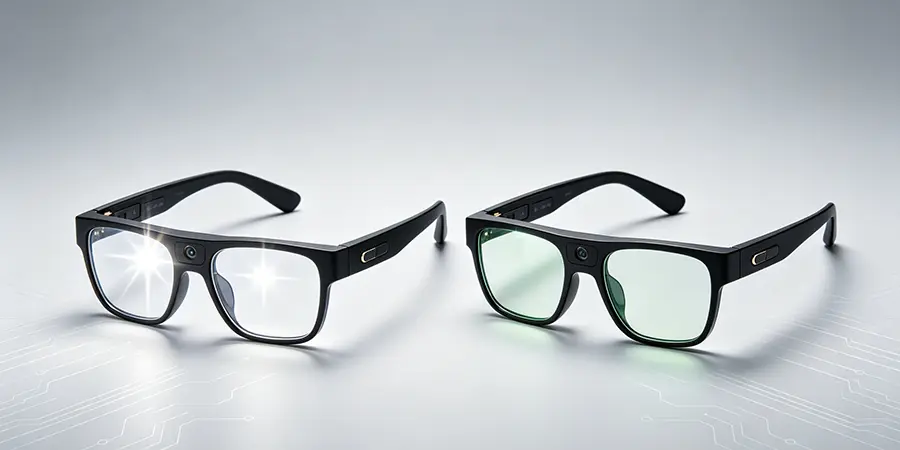
- Bright white/silver reflection: Your lenses do NOT have AR coating. This is the natural reflection of uncoated plastic or polycarbonate lenses, and it’s exactly the glare that’s ruining your videos and video calls.
- Soft colored reflection (green, blue, purple, faint gold): Your lenses DO have AR coating. The color depends on the type and number of layers (premium multi-layer coatings usually have green/blue reflections). The softer, colored reflection means the coating is doing its job.
2. The Screen & Video Test (Perfect For Your SpeCiC AI Camera Glasses)
This test is tailor-made for your SpeCiC smart glasses, because it doesn’t just tell you if you have AR coating—it shows you exactly how that coating (or lack thereof) is affecting the core features of your glasses. It’s also the most convincing test for anyone who’s on the fence.
Part 1: The Screen Glare Test
- Sit down in front of your computer, laptop, or even your phone screen, with the brightness turned up to a normal level.
- Put on your SpeCiC glasses, and look straight at the screen.
- Close one eye at a time, and look at the reflection on the lens. If you can see a bright, clear reflection of the screen, even when you’re looking straight ahead, you don’t have AR coating. If it’s faint or non-existent, you do.
Part 2: The SpeCiC-Specific Camera Video Test
This is the test that will make you a lifelong AR coating believer.
- Put on your SpeCiC glasses, pair them to the HeyCyan app, and stand in a room with normal overhead lighting (or outside in daylight, avoid direct harsh sun).
- Double-tap the right temple to start recording a 15-second video. Slowly turn your head to face different light sources: a window, a lamp, your computer screen.
- Stop recording, open the video in the HeyCyan app, and play it back.
If the video has bright, washed-out glare spots or ghost images, your lenses don’t have AR coating. If it’s crisp and clear, you do.
3. The Transparency & Contrast Check
This test is simple, but it’s a great way to tell the difference between basic uncoated lenses and high-quality AR coated lenses. AR coating doesn’t just stop reflections—it also lets more light pass through the lens, which makes everything you see look clearer, sharper, and higher contrast.
- Grab a piece of paper with small, black text printed on it (a book page, a printed document, even a phone screen works).
- Hold your SpeCiC glasses up about 6-12 inches away from the paper, so you’re looking through one lens at the text.
- Move the glasses slightly to the side, so you’re looking at the same text with your naked eye, right next to the lens.
- Compare the two views.
If the text through the lens looks dimmer or grayer, you don’t have AR coating. If it looks almost identical to your naked eye, you do.
4. The Water & Smudge Resistance Test (Bonus: Checks For Hydrophobic Coating Too)
This test is a great secondary check, because most high-quality AR coatings (the kind you want on your SpeCiC glasses) come with an added hydrophobic (water-repellent) and oleophobic (oil-repellent) top layer. It’s not technically part of the AR coating itself, but it’s almost always paired with premium AR treatments.
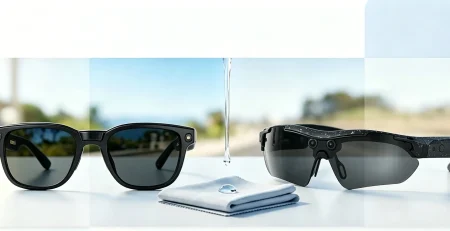
- Grab a small spray bottle with clean water (or flick a few drops onto the lens with your finger).
- Spray or flick 2-3 small drops onto the front surface of your SpeCiC lens.
- Tilt the lens up and down slightly, and watch how the water behaves.
If the water spreads out into a thin sheet, you don’t have AR coating. If it forms tight, round beads that roll off easily, you have a premium AR coating with a hydrophobic top layer.
5. The Angle Tilt Test (The “Squint And Tilt” Hack)
This test is a great way to confirm what you saw in the light reflection test, and it works especially well for lenses that have a partial or basic AR coating (vs. a full premium multi-layer coating).
- Hold your SpeCiC glasses up to a bright light source, just like you did for the first test.
- Start with the lens straight on, then slowly tilt it at a steeper and steeper angle.
- Watch how the reflection changes.
If the reflection gets brighter and stays white/silver no matter what angle, you don’t have AR coating. If it stays faint and colored, you have a full multi-layer coating. If it’s faint straight on but bright white at steep angles, you have a basic single-layer coating.
6. The Order & Documentation Check (For SpeCiC Custom Lens Owners)
If you’ve done all the tests above and you’re still not sure, the easiest way to confirm is to check your order details and documentation from SpeCiC. This is the only 100% foolproof way to know exactly what coatings are on your lenses, straight from the source.
- Pull up your order confirmation email from SpeCiC, or log into your account on the SpeCiC website.
- Look at the lens options you selected. If you added anti-reflective coating, it will be listed clearly.
- If you can’t find your order details, reach out to SpeCiC’s customer support team with your order number.
Wait, We Already Said It Matters—But Let’s Break It Down *Specifically* For Your SpeCiC AI Frames
We touched on this earlier, but it’s worth repeating in detail. Your SpeCiC glasses aren’t just regular glasses with a camera glued on. They’re a purpose-built wearable device, and every single feature is designed to work best with AR coated lenses.
- It unlocks the full potential of your 8MP Sony camera: Without AR coating, every photo and video you shoot will be marred by glare. With it, you get sharp, professional-looking footage, even in tricky lighting.
- It eliminates Zoom/video call embarrassment: People can see your eyes clearly, not just the reflection of your screen. It makes calls feel more personal and professional.
- It makes driving safer: It cuts down on blinding streaks from oncoming headlights and eliminates dashboard reflections on the back of your lenses.
- It boosts your AI feature experience: The camera gets a clear, glare-free shot for translation and object recognition, making those features work faster and more accurately.
- It makes all-day wear way more comfortable: It reduces eye strain from screen time, and the hydrophobic/oleophobic layer makes fingerprints wipe off easily.
Now, Let’s Debunk The 6 Most Common AR Coating Myths (That Are Total BS)
By now, you’re probably convinced that AR coating is a must-have. But there are a ton of myths floating around online, and we’re here to debunk them once and for all.
This is the most common myth. Blue light blocking filters out high-energy blue light from screens. AR coating reduces reflections and glare. They do two completely different things, and one does not replace the other. In fact, blue light blocking lenses benefit *more* from AR coating, because the filter can create additional reflections.
This is not just wrong—it’s dangerous. Dark tinted lenses actually need AR coating *more* than clear lenses, especially on the back surface. Light from behind you bounces off the back of the lens and straight into your eyes, creating blinding glare when you’re driving or hiking.
Let’s talk about the biggest myth that’s been floating around for 20 years: “AR coating scratches way easier than regular lenses.” Is this true? Spoiler: it’s not—but why do people still believe it? Because decades ago, early AR coatings were soft and prone to scratching. Modern premium AR coatings have a hard, scratch-resistant top layer that makes them *more* scratch-resistant than uncoated lenses.
As we just said—this is outdated. Modern premium AR coatings have a hard, scratch-resistant top layer. When cared for properly, they’ll last just as long, if not longer, than uncoated lenses.
This is the myth that leads to the most disappointment. Most budget smart glasses brands skip AR coating entirely to cut costs. Even premium brands often only include a basic single-layer coating, or lock the premium multi-layer coating behind a paywall.
Save your money—these DIY “AR coating sprays” are a scam. Real AR coating is applied in a vacuum chamber, using a precise multi-layer process. The sprays are just temporary silicone coatings that wear off in a few days and leave a streaky mess.
This is ridiculous. Even if you have perfect vision (plano lenses), AR coating will eliminate glare, make your smart glasses camera work better, and make all-day wear more comfortable. It’s for everyone who wears smart glasses, period.
What’s the dumbest AR coating myth you’ve ever heard online? Drop it in the comments, and we’ll debunk it together!
Okay, You Have AR Coating—Now How Do You Keep It In Perfect Shape?
If you’ve confirmed your SpeCiC lenses have AR coating, congratulations! Now you need to take care of that coating to make sure it lasts for years. AR coating is durable, but it’s not indestructible, and bad cleaning habits can scratch, wear, or damage it over time.
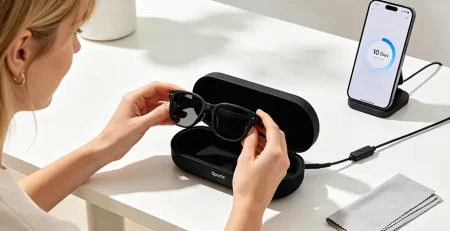
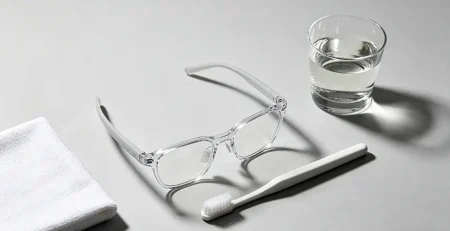
Luckily, your SpeCiC glasses come with everything you need to keep your lenses in perfect shape: a high-quality microfiber cleaning cloth and a protective storage pouch. Use them. They’re not just free accessories—they’re the best tools for caring for your AR coated lenses.
Another unpopular opinion: most people clean their AR coated lenses *completely wrong*, and brands don’t do a good enough job teaching them. Is that the brand’s fault, or the consumer’s? We think it’s a little bit of both. Brands should include clear, step-by-step cleaning instructions *in the box*, not just buried on a website. But consumers should also take 2 minutes to read those instructions instead of wiping their lenses with their shirt.
Our Top 6 Care Tips
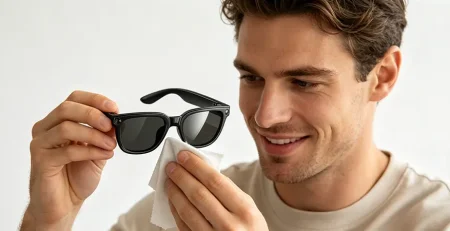
- Always use the included microfiber cloth. Never use paper towels, toilet paper, napkins, or your shirt. Paper products are made of abrasive wood fibers, and your shirt has dirt and oils on it.
- Never use harsh chemicals. Avoid window cleaner, alcohol, bleach, or Windex. These will strip the hydrophobic/oleophobic top layer and can damage the AR layers themselves.
- Rinse with water first if they’re dirty. If your lenses have dust, dirt, or sand on them, don’t wipe them dry. Rinse with clean water first to wash away the particles, then gently wipe dry.
- Store in the included protective pouch. The biggest cause of scratched lenses is leaving them face-down on a table or tossing them in your bag unprotected.
- Avoid extreme temperatures. Don’t leave your SpeCiC glasses in a hot car on a summer day, or in direct sunlight for long periods of time.
- Don’t touch the lenses with your fingers. The oils from your skin will leave smudges, and repeated touching can wear down the oleophobic layer.
Wrapping Up: AR Coating Is The Small Upgrade That Makes A Massive Difference
At the end of the day, anti-reflective coating isn’t just a fancy add-on for your smart glasses. It’s the key to unlocking the full potential of your SpeCiC AI frames. Without it, you’re missing out on crisp, glare-free video, clear video calls, safer driving, more reliable AI features, and all-day comfort. With it, your smart glasses work exactly the way they’re supposed to: seamlessly, effortlessly, and without the annoying glare that ruins the experience.
We’ve given you 6 foolproof ways to check if your lenses have AR coating, from the simple light reflection test to the SpeCiC-specific camera video test. You know exactly what to look for, what the results mean, and how to confirm your coating straight from the source. You know why AR coating matters so much for your smart glasses, you know the common myths to avoid, and you know how to care for your coating to make it last.
Now, it’s time for you to grab your glasses and do the tests. And if you find out your lenses don’t have AR coating? Don’t worry—you can reach out to SpeCiC’s customer support team to upgrade your lenses, and finally get the full experience you paid for.
The best way to make your smart glasses last for years is to use them for what they’re designed for, and take care of them properly. But the second best way? Demand that brands include AR coating as a standard feature on all camera-equipped smart glasses. It’s time for the industry to stop cutting corners and start delivering on their promises.
What’s your #1 rule for caring for your AR coated lenses? What’s one thing you wish you knew before you bought your first pair of smart glasses? Drop your best tips and tricks in the comments to help the whole community!