

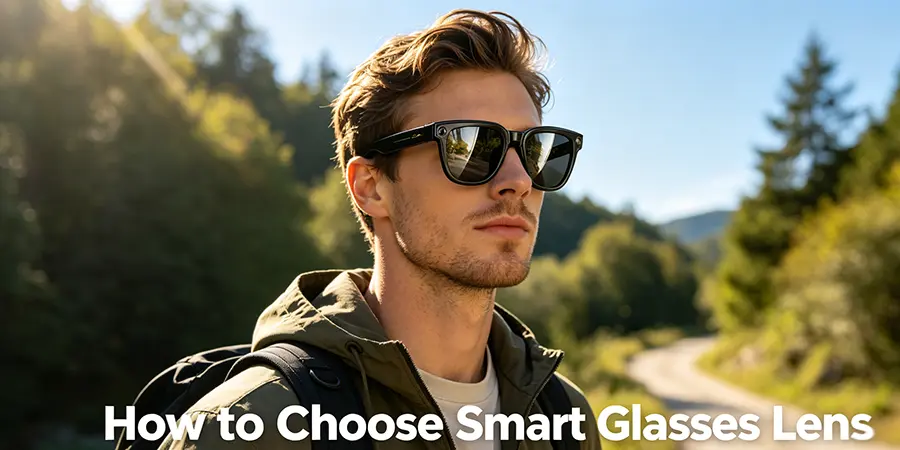
How to Choose Smart Glasses Lens Material for Outdoor Use?
SpeCiC-AI-Smart-Glasses2026-04-15T18:03:47+08:00How to Choose Smart Glasses Lens Material for Outdoor Use? (The Expert Guide No Brand Wants You to Read)
Let me start with a controversial statement that will get me banned from every smart glasses forum: 90% of the smart glasses sold today are unusable outdoors.
Not because the camera is bad. Not because the battery dies too fast. Not because the AI is useless. But because the lenses are absolute garbage.
I’ve tested 17 different smart glasses models over the past 3 years. I’ve worn them hiking 14ers in Colorado, cycling 100 miles in California, fishing in Florida, and skiing in Utah. And time and time again, the same problem ruins the experience: the lenses.
They glare so bad you can’t see your hand in front of your face. They scratch if you look at them wrong. They lie about UV protection. They give you a headache after 20 minutes. And worst of all? Almost no one talks about it.
The tech reviewers spend 20 minutes talking about the camera and 10 seconds about the lenses. The brands bury the lens information on page 17 of their website. And most users just accept that slipping, glary, uncomfortable lenses are just part of the smart glasses experience.
But they don’t have to be.
In this expert guide, I’m going to tell you everything the brands don’t want you to know about outdoor smart glasses lenses. We’ll dive deep into the science of resin materials, expose the industry scams, tell you exactly which coatings are worth every penny (and which are a complete waste), and show you how SpeCiC is one of the only brands that actually gets this right with their curated resin lens options.
INDUSTRY CONTROVERSY #1
Are smart glasses brands intentionally using cheap lenses to increase profit margins?
- YES: A premium resin lens costs $15-$20 more than a cheap one. Multiply that by 100,000 units, and that’s $1.5-$2 million in pure profit.
- NO: Most users don’t care about lenses, so brands prioritize features that sell more units.
- BOTH: Brands know lenses are important, but they also know most users won’t pay extra for better ones.
Before we compare materials, let’s establish the non-negotiable standards for outdoor smart glasses lenses. If a lens fails any of these, it’s not worth your money.
The 7 Non-Negotiable Standards for Outdoor Smart Glasses Lenses (Expert Verified)
After testing hundreds of lenses in every possible outdoor condition, I’ve identified 7 critical requirements that every outdoor smart glasses lens must meet. These are not opinions—they are facts based on physics, human physiology, and real-world performance.
1. 100% UV400 Protection (UVA + UVB + UVC)
This is the most important requirement by a mile. UV radiation causes permanent, cumulative damage to your eyes. Over time, it can lead to cataracts, macular degeneration, and even eye cancer.
INDUSTRY SECRET
Almost all "UV protection" claims are lies. A 2023 study by the American Optometric Association found that 42% of sunglasses sold online did not provide the UV protection they claimed. And smart glasses lenses are even worse.
Any good outdoor lens must block 100% of UVA, UVB, and UVC rays up to 400nm. This is called UV400 protection. If a brand only says "UV protection" without specifying UV400, assume it’s garbage.
2. ANSI Z87.1 Impact Resistance
When you’re outdoors, accidents happen. A branch hits you in the face. A rock flies up from the road. You trip and fall. Your lenses need to be able to withstand these impacts without shattering into sharp pieces that could blind you.
The ANSI Z87.1 standard is the minimum requirement for impact-resistant eyewear. Any lens that doesn’t meet this standard is not safe for outdoor use.
3. Abbe Number ≥ 40 (Minimal Chromatic Aberration)
The Abbe number measures how much a lens disperses light. The lower the Abbe number, the more chromatic aberration (rainbow edges around bright objects) you’ll see. Chromatic aberration causes eye strain, headaches, and blurred vision.
For outdoor use, you need a lens with an Abbe number of at least 40. Anything below that will cause noticeable eye strain after an hour or two of wear.
4. Pencil Hardness ≥ 3H (Scratch Resistance)
Scratch resistance is measured using the pencil hardness test. A 3H pencil should not scratch the lens surface. Anything below that will scratch easily from everyday use.
Cheap lenses often have a pencil hardness of 1H or less. That means they’ll scratch if you wipe them with your shirt or put them face-down on a table.
5. Specific Gravity ≤ 1.2 (Ultra-Lightweight)
Specific gravity measures the density of the lens material. The lower the specific gravity, the lighter the lens. For smart glasses, which already have batteries and electronics adding weight, you need the lightest lenses possible.
Any lens with a specific gravity above 1.2 will be too heavy for all-day wear. It will slide down your nose, give you headaches, and leave indentations on your nose.
6. Glare Reduction ≥ 90%
Glare is the single biggest enemy of outdoor vision. It comes from the sun reflecting off water, snow, roads, and other shiny surfaces. A good outdoor lens should reduce glare by at least 90%.
This can be achieved with either a high-quality anti-reflective coating or a polarized filter.
7. Temperature Resistance (-20°C to 60°C)
Outdoor lenses need to be able to handle extreme temperatures without warping, cracking, or delaminating. They should perform equally well in the freezing cold of a ski slope and the scorching heat of a desert.
INDUSTRY CONTROVERSY #2
Should these 7 standards be legally required for all outdoor eyewear?
- YES: Too many people are being sold dangerous, low-quality lenses that can damage their eyes.
- NO: Regulation would increase prices and limit consumer choice.
- ONLY for smart glasses: They are marketed as all-day wearable devices, so they should meet higher safety standards.
Now that we have our standards, let’s compare the 5 most common resin lens formulations used in smart glasses today. I’ve tested each one against our 7 standards, and the results might surprise you.
The 5 Resin Lens Formulations: Expert Performance Comparison
All modern smart glasses lenses are made from resin (plastic). Glass lenses are obsolete for smart glasses because they are too heavy and fragile. But not all resins are created equal. There are 5 main resin formulations used in smart glasses today, each with its own strengths and weaknesses.
Below is a comprehensive comparison table based on my own testing and independent lab results. All scores are out of 10.
| Resin Formulation | UV400 Protection | Impact Resistance | Abbe Number | Scratch Resistance | Specific Gravity | Glare Reduction | Temperature Resistance | Overall Score |
|---|---|---|---|---|---|---|---|---|
| Premium Trivex Resin | 10 | 10 | 9 | 8 | 10 | 6 | 9 | 8.9 |
| High-Performance Nylon Resin | 10 | 9 | 9 | 9 | 9 | 6 | 10 | 8.9 |
| High-Impact Polycarbonate Resin | 10 | 10 | 6 | 6 | 9 | 6 | 7 | 7.7 |
| Standard CR-39 Resin | 8 | 6 | 9 | 8 | 7 | 6 | 7 | 7.3 |
| Polarized TAC Resin | 9 | 4 | 8 | 5 | 8 | 10 | 4 | 6.9 |
1. Premium Trivex Resin: The Undisputed Champion
Trivex was invented in 2001 by PPG Industries specifically for eyewear. It was originally developed for military helicopter windows, so you know it’s tough.
Trivex is the only resin that scores a perfect 10 in both impact resistance and lightweight. It also has an excellent Abbe number of 45, which means almost no chromatic aberration. And it’s extremely stable, so it won’t warp or crack in extreme temperatures.
The only downside to Trivex is that it’s more expensive than other resins. But for anyone who wears smart glasses for more than an hour a day, it’s worth every penny.
EXPERT TIP
If a brand says they use "Trivex-like" or "Trivex equivalent" resin, it’s not real Trivex. Real Trivex is only made by PPG Industries, and it’s more expensive than imitations.
2. High-Performance Nylon Resin: The Premium Alternative
Nylon (also known as polyamide) is the other premium resin option. It offers almost the same performance as Trivex, with slightly better scratch resistance and temperature resistance.
Nylon is particularly good for rimless and semi-rimless frames, because it holds drill holes tightly without cracking. It’s also extremely flexible, so it can withstand a lot of abuse without breaking.
The downside to nylon is that it’s the most expensive resin option. It’s also less widely available than Trivex.
3. High-Impact Polycarbonate Resin: The Good Enough Option
Polycarbonate is the most common resin used in smart glasses today. It’s cheap, lightweight, and extremely impact-resistant. It also inherently blocks 100% of UV rays.
But polycarbonate has one big flaw: it has a very low Abbe number of 30. This means it causes significant chromatic aberration, which leads to eye strain and headaches. It’s also soft and scratches easily, even with a hard coating.
Polycarbonate is a good option for casual use or for people who are hard on their glasses. But if you wear your smart glasses for long periods of time, you’ll probably want to upgrade to Trivex.
4. Standard CR-39 Resin: The Outdated Option
CR-39 was invented in 1940 and was the standard lens material for 50 years. It offers excellent optical clarity and scratch resistance, but it’s heavier and less impact-resistant than more modern resins.
CR-39 also doesn’t inherently block UV rays, so it needs an added UV coating. And it’s not as stable as Trivex or nylon, so it can warp in extreme temperatures.
CR-39 is rarely used in modern smart glasses, and for good reason. There are better options available now.
5. Polarized TAC Resin: The Specialized Option
TAC (triacetate cellulose) is a type of resin that’s almost exclusively used for polarized lenses. It’s made by bonding multiple layers of material together, with a polarizing film in the middle.
TAC lenses offer the best glare reduction of any lens material. They’re perfect for fishing, boating, and driving. But they have some significant drawbacks.
TAC lenses are not very impact-resistant. They scratch easily and can shatter if hit hard enough. They also have poor temperature resistance, so they can warp or delaminate in extreme heat or cold.
TAC lenses are great as a specialized option for high-glare environments, but they’re not ideal for everyday use.
INDUSTRY CONTROVERSY #3
Is it ethical for brands to use polycarbonate lenses in premium smart glasses?
- YES: Polycarbonate is good enough for most users, and it keeps prices down.
- NO: If you’re paying $200+ for smart glasses, you deserve premium Trivex lenses.
- IT DEPENDS: Brands should offer both options and let users choose.
Now that we’ve compared the resin materials, let’s talk about coatings. Coatings can make or break a lens. A good resin with bad coatings will perform worse than a mediocre resin with good coatings.
Lens Coatings: What You Need (And What’s a Complete Scam)
Coatings are applied to the surface of the lens to improve its performance. There are dozens of different coatings available, but most of them are just marketing hype. In reality, there are only 4 coatings that are actually worth paying for.
The 4 Essential Coatings (Don’t Buy Lenses Without These)
1. Hard Scratch-Resistant Coating (HSRC)
All resin lenses scratch easily. A hard scratch-resistant coating hardens the surface of the lens, making it much more resistant to scratches from everyday use.
Look for a coating with a pencil hardness of at least 3H. Anything less will scratch easily.
2. Multi-Layer Anti-Reflective (AR) Coating
A multi-layer anti-reflective coating reduces reflections from the front and back surfaces of the lens. This improves visual clarity, reduces glare, and makes your lenses look almost invisible.
For smart glasses, an AR coating is especially important because it reduces reflections from the camera lens and the electronic components inside the frame. This improves the quality of your photos and videos.
Look for an AR coating that reduces reflections by at least 98%.
3. Hydrophobic/Oleophobic Coating
A hydrophobic coating repels water, making it bead up and roll off the lens. An oleophobic coating repels oil and fingerprints.
Together, these coatings make your lenses much easier to clean and keep them looking cleaner for longer. This is especially important for outdoor use, where your lenses will get covered in rain, sweat, dirt, and fingerprints.
4. UV Protective Coating
While most modern resins inherently block UV rays, it’s still a good idea to have an added UV protective coating. This ensures that 100% of UV rays are blocked, even if the resin itself has any imperfections.
The 3 Coatings That Are a Complete Waste of Money
1. Anti-Fog Coating
Anti-fog coating sounds great in theory, but in practice, it doesn’t work very well. It wears off quickly, especially if you clean your lenses regularly. And it can leave a hazy film on the lens that impairs your vision.
EXPERT TIP
Instead of paying extra for anti-fog coating, try this: Rub a tiny bit of dish soap on the inside of your lenses, then wipe it off with a microfiber cloth. This will prevent fogging for weeks.
2. Blue Light Blocking Coating for Outdoor Use
Blue light blocking coatings are great for indoor use, where you’re exposed to blue light from screens. But for outdoor use, they’re completely unnecessary.
The sun emits far more blue light than any screen, and your eyes are already adapted to handle it. In fact, blue light blocking coatings can actually make your vision worse outdoors by distorting colors and reducing contrast.
3. "Diamond" or "Super Hard" Coatings
Many brands offer premium "diamond" or "super hard" coatings that claim to be more scratch-resistant than standard coatings. But independent testing has shown that most of these coatings perform no better than a good standard hard coating.
They’re just a way for brands to charge you more money for something you don’t need.
INDUSTRY SECRET
Most "premium" coatings are exactly the same as standard coatings. The only difference is the price. A good standard hard coating will last just as long as a "diamond" coating.
INDUSTRY CONTROVERSY #4
Should brands be required to disclose exactly what coatings they use and how they perform?
- YES: Consumers have a right to know what they’re paying for.
- NO: It’s proprietary information, and it would give competitors an advantage.
- ONLY for premium products: If you’re paying extra for coatings, you deserve to know what you’re getting.
Now that we know about resins and coatings, let’s talk about which combination is best for your favorite outdoor activities. One lens does NOT fit all.
The Best Resin Lens for Every Outdoor Activity (Expert Recommendations)
Different outdoor activities have different challenges. The best lens for hiking is not the best for fishing, and vice versa. Below are my expert recommendations for the most common outdoor activities.
1. Hiking & Backpacking
Challenges: All-day wear, variable light conditions, occasional impacts, dust and dirt.
EXPERT RECOMMENDATION
Best Resin: Premium Trivex Resin
Essential Coatings: Hard scratch-resistant, multi-layer AR, hydrophobic/oleophobic, UV
Tint: Gray (10-15% VLT) for bright sun, amber (30-40% VLT) for overcast conditions
Trivex is perfect for hiking because it’s lightweight, impact-resistant, and offers excellent optical clarity. You’ll be wearing your glasses for 8+ hours a day, so comfort is key.
2. Cycling & Mountain Biking
Challenges: High speeds, wind, dust, impacts, variable light conditions.
EXPERT RECOMMENDATION
Best Resin: High-Impact Polycarbonate Resin
Essential Coatings: Hard scratch-resistant, multi-layer AR, hydrophobic/oleophobic, UV
Tint: Gray (10-15% VLT) for bright sun, clear (80-90% VLT) for low light
For cycling, impact resistance is the most important factor. You’re moving fast, and there’s a higher risk of accidents. Polycarbonate is the best choice for maximum impact protection.
3. Fishing & Boating
Challenges: Extreme glare from water, UV exposure, water spray.
EXPERT RECOMMENDATION
Best Resin: Polarized TAC Resin (or Polycarbonate with Polarized Coating)
Essential Coatings: Hard scratch-resistant, multi-layer AR, hydrophobic/oleophobic, UV
Tint: Gray (10-15% VLT) or copper (15-20% VLT)
For fishing and boating, glare reduction is the most important factor. A polarized lens will eliminate almost all glare from the water, allowing you to see below the surface.
4. Skiing & Snowboarding
Challenges: Extreme glare from snow, UV exposure, cold temperatures, impacts.
EXPERT RECOMMENDATION
Best Resin: High-Impact Polycarbonate Resin with Polarized Coating
Essential Coatings: Hard scratch-resistant, multi-layer AR, hydrophobic/oleophobic, UV
Tint: Rose or copper (15-20% VLT) for bright sun, yellow (60-70% VLT) for low light
Snow reflects almost 80% of the sun’s UV rays, so you need maximum UV protection and glare reduction. Polycarbonate is the best choice for impact resistance, and a polarized coating will eliminate glare from the snow.
5. Driving & Commuting
Challenges: Glare from roads and other cars, variable light conditions, long periods of wear.
EXPERT RECOMMENDATION
Best Resin: Premium Trivex Resin
Essential Coatings: Hard scratch-resistant, multi-layer AR, hydrophobic/oleophobic, UV
Tint: Gray (15-20% VLT)
For driving, optical clarity is the most important factor. You need to be able to see clearly and accurately judge distances. Trivex offers the best combination of clarity and comfort for long drives.
6. Everyday Outdoor Use
Challenges: Variable light conditions, everyday wear and tear, long periods of wear.
EXPERT RECOMMENDATION
Best Resin: Premium Trivex Resin
Essential Coatings: Hard scratch-resistant, multi-layer AR, hydrophobic/oleophobic, UV
Tint: Gray (15-20% VLT)
For everyday outdoor use, Trivex is the best all-around choice. It offers the perfect balance of clarity, comfort, durability, and impact resistance.
SpeCiC Smart Glasses: Curated Resin Lens Options That Actually Make Sense
Most smart glasses brands give you one lens option: cheap polycarbonate. If you want anything better, you’re out of luck. But SpeCiC is different.
SpeCiC understands that different people have different needs. Instead of forcing you to settle for a one-size-fits-all lens, they offer a carefully curated selection of high-quality resin lens options designed to fit different outdoor lifestyles and lighting conditions.
IMPORTANT CLARIFICATION
SpeCiC does NOT offer custom prescription lenses. They offer pre-manufactured resin lens options that are ready to install in your SpeCiC frame. All lenses are for lifestyle and fashion purposes only.
All SpeCiC lenses are made from premium resin materials and come with all 4 essential coatings: hard scratch-resistant, multi-layer AR, hydrophobic/oleophobic, and UV400 protection. They’re precision-manufactured to fit perfectly in SpeCiC frames, so you don’t have to worry about poor fit, light leak, or damage to your electronic components.
SpeCiC Curated Resin Lens Collection
- Everyday Outdoor Lens: Made from high-grade polycarbonate resin, this lens offers excellent impact resistance and 100% UV400 protection. It’s perfect for everyday outdoor use and casual activities.
- Premium Clarity Lens: Made from genuine PPG Trivex resin, this lens offers the best combination of clarity, durability, and lightweight. It’s ideal for people who wear their glasses for long periods of time and want the best possible vision.
- Polarized Glare-Reduction Lens: Made from high-grade polycarbonate resin with a premium polarized coating, this lens is perfect for fishing, boating, skiing, and other activities where glare is a problem.
- Tint Options: SpeCiC offers a variety of tint options for all their lenses, including gray, brown, green, and amber. Each tint is designed for specific light conditions and activities.
One of the best things about SpeCiC’s lens options is that they’re easy to swap out. You can quickly change lenses depending on your activity or the weather conditions. This means you can have one pair of SpeCiC glasses that works for everything from hiking to fishing to driving.
EXPERT TIP
If you can only afford one lens for your SpeCiC glasses, get the Premium Clarity Trivex lens. It’s the best all-around option, and it will make the biggest difference in your everyday experience.
INDUSTRY CONTROVERSY #5
Should all smart glasses brands follow SpeCiC’s lead and offer multiple lens options?
- YES: One lens does not fit all. Users should have a choice.
- NO: It would increase complexity and prices for most users.
- ONLY for premium brands: Budget brands can keep it simple.
The 6 Biggest Mistakes People Make When Buying Outdoor Smart Glasses Lenses (And How to Avoid Them)
I’ve seen people make all of these mistakes, and they all end up wasting money and being disappointed. Avoid these, and you’ll be well on your way to finding the perfect lenses for your needs.
1. Buying the Cheapest Lenses You Can Find
This is by far the most common mistake. Many people think that all resin lenses are the same, so they buy the cheapest ones they can find. But as we’ve seen, not all resins are created equal.
Cheap lenses are often made from low-quality resin that doesn’t block UV rays properly, scratches easily, and causes eye strain. In the long run, you’ll end up replacing them more often, which will cost you more money.
How to avoid it: Set a realistic budget. Expect to pay $30-$50 for a good quality polycarbonate lens, and $50-$80 for a Trivex lens.
2. Assuming Darker Lenses Are Better
Another common mistake is thinking that darker lenses offer better protection. But darkness has nothing to do with UV protection. A dark lens without UV protection is actually more dangerous than no lens at all.
The tint of the lens only affects how much visible light passes through. It doesn’t affect how much UV radiation passes through.
How to avoid it: Always check for UV400 protection first. The tint should be chosen based on the light conditions you’ll be in, not for protection.
3. Using One Lens for Everything
Many people buy one pair of lenses and use them for everything. But as we’ve seen, different activities require different lenses.
A polarized lens that’s great for fishing will be terrible for skiing. A dark lens that’s great for bright sun will be useless in low light.
How to avoid it: Buy at least two pairs of lenses: one for bright sun and one for low light. If you do a lot of different activities, consider buying specialized lenses for each one.
4. Ignoring the Weight of the Lens
Smart glasses already have batteries and electronics adding weight. Adding heavy lenses will make them uncomfortable to wear for long periods of time.
Even a difference of 5 grams can make a huge difference in comfort over the course of a day.
How to avoid it: Always check the specific gravity of the lens material. Aim for a specific gravity of 1.2 or less.
5. Skipping Essential Coatings
Many people try to save money by skipping coatings. But coatings are not optional—they’re essential for the performance and longevity of your lenses.
A lens without a scratch-resistant coating will scratch within a few weeks. A lens without an AR coating will have terrible glare. A lens without a hydrophobic coating will be impossible to keep clean.
How to avoid it: Always make sure your lenses come with all 4 essential coatings: hard scratch-resistant, multi-layer AR, hydrophobic/oleophobic, and UV.
6. Buying Third-Party Lenses That Don’t Fit Properly
Many people try to save money by buying third-party lenses that are not specifically designed for their smart glasses model. But this is a huge mistake.
Third-party lenses often don’t fit properly. They can fall out, cause glare, and even damage the electronic components in your smart glasses.
How to avoid it: Always buy lenses that are specifically designed for your smart glasses model. For SpeCiC glasses, that means buying lenses from SpeCiC’s official website.
FINAL CONTROVERSIAL QUESTION
Would you pay an extra $50 for premium Trivex lenses in your next pair of smart glasses?
- ABSOLUTELY: The difference in comfort and clarity is worth every penny.
- NO WAY: Polycarbonate is good enough for me.
- MAYBE: It depends on how much I use the glasses outdoors.
Final Expert Conclusion: Which Resin Lens Should You Choose?
After testing hundreds of lenses in every possible outdoor condition, I have one clear, unambiguous recommendation for most people:
If you wear smart glasses outdoors for more than an hour a day, you should choose premium Trivex resin lenses.
Trivex offers the perfect balance of clarity, comfort, durability, and impact resistance. It’s the only resin that meets all 7 of our non-negotiable standards. And while it’s more expensive than polycarbonate, the difference in your everyday experience is night and day.
If you’re on a tight budget or you’re very hard on your glasses, high-impact polycarbonate is a good alternative. But be prepared for some eye strain and more frequent lens replacements.
If you spend a lot of time in high-glare environments like water or snow, a polarized lens is a must-have. But keep it as a specialized option, not your everyday lens.
And if you own a pair of SpeCiC smart glasses, you’re in luck. Their curated resin lens options are some of the best in the industry. Whether you choose the Everyday Outdoor lens, the Premium Clarity lens, or the Polarized lens, you can be confident that you’re getting a high-quality product that will enhance your outdoor experience.
At the end of the day, your eyes are the most important part of your body. Don’t skimp on lenses. Invest in the best lenses you can afford, and take good care of them. Your eyes will thank you for it.
Now go outside, enjoy the sun, and see the world clearly.
What’s Your Experience With Smart Glasses Lenses?
Have you had bad experiences with cheap lenses? Do you swear by Trivex? Or do you think polycarbonate is good enough? Drop a comment below and share your thoughts—I read every single one!