


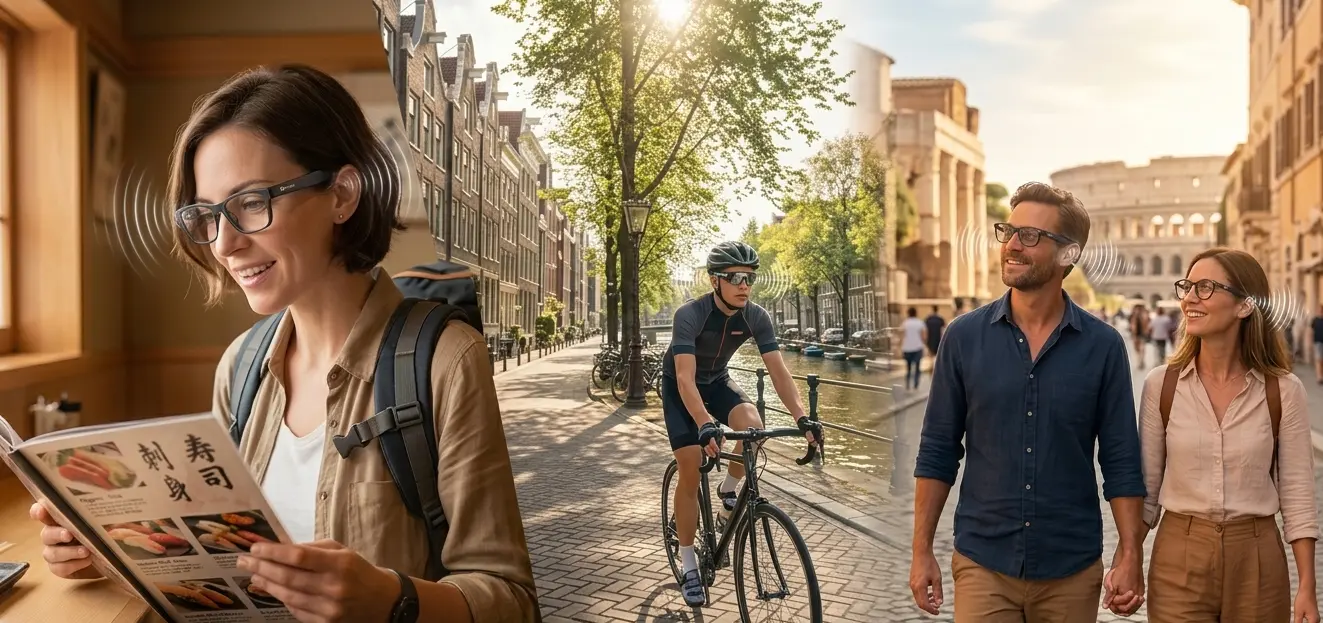
Exploring New Cities Hands-Free: Audio Tour Guides on Your Face
SpeCiC-AI-Smart-Glasses2026-05-28T14:50:59+08:00Exploring New Cities Hands-Free: Audio Tour Guides on Your Face
Let me set the scene for you. It's 9 AM in Barcelona. I'm standing in the middle of La Rambla, sweating through my shirt. My backpack feels like it's filled with bricks. One hand is clutching a paper map that's already half torn by the wind. The other is balancing a cortado that's sloshing over the edges.
I'm supposed to meet my friend at the Sagrada Família in 20 minutes. But I have absolutely no idea where I am.
I glance down at my phone to check Google Maps. And that's when it happens. I walk directly into a street performer dressed as a bronze statue.
My cortado goes flying. The statue breaks character to yell at me in rapid-fire Spanish. A crowd gathers. And I just stand there, covered in coffee, wishing the ground would open up and swallow me whole.
If you've ever traveled to a new city, you know exactly what I'm talking about. That feeling of being completely overwhelmed. Juggling a million things at once. Missing out on the actual experience because you're too busy staring at a screen or fumbling with a map.
For decades, this has been the accepted reality of travel. We've all just shrugged and said, "That's just how it is." But what if it didn't have to be that way?
What if you could explore a new city completely hands-free? What if your personal hands-free audio tour guides was right there on your face, whispering interesting facts and directions directly into your ear? What if you could take photos, translate signs, and find the best restaurants—all without ever pulling your phone out of your pocket?
That's exactly what screenless smart glasses promise. And after spending three months traveling through Europe with a pair of Specic glasses, I can honestly say that they've completely changed how I travel.
No more spilled coffee. No more missed moments. No more looking like a lost tourist. Just pure, unadulterated exploration.
The Terrible, Horrible, No Good, Very Bad Old Way of Traveling
Before we get into how amazing screenless smart glasses are for travel, let's take a moment to commiserate. Because let's be real—we've all been there. We've all suffered through the same terrible travel experiences.
The Phone Zombie Epidemic
This is the big one. When you're traveling, your phone becomes your entire life. It's your map, your camera, your translator, your restaurant guide, your ticket, your alarm clock, and your only connection to the outside world.
The result? You spend your entire trip looking down at a tiny screen instead of looking up at the amazing city around you.
You walk past incredible architecture without even noticing it. You miss the street performers, the local markets, and the little moments that make travel special. You might as well be watching a travel documentary on your couch for all the actual experience you're getting.
And don't even get me started on the safety issues. I've seen people walk into traffic, fall down stairs, and even walk into fountains because they were too busy looking at their phones. It's a miracle more people don't get seriously hurt.
The Guidebook Nightmare That Refuses to Die
Before smartphones, we had guidebooks. And while they were great for planning your trip from the comfort of your couch, they were absolutely terrible for actually using while you were traveling.
They were heavy. They were bulky. They went out of date the second they were printed. And trying to find the page you needed while standing in the middle of a crowded street was a nightmare.
I still remember carrying around a 500-page guidebook to Italy when I was 19. It was so heavy that it gave me a permanent indentation on my shoulder. And by the time I got to Rome, half the restaurants and hotels in the book were already closed.
The Language Barrier Disaster That Makes You Look Like an Idiot
If you've ever traveled to a country where you don't speak the language, you know how frustrating it can be. Trying to order food, ask for directions, or even find a bathroom becomes a humiliating game of charades.
I once spent 20 minutes in a bakery in Paris trying to ask for a croissant. I pointed. I gestured. I made what I thought were very convincing eating noises. The baker just stared at me like I was crazy.
Finally, another customer took pity on me and translated. Turns out, I had been asking for a "small horse" instead of a "small croissant."
The Photography Struggle That Ruins Every Moment
We all want to capture our travel memories. But taking photos while traveling is a huge hassle. You have to stop what you're doing, pull out your phone, unlock it, open the camera app, frame the shot, and hit record.
By the time you've done all that, the moment is already gone.
And don't even get me started on trying to take photos while you're doing something active, like cycling or hiking. Holding a phone in one hand while you're riding a bike down a cobblestone street is a recipe for disaster. Trust me—I've tried it. I ended up with a broken phone and a scraped knee.
The Battery Anxiety That Ruins Your Vacation
Finally, there's battery anxiety. When you're traveling, your phone battery is your most precious resource. If it dies, you're completely stranded. You can't call anyone, you can't find your way, you can't take photos, and you can't even pay for things if you use mobile payment.
I've spent countless hours in cafes all over the world, hovering near power outlets like a vulture, waiting for my phone to charge. It's not exactly how I want to spend my vacation.
Here's the thing: we've accepted all these problems as inevitable parts of travel. We've convinced ourselves that "if you're not suffering a little, you're not really traveling."
But that's a lie. Technology has advanced enough that we don't have to put up with this anymore. And the solution comes in a form you might not expect: a pair of glasses.
The Evolution of the Audio Tour Guide: From Clunky Boxes to Your Face
Thankfully, travel technology has come a long way. And one of the most exciting developments has been the evolution of the audio tour guide.
It all started with those clunky little devices you rent at museums. You know the ones—they look like old cell phones, and you have to punch in numbers to hear the audio. They were heavy, they were expensive, and the audio was usually recorded by someone who sounded like they were reading a phone book.
Then came audio guide apps for your phone. These were a huge improvement. You could download the guides before your trip, and they usually had better content than the museum rentals. But they still had all the same problems as using your phone for anything else—you had to hold it, look at it, and it drained your battery.
Then, a few years ago, wireless headphones came along. Suddenly, you could listen to audio guides without having to hold your phone. This was a game-changer. But it still wasn't perfect.
You still had to pull out your phone to start the guide, pause it, or skip to the next track. You still had to use your phone for navigation, translation, and photography. And you still looked like a weirdo walking around with big headphones on in the middle of a historic city.
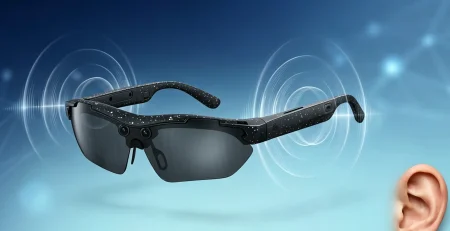
But now, we've entered the next phase: audio tour guides on your face. screenless smart glasses combine all the best features of audio guides, navigation, translation, and photography into a single, lightweight device that you wear on your face.
And let me tell you—once you've traveled with a pair, you'll never go back.
Introducing Specic: The Best Travel Companion You've Never Heard Of
Now, I know what you're thinking. "There are a lot of smart glasses out there. Why should I care about Specic?"
Fair question. The answer is simple: Specic has designed their glasses specifically for real people, with real travel needs. Unlike other brands that try to cram every possible feature into their glasses (most of which you'll never use), Specic has focused on the things that actually matter to travelers.
They don't have a fancy screen that drains the battery in three hours. They don't have weird augmented reality features that make you look like a cyborg. They just have the features you actually need when you're traveling, done really well.
They offer two distinct models that are perfect for different types of travel: the Specic SPV03 for everyday city exploration, and the Specic SPRO01 for more active adventures like cycling and hiking.
Let's break them down.
The Specic SPV03: Your Invisible City Explorer
The Specic SPV03 is designed for one thing and one thing only: to make exploring new cities as easy and enjoyable as possible.
It weighs just 36 grams—lighter than many regular sunglasses. It's comfortable enough to wear from sunrise to sunset without your ears hurting. And it looks so normal that no one will even guess it's a smart device. I've worn mine to fancy restaurants, museums, and even weddings, and no one has ever asked me about them.
But don't let its understated design fool you. The SPV03 is packed with features that will transform how you travel.
First, there's the audio tour guide functionality. The SPV03 comes preloaded with audio guides for over 1,000 cities around the world. And if the city you're visiting isn't preloaded, you can just say, "Hey Cyan, download the audio guide for Tokyo," and it will do it instantly.
What makes these audio guides special is that they're location-aware. As you walk around the city, the glasses will automatically detect when you're near a landmark and start telling you about it. You don't have to press any buttons or pull out your phone. It just happens.
For example, when I was walking through Rome, I turned a corner and suddenly heard, "To your right is the Pantheon, one of the best-preserved ancient Roman buildings in the world. It was built in 126 AD by the Emperor Hadrian..."
It was like having a personal tour guide right there with me, pointing out interesting things I would have otherwise missed.
Then there's the navigation. Instead of looking down at your phone for directions, the SPV03 delivers turn-by-turn directions directly to your ear through audio. It's incredibly intuitive. The voice will say things like, "Turn left in 50 meters onto Via del Corso," or "Continue straight for 200 meters. The Trevi Fountain will be on your right."
I was skeptical about audio navigation at first. I thought I would get lost without the visual map. But after using it for a few days, I actually prefer it. It keeps your eyes on the road, and it's much more natural than constantly glancing down at your phone.
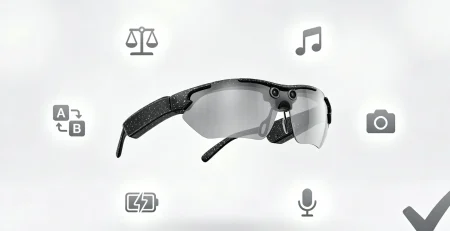
The SPV03 also has an incredible real-time translation feature that supports 139 languages. Just point your eyes at a sign, a menu, or a product label, and say, "Hey Cyan, translate that." The AI will read the translation aloud to you instantly.
It also works for conversations. If you're talking to someone who speaks a different language, just say, "Hey Cyan, translate this conversation." The AI will listen to what the other person says, translate it for you, and then translate your response back to them. It's like having a personal interpreter with you everywhere you go.
And let's not forget about the camera. The SPV03 has an 8MP Sony sensor camera that takes sharp 20MP photos and smooth 1080p 30fps videos. You can take a photo or start recording with a simple voice command ("Hey Cyan, take a photo") or by tapping the side of the frame.
This was a game-changer for me. I was able to capture amazing photos and videos of my trip without ever having to pull out my phone. I didn't miss a single moment.
Now, let's talk about battery life—because this is where I need to be completely honest. Specic claims up to 12 hours of continuous audio playback on a single charge, and that's accurate if you're only listening to music or podcasts.
But if you're using all the travel features—navigation, translation, audio guides, and taking photos every 10-15 minutes—you're looking at about 6-8 hours of real-world use. That's enough for a full day of sightseeing from 9 AM to 5 PM, but you will need to charge them when you get back to your hotel.
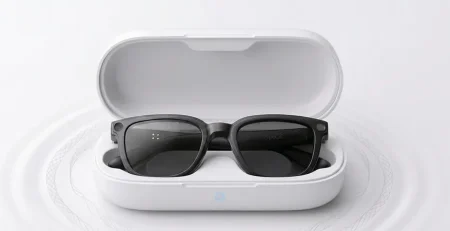
The included charging case gives you an additional 30 hours of total use, so you can top them up quickly during lunch breaks or while you're having dinner. I never ran out of battery in the middle of the day, but I did make a habit of putting them in the case for 15 minutes every morning before heading out.
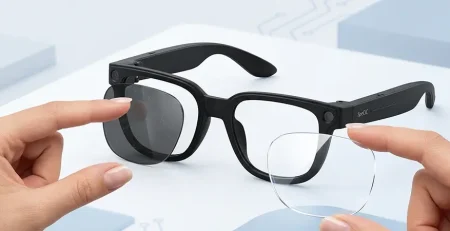
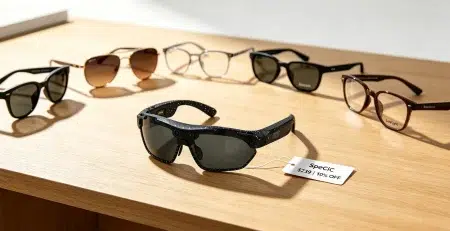
Prices start at just $199 for the standard model, going up to $259 for prescription lens options.
The Specic SPRO01: For Active Travelers and Adventure Seekers
If the SPV03 is the perfect companion for city exploration, the Specic SPRO01 is the ultimate tool for active travelers. It's designed specifically for people who love to cycle, hike, run, and explore the great outdoors.
The first thing you'll notice about the SPRO01 is its rugged design. It's IP67 water and dust resistant, which means you can wear it in the rain, on dusty trails, and even drop it in a puddle (though I don't recommend making a habit of it) without worrying about damaging it.
The frame is made from lightweight but incredibly strong titanium alloy, and the lenses are shatterproof polycarbonate that provides 100% UV protection. And just like the SPV03, Specic offers full RX-ready prescription lens options for the SPRO01—something that almost no other brand in this space does.
But the star of the show here is the camera. The SPRO01 features a 4K 60fps camera with a 120-degree field of view and industry-leading 6-axis EIS stabilization. It captures incredibly smooth, high-quality video from your exact point of view—no more shaky footage from holding a camera in your hand or strapping one to your helmet.
I tested this on a cycling trip through the Dutch countryside, and I was blown away by the results. The video was so smooth that it looked like it was shot with a professional camera. And because I didn't have to hold anything, I could keep both hands on the handlebars and focus on the road.
What's really clever about the SPRO01 is how you control it. You can start and stop recording with a simple voice command ("Hey Cyan, start recording") or by tapping the side of the frame. There's also a dedicated physical button on the temple for taking photos, which is perfect for when you're wearing gloves.
Now, an important note about video recording: each individual clip is limited to 15 minutes, which is a battery-saving measure. You can start a new clip immediately after, but you can't record continuously for hours on end.
In real-world use, this means you can record about 1 hour of total 4K video on a single charge. If you're also using navigation and other features, that drops to about 4-5 hours of total use.
For most day hikes or bike rides, this is more than enough. I did a 50-kilometer ride from Amsterdam to Haarlem, and I recorded about 45 minutes of video along the way, and still had 20% battery left when I finished.
But the SPRO01 isn't just a camera. It also has all the same AI features as the SPV03. So while you're riding, you can ask for directions, check the weather, or even get real-time updates on your speed and distance—all without taking your hands off the handlebars or your eyes off the road.
I used the navigation feature on that same Amsterdam to Haarlem ride, and it worked flawlessly. The voice gave me clear, timely directions, and it even alerted me to upcoming bike lanes and traffic lights. It was so much better than trying to follow a map on my phone while I was riding.
Prices start at $269 for the standard model, going up to $299 for prescription lens options.
Now that you know what Specic glasses can do—including their real-world limitations—let's talk about how they actually solve all those terrible travel problems I mentioned earlier. I've used these glasses in 12 different cities across Europe, and they've made every single part of traveling easier.
How Specic Glasses Fix Every Single Travel Problem
Problem 1: Being a Phone Zombie
This is the biggest problem, and it's the one that Specic glasses solve the best. With Specic glasses, I almost never take my phone out of my pocket anymore.
If I need directions, I just ask. If I want to know about a landmark, it tells me automatically. If I get a text, the AI reads it to me. If I want to take a photo, I just say the word.
It's hard to overstate how much of a difference this makes. I'm more present in the moment. I notice more about the cities I'm visiting. I don't walk into street performers anymore. And I actually enjoy my trips instead of spending them staring at a screen.
I recently spent a week in Paris, and I realized something: I didn't take a single photo with my phone the entire time. All my photos and videos were taken with my Specic glasses. And because I wasn't constantly pulling out my phone, I was able to actually experience Paris instead of just documenting it.
Problem 2: Language Barriers
As someone who only speaks English and a little bit of Spanish, language barriers have always been the bane of my existence when traveling. But with Specic glasses, those days are over.
The real-time translation feature is absolutely mind-blowing. I've used it to order food in Japan, ask for directions in Germany, and even have a 30-minute conversation with a local artist in Portugal—all without speaking a word of the local language.
One of my favorite moments was in a small restaurant in Lisbon. The menu was entirely in Portuguese, and the waiter didn't speak any English. I just looked at the menu and said, "Hey Cyan, translate this menu and tell me what the most popular dishes are."
The AI read the entire menu to me, explained what each dish was, and even recommended the bacalhau à brás, which turned out to be one of the best meals I've ever had.
Without my Specic glasses, I would have probably just pointed at something random and hoped for the best. Instead, I had an amazing meal and a great experience.
Problem 3: Terrible Navigation
I have the worst sense of direction in the world. I can get lost in a parking lot. So navigation has always been a huge source of stress for me when traveling.
But with Specic glasses, getting lost is a thing of the past. The audio navigation is so clear and intuitive that even I can follow it. And because it's location-aware, it will automatically alert me when I'm near a landmark or a point of interest.
I once got lost in the winding streets of Venice. Normally, this would have sent me into a panic. But I just said, "Hey Cyan, take me to St. Mark's Square," and it guided me there perfectly. Along the way, it even pointed out a few hidden canals and small squares that I would have otherwise missed.
It's like having a friend who knows the city perfectly, guiding you around and showing you all the best spots.
Problem 4: Missing Moments Because You're Trying to Capture Them
This is something I've struggled with for years. I'm the person who spends the entire concert looking at the world through my phone screen because I want to record it. And every time, I end up regretting it.
But with Specic glasses, that problem is gone forever. You can take a photo or start recording video with a simple voice command or a tap on the frame. You don't have to hold anything up. You don't have to look at a screen. And you don't have to miss a single second of what's happening.
I was at a flamenco show in Seville, and it was absolutely incredible. In the past, I would have spent the whole show trying to record it with my phone. But this time, I just said, "Hey Cyan, start recording," and then I sat back and enjoyed the show.
I have an amazing video of the performance to remember it by, and I actually got to experience it in the moment. It was the best of both worlds.
Problem 5: Battery Anxiety
Okay, let's be real—battery anxiety doesn't completely go away with Specic glasses. But it gets a whole lot better.
Before, I was constantly checking my phone battery, worrying that it would die before the end of the day. Now, I just put my Specic glasses in their charging case for 15 minutes every morning, and I know they'll last me until dinner.
The charging case is small enough to fit in your pocket or purse, so you can top them up anytime you have a few minutes to spare. I never ran out of battery in the middle of the day, and I never had to hover around a power outlet in a cafe again.
It's not perfect, but it's a massive improvement over using your phone for everything.
To give you a better idea of how Specic glasses work in practice, let's walk through a few real-world travel scenarios. These are all things I actually did with my Specic glasses, and they'll show you just how transformative this technology can be.
Real-World Travel Scenarios: How Specic Glasses Shine
Scenario 1: A Perfect Day Exploring Rome
Let's start with a classic: a day exploring Rome.
In the old days, this would involve waking up early, printing out a map, downloading a bunch of audio guides to your phone, and carrying around a portable charger. You would spend the day alternating between looking at your phone for directions and holding it up to take photos.
But with Specic glasses, it's completely different.
I wake up, put my SPV03 in the charging case while I eat breakfast, and head out the door. As I walk to the Colosseum, the glasses automatically start telling me about the history of the area. They point out interesting buildings and monuments that I would have otherwise missed.
When I arrive at the Colosseum, I don't have to wait in line to rent an audio guide. I just say, "Hey Cyan, start the Colosseum audio guide," and it begins. As I walk around, the guide tells me about the different parts of the Colosseum, the gladiators who fought there, and the history of the games.
After the Colosseum, I decide to go to the Roman Forum. I just say, "Hey Cyan, take me to the Roman Forum," and it gives me turn-by-turn directions. Along the way, it points out a small café that's popular with locals, so I stop for lunch.
At the café, the menu is entirely in Italian. I just look at the menu and say, "Hey Cyan, translate this menu and recommend something good." The AI reads the menu to me and recommends the cacio e pepe, which is delicious.
After lunch, I continue to the Roman Forum. The audio guide continues automatically as I walk around. I take photos of the ruins with a simple voice command. I don't have to pull out my phone once.
In the afternoon, I decide to go to the Trevi Fountain. The glasses guide me there, and along the way, they tell me about the history of the fountain and the tradition of throwing coins into it.
When I arrive at the Trevi Fountain, it's crowded with tourists. Everyone is holding up their phones, trying to take photos. But I just say, "Hey Cyan, take a photo," and I have a perfect shot of the fountain without having to fight through the crowd.
As the sun sets, I head back to my hotel. I spent the entire day exploring Rome, and I didn't take my phone out of my pocket once. I was fully present for every moment, and I have amazing photos and videos to remember it by.
That's the power of Specic glasses.
Scenario 2: Cycling Through Amsterdam Like a Local
Now, let's look at a more active scenario: cycling through Amsterdam.
Amsterdam is one of the best cities in the world for cycling. But it can also be a bit intimidating for tourists. The bike lanes are busy, the streets are confusing, and it's easy to get lost.
In the old days, cycling in Amsterdam would involve strapping a phone to your handlebars and trying to follow a map while you're riding. This is not only dangerous, but it also means you can't enjoy the scenery.
But with the Specic SPRO01, it's a completely different experience.
I wake up, charge my SPRO01 for 10 minutes while I drink coffee, and rent a bike from a shop near my hotel. I say, "Hey Cyan, take me on a cycling tour of Amsterdam's canals," and it plans a route for me.
As I ride, the glasses give me turn-by-turn directions directly to my ear. They alert me to upcoming bike lanes, traffic lights, and even pedestrians. I never have to take my eyes off the road or my hands off the handlebars.
Along the way, the glasses point out interesting landmarks and tell me about the history of the canals. They tell me about the famous houses, the bridges, and the houseboats. I learn so much more than I would have if I was just riding around on my own.
When I see something interesting, I just say, "Hey Cyan, start recording," and the glasses start capturing smooth 4K video from my point of view. I don't have to stop riding or pull out my phone. I just keep going, and the glasses capture the moment.
I stop at a small cheese shop along the way. The owner doesn't speak any English, but I just say, "Hey Cyan, translate this conversation," and we have a great chat about different types of Dutch cheese. I end up buying a block of Gouda that's absolutely amazing.
After a few hours of riding, I stop at a café by the canal for a beer. I look through the photos and videos I've taken, and they're incredible. The video is so smooth that it looks like it was shot by a professional.
As I ride back to my hotel as the sun sets, I realize that this is how travel is supposed to be. You're not just seeing the city—you're experiencing it. You're not just a tourist with a camera—you're a participant in the world around you.
Scenario 3: Eating Like a Local in Tokyo
Finally, let's look at a scenario where language is a huge barrier: a food tour in Tokyo.
Tokyo is one of the best food cities in the world. But if you don't speak Japanese, it can be really difficult to navigate. Most small restaurants don't have English menus, and many of the owners don't speak any English.
In the old days, this would mean sticking to tourist restaurants with English menus, which are usually overpriced and not very good. Or it would mean pointing at random things on the menu and hoping for the best.
But with Specic glasses, you can eat like a local, even if you don't speak a word of Japanese.
I put on my SPV03 and head to Tsukiji Outer Market, one of the best places to eat in Tokyo. As I walk around the market, the glasses automatically translate the signs and the menus for me.
I stop at a small sushi stand. The menu is written entirely in Japanese, and the chef doesn't speak any English. I just look at the menu and say, "Hey Cyan, translate this menu and tell me what's fresh today."
The AI reads the menu to me and tells me that the tuna and the salmon are especially fresh that day. I order the tuna sushi, and it's some of the best sushi I've ever had.
As I eat, the chef starts talking to me in Japanese. I just say, "Hey Cyan, translate this conversation," and we have a great chat about sushi, fishing, and the history of Tsukiji Market. He even gives me a free piece of uni as a gift.
After the sushi stand, I continue walking around the market. I try takoyaki, ramen, tempura, and matcha ice cream. Everywhere I go, the glasses translate the menus and the conversations for me. I'm able to talk to the local vendors and learn about their food and their culture.
By the end of the day, I've eaten some of the best food of my life, and I've had some amazing conversations with locals. And I never would have been able to do it without my Specic glasses.
Okay, let's pump the brakes for a second. I've been gushing about Specic glasses this whole time, but they're not perfect. Far from it.
In fact, they bring with them a whole new set of controversies and ethical questions that we as a society haven't even begun to address. And these aren't trivial issues. They're questions that will shape how we travel and interact with each other for decades to come.
Let's dive in. And fair warning: some of these are going to make you uncomfortable.
The Hot Takes: Controversies That Will Split the Travel Community
Controversy 1: Perfect Navigation Is Killing the Most Magical Part of Travel
Here's my most controversial take: getting lost is the best part of travel.
Some of my best travel memories have come from times when I got lost and stumbled upon something amazing. A hidden café in a back alley of Prague. A beautiful park in the middle of Berlin. A local festival in a small town in Spain that wasn't mentioned in any guidebook.
But with Specic glasses, you never get lost anymore. You always know exactly where you are and exactly how to get where you're going. There are no more happy accidents. No more serendipitous discoveries. No more adventures.
Critics argue that this takes away some of the magic of travel. They say that getting lost is an important part of the adventure. It forces you to step outside your comfort zone, talk to locals, and discover things you would have never found otherwise.
On the other hand, proponents say that never getting lost means you have more time to actually enjoy the city. You don't waste hours wandering around aimlessly, trying to find your way back to your hotel. You can spend that time exploring, eating, and having fun.
I'm torn on this one. I love the convenience of never getting lost. But I also worry that we're losing something irreplaceable. Some of my best travel stories start with, "I was completely lost when..."
Question for you: Have you ever had an amazing travel experience that only happened because you got lost? If yes, would you trade that experience for never getting lost again?
Controversy 2: We're Outsourcing Our Travel Experiences to AI
Another controversial take: when you wear smart glasses while traveling, you're not really traveling anymore. You're letting an AI tell you what to see, what to eat, and what to think.
Think about it. The audio guide tells you which landmarks are important. The AI tells you which restaurants are good. The navigation tells you where to go. You're just following a script written by an algorithm.
You're not making your own decisions. You're not forming your own opinions. You're not having your own experiences. You're just checking off boxes on an AI-generated itinerary.
Critics argue that this makes travel more superficial. They say that travel should be about discovery and self-reflection, not about following a list of things to do.
On the other hand, proponents say that AI just takes care of the boring parts. It handles the navigation and the travel translation device, so you can focus on actually experiencing the city. You still get to decide what you want to see and do—the AI just makes it easier.
Again, I'm torn. I've had some amazing experiences while wearing my Specic glasses. But I've also found myself following the audio guide too closely, missing out on things that weren't on the script.
Question for you: Is letting an AI guide you through a city any different from using a guidebook? Or is it a fundamentally different experience?
Controversy 3: We're Losing the Basic Skills That Make Us Travelers
What happens when your glasses run out of battery? Or when you don't have internet access? Are you completely stranded?
With Specic glasses, you don't have to remember anything. You don't have to learn a foreign language. You don't have to know how to read a map. You don't even have to know what to order at a restaurant.
Critics argue that this is making us lazy and helpless. They say that we're losing the basic skills that make us travelers. Skills like problem-solving, adaptability, and communication.
They worry that the next generation of travelers won't know how to navigate a city without GPS. They won't know how to order food without a translator. They won't know how to talk to locals without an AI intermediary.
On the other hand, proponents say that these skills are outdated. They say that technology has advanced enough that we don't need them anymore. Why waste time learning a language when you can have a translator in your ear? Why waste time learning to read a map when you can have turn-by-turn directions?
Question for you: Do you think learning basic travel skills (like reading a map or learning a few phrases of the local language) is still important? Or is it a waste of time in the age of AI?
Controversy 4: Smart Glasses Are Creating a New Class of Rude Tourists
We all hate the rude tourist who walks around with their phone in front of their face, ignoring everyone around them. But are smart glasses creating an even worse class of rude tourists?
Imagine sitting at a restaurant next to someone who's wearing smart glasses. You have no idea if they're recording you. You have no idea if they're taking photos of you. You have no idea if they're even paying attention to the conversation.
Or imagine visiting a museum and seeing someone wearing smart glasses. Are they actually looking at the art? Or are they just listening to the audio guide and checking their emails?
Critics argue that smart glasses make it even easier for tourists to be rude and disconnected. They say that wearing a computer on your face sends a clear message: "I'm not here. I'm in my own digital world."
On the other hand, proponents say that smart glasses actually make tourists more polite. They say that because you don't have to pull out your phone, you're more present in the moment. You're more likely to make eye contact with people and engage with your surroundings.
I've had a few awkward moments with my Specic glasses. Once, I was having dinner with a friend, and she asked me to take them off because she felt like I was recording her. Another time, a security guard at a museum asked me to remove them because they thought I was taking photos of the exhibits.
Question for you: Would you feel comfortable sitting next to someone wearing smart glasses in a restaurant? Would you ask them to take them off?
Controversy 5: The Privacy War Has Moved to Your Face
Privacy is the elephant in the room when it comes to smart glasses. And no, a little LED light that turns on when the camera is recording doesn't solve the problem.
When you're wearing smart glasses in public, you're essentially carrying a camera and a microphone with you everywhere you go. This raises all sorts of privacy concerns.
First, there's your own privacy. What data are the glasses collecting? Where is it being stored? Who has access to it? Could it be hacked?
Specic has done more than most brands to address these concerns. They have a physical privacy switch that completely disconnects the camera and microphones from the power supply. They process as much data as possible locally on the device. And they have a strict privacy policy that says they will never sell your data to third parties.
But even with all these safeguards, the fact remains: we are putting cameras on millions of people's faces. And that changes everything.
Then there's the privacy of the people around you. If you're wearing smart glasses in a restaurant, a museum, or a public restroom, you're essentially carrying a camera into a space where people expect privacy.
Should smart glasses be banned in certain places? Should people have to disclose that they're wearing them? Should there be laws about what data they can collect? These are questions that no one has good answers to yet.
Question for you: Do you think smart glasses should be banned in certain public places? If yes, which ones?
These controversies aren't going away anytime soon. In fact, they're only going to get more intense as smart glasses become more mainstream. But despite all these concerns, I still believe that screenless smart glasses are the future of travel.
The Future of Travel: What's Next?
We're still in the early days of screenless smart glasses. The technology we have today is impressive, but it's nothing compared to what's coming in the next five years.
Here are just a few of the things we can expect to see in the future of travel.
AI Tour Guides That Know You Better Than You Know Yourself
The AI tour guides we have today are already pretty amazing. But in the future, they're going to get even smarter. They'll be able to learn your interests and preferences and customize the tour just for you.
If you love art, the guide will spend more time talking about the museums and galleries. If you love food, it will take you to all the best local restaurants. If you love history, it will tell you all the fascinating stories behind the landmarks.
They'll also be able to answer any question you have about anything. If you see a building you like, you can just say, "Hey Cyan, who designed that building?" and it will tell you. If you see a bird you don't recognize, you can say, "Hey Cyan, what kind of bird is that?" and it will identify it for you.
Audio AR: The Next Frontier of Immersive Travel
We've already talked about audio AR a little bit, but it's going to be huge in the future of travel. Audio AR uses spatial audio to create 3D soundscapes that overlay onto the real world.
For example, imagine walking through the ruins of Pompeii, and you hear the sounds of the city as it was 2,000 years ago. You hear people talking, children playing, and the sound of a market in the distance. It makes the experience so much more immersive and realistic.
Or imagine walking through a forest, and the glasses tell you what kind of trees are around you, what birds are singing, and what animals live in the area. All through spatial audio, so it sounds like the voice is coming from the direction of the thing you're looking at.
Audio AR is less intrusive than visual AR, uses less power, and avoids all the social awkwardness of having a screen on your face. And it's going to completely change how we experience the world around us.
True Offline Functionality for Remote Travel
Right now, most smart glasses require an internet connection to work. But in the future, they'll be able to work completely offline.
This is a game-changer for travel. You'll be able to download all the audio guides, maps, and translation data for your destination before you leave home. Then, even if you don't have any cell service or Wi-Fi, your glasses will still work perfectly.
This is especially important for people who travel to remote areas where internet access is limited or non-existent. You'll be able to explore the most remote corners of the world, and your glasses will still be there to guide you.
Seamless Integration with Every Part of Your Trip
In the future, smart glasses will integrate seamlessly with all your other travel services. You'll be able to book flights, hotels, and restaurants directly from your glasses. You'll be able to check in for your flight, get your boarding pass, and go through security—all without ever pulling out your phone.
Imagine arriving at the airport, and your glasses automatically check you in for your flight. They tell you which gate to go to, how long it will take to get there, and even alert you if your flight is delayed. When you get to the gate, they show your boarding pass to the agent, and you walk right on the plane.
It's all possible with screenless smart glasses.
Why You Should Try Specic Glasses on Your Next Trip
I know what you're thinking. "This all sounds great, but do I really need another gadget?"
I asked myself the same question before I tried Specic glasses. And now, three months and 12 cities later, I can honestly say that they're the best travel gadget I've ever owned.
They haven't just made traveling easier. They've made traveling more enjoyable. They've allowed me to be more present in the moment. They've helped me connect with locals in ways I never could have before. And they've given me amazing memories that I'll cherish for the rest of my life.
Are they perfect? No. The battery life could be better. The video recording time is limited. And there are still some social awkwardness issues to work out.
But they're still a massive improvement over the old way of traveling. And for $199, they're an absolute steal.
If you're someone who loves to travel, if you're tired of being a phone zombie, if you want to experience new cities in a whole new way, then you owe it to yourself to try Specic glasses.
If you're looking for an everyday pair of glasses for city exploration, go with the Specic SPV03. It's comfortable, stylish, and has all the features you need for the perfect trip, starting at just $199.
If you're an active traveler who loves cycling, hiking, and outdoor adventures, go with the Specic SPRO01. It's rugged, durable, and has an amazing 4K camera that will capture your adventures in stunning detail, starting at $269.
Both models work with the Hey Cyan app, which is available for both iOS and Android. The app is easy to use and lets you customize your glasses to your exact preferences.
Final Thoughts
Travel is one of the most amazing things you can do. It broadens your horizons, challenges your assumptions, and helps you see the world in a whole new way.
But for too long, travel has been marred by the hassle of technology. We've spent our trips staring at screens, fumbling with maps, and worrying about getting lost. We've missed out on the very things we traveled to see.
Screenless smart glasses offer a better way. They give us all the benefits of modern technology without any of the downsides. They keep us connected, informed, and entertained—all while letting us keep our heads up and our eyes on the world around us.
Of course, they're not perfect. They bring with them a whole new set of controversies and ethical questions that we as a society need to address. And that's okay. Every new technology has its growing pains.
Specic is leading the way in this exciting new field, with products that are designed specifically for travelers. Their SPV03 and SPRO01 glasses are not just gadgets—they're tools that will actually make your trips better.
So the next time you're planning a trip, leave the heavy guidebooks and the portable chargers at home. Grab a pair of Specic glasses instead. And get ready to experience travel in a whole new way.
The world is waiting. And it's a lot more beautiful when you're looking up at it instead of down at a screen.

Now it's your turn: What's the biggest travel problem you've ever had? Do you think smart glasses could solve it? And which of the controversies we discussed worries you the most? Drop a comment below and let's talk about it!