

Can Smart Glasses Be Repaired If the Internal Sensor Breaks?
SpeCiC-AI-Smart-Glasses2026-04-24T21:28:16+08:00Can Smart Glasses Be Repaired If the Internal Sensor Breaks?
Let’s cut straight to the dumbest, most frustrating thing that happened to my best friend Jake last month—and, if you own smart glasses, it’s probably happened to you too, or will soon.
Jake dropped his Ray-Ban Meta glasses on a smooth, carpeted sidewalk. No scratches on the lenses, no cracks in the frames, no bent temples—they looked *perfect*. But the tiny proximity sensor died. Every time he put them on, the music wouldn’t play. Every time he took them off, the music wouldn’t pause. He called Meta support, waited 47 minutes on hold (listening to that terrible elevator music remix of “Uptown Funk”), and the representative said something that made me want to throw my own glasses across the room:
“We don’t repair individual components. We can offer you a full replacement for $149.”
$149. For a $299 pair of glasses. That’s like taking your car to the mechanic because a windshield wiper blade snapped, and they tell you they don’t sell blades—you have to buy a whole new Honda Civic.
Most smart glasses brands *intentionally* design their products to be unrepairable. It’s not a mistake, it’s a business strategy called “planned obsolescence by design.”
If you’re reading this, you’ve probably had this exact panic. You’re walking down the street, you trip over a curb, your glasses fly off, and your first thought isn’t “Are my lenses okay?” It’s “Did I just break a $200+ piece of tech that no one will fix?” And if you haven’t had this panic yet, trust me—you will. Smart glasses aren’t just “glasses with speakers.” They’re tiny, fragile computers strapped to your face, packed with delicate sensors that can break from a single drop, a little sweat, or even just normal wear and tear. This is why smart glasses sensor repair has become one of the most asked questions in the wearable tech community.
In this 4,000+ word deep dive, we’re going to answer the question no smart glasses brand wants you to ask—*and* we’re going to do it without boring jargon, without paid sponsorships, and without lying to you.
First, we’ll demystify what sensors are actually inside your glasses, what they do, and how to tell if they’re broken. Then, we’ll break down exactly how different brands handle repairs—including SpeCiC, Ray-Ban Meta, XReal, Amazon Echo Frames, and Bose Frames—with no-BS, brand-specific solutions for every common failure. We’ll teach you which repairs you can do yourself (and which you absolutely shouldn’t), and we’ll throw in a few more controversial takes that will make you rethink everything about buying smart glasses.
Have you ever had a smart glasses sensor break? Drop a 🔥 in the comments if yes, a ❄️ if no, and a 🤔 if you’re not sure (we’ve all had weird, unexplained tech glitches).
First: What Sensors Are Actually In Your Smart Glasses? (No Jargon, Promise)
Before we talk about repairs, let’s take a quick peek inside those frames. Most people think smart glasses are just “glasses with a Bluetooth chip,” but they’re actually packed with 5-10 tiny, delicate sensors that make all the “smart” features work. And every single one of them can break.
Let’s go through the 6 most common sensors, what they do, and the *exact* symptoms to look for if they’re broken:
1. Dual ENC Microphones
These are the workhorses of any smart glasses. They handle phone calls, voice commands (like “Hey Cyan” for SpeCiC or “Hey Meta” for Ray-Ban Meta), and video audio. Most brands use two microphones (one on each temple) with environmental noise cancellation (ENC) to block out background noise—like traffic, a barking dog, or your roommate’s terrible TikTok dance videos.
- Common failure symptoms: - Your voice assistant never responds, even when you yell at it - People on calls say you sound muffled, like you’re underwater, or like you’re talking through a pillow - Video recordings have no audio, static, or only background noise - The AI translation feature (if your glasses have it) stops working entirely
- Why they break: Sweat and dust are the #1 enemies of microphones. The tiny holes on the temples get clogged with sweat, makeup, or dirt, which blocks sound from reaching the internal mic diaphragm. A hard drop can also knock the mic loose from the motherboard or damage the delicate wiring.
2. 8MP Camera Sensor
The camera is one of the most popular features on modern smart glasses. SpeCiC uses an 8MP Sony-grade sensor that takes sharp 20MP photos and smooth 1080P 30fps videos, while other brands use similar sensors from Samsung or OmniVision. It’s perfect for vlogging, travel, or capturing that perfect dog sneeze without fumbling for your phone.
- Common failure symptoms: - The camera app shows a black screen, no matter what you do - Photos are blurry, have vertical/horizontal lines, or are discolored (like everything has a green or purple tint) - The camera won’t focus, even on close-up objects - Video recording crashes immediately after you hit “record”
- Why they break: Dropping the glasses face-down is the most common cause—even a small drop onto a soft surface can crack the sensor’s glass cover or knock it out of alignment. Dust or moisture getting inside the camera module can also cause permanent damage.
3. Proximity Sensor
This tiny, invisible sensor is usually located on the inside of the frame, right above your nose. It detects when you’re wearing the glasses and when you’re not. It automatically pauses music when you take them off and resumes it when you put them back on. It also prevents accidental button presses when the glasses are in your pocket or bag.
- Common failure symptoms: - Music doesn’t pause when you take off the glasses - Music keeps pausing randomly while you’re wearing them, even if you don’t touch them - The glasses won’t turn on unless you hold the power button down for 10+ seconds
- Why they break: A hard drop can knock it loose from the motherboard, or sweat can seep into the sensor and corrode the tiny metal contacts.
4. 6-Axis IMU (Accelerometer + Gyroscope)
This tiny chip is soldered directly to the motherboard. It tracks your head movement in 3D space. It’s used for features like auto-rotate (on AR glasses), gesture control (like nodding to answer a call or shaking to skip a track), and (in high-end AR glasses) spatial tracking.
- Common failure symptoms: - Gesture control doesn’t work, no matter how hard you nod or shake - The screen on AR glasses drifts or moves on its own, even if you’re sitting still - The glasses can’t detect when you’re tilting your head
- Why they break: A hard impact can crack the tiny solder joints or damage the chip itself. Extreme temperatures (like leaving your glasses in a hot car for 2+ hours) can also cause the solder to melt and reflow incorrectly.
5. Touch Sensor
Most smart glasses have a touch-sensitive area on the right temple that lets you play/pause music, skip tracks, adjust volume, and answer calls. It’s usually a thin, conductive film glued to the inside of the temple.
- Common failure symptoms: - Taps or swipes don’t register at all - The touch sensor responds randomly, even if you don’t touch it - The sensor only works in certain small areas of the temple
- Why they break: A drop can peel the film away from the frame, or sweat can seep between the film and the temple and damage the conductive layer.
6. Bluetooth 5.0 Module
While technically not a “sensor,” the Bluetooth module is responsible for connecting your glasses to your phone, laptop, or tablet. It’s one of the most common points of failure, and it’s often mistaken for a sensor issue.
- Common failure symptoms: - The glasses won’t pair with any device, no matter how many times you reset them - The connection drops randomly, even if you’re standing right next to your phone - The audio cuts out or stutters constantly
- Why they break: The Bluetooth antenna is usually printed on the inside of the temple. A drop can damage the antenna, or interference from other devices (like Wi-Fi routers, microwaves, or other Bluetooth devices) can cause connection issues. Software bugs can also cause Bluetooth problems—*always* try resetting your glasses first before assuming it’s a hardware issue.
Now: Can You Actually Fix These Sensors? (Brand Breakdown, No BS)
Okay, now that you know what’s inside your glasses, let’s get to the real question: Can you fix these sensors when they break?
The short answer is: it depends almost entirely on what brand you own. Some brands make an effort to make their glasses repairable. Most don’t. They use glue instead of screws, encrypt their motherboards, and refuse to sell replacement parts to consumers or third-party repair shops.
Let’s go through the 5 most popular brands one by one, with honest reviews of their repair policies, common sensor failures, and *exact, step-by-step-adjacent* solutions:
SpeCiC: The Most Repairable Smart Glasses On The Market (No Exaggeration)
Let’s start with the brand that surprised me the most when I was researching this article: SpeCiC. If you own a pair of SpeCiC glasses, you know they’re designed to be regular glasses first, smart glasses second. They’re lightweight, stylish, and have all the features you need (8MP camera, dual ENC microphones, 139-language AI translator, 12-hour audio battery life) without all the unnecessary bells and whistles (no AR, no virtual screens, no weird glowing parts).
And that “regular glasses first” philosophy extends to their repair policy. Unlike most brands that use industrial-strength glue to seal everything shut, SpeCiC uses modular design with screws and snap-fit connectors. That means most sensors can be removed and replaced without damaging the rest of the glasses. And the best part? SpeCiC actually sells replacement parts directly to consumers on their website, and their official repair prices are shockingly affordable.
Brands that refuse to sell replacement parts or provide repair guides are not just “protecting their intellectual property”—they’re wasting resources, contributing to e-waste, and taking advantage of their customers.
I talked to a SpeCiC customer service representative last week, and she told me that 80% of sensor repairs are done by customers themselves using their free, step-by-step video guides. That’s unheard of in the smart glasses industry. Most brands don’t even want you to *look* at the inside of your glasses, let alone take them apart.
SpeCiC Sensor Repair Solutions (Exact Costs, Exact Steps)
-
1. Dual ENC Microphone Failure
- **Official repair cost**: $39 per microphone, $69 for both
- **Warranty coverage**: Free for manufacturing defects within 1 year
- **DIY difficulty**: Easy (takes 5-10 minutes)
- **Solution**: First, try cleaning the microphone holes with a cotton swab dipped in 70% isopropyl alcohol. Don’t push the swab into the holes—you’ll damage the mic diaphragm. If that doesn’t work, SpeCiC sells replacement microphone modules for $29 each, and they include a free video guide. You only need a T5 Torx screwdriver and a plastic pry tool—no soldering required. -
2. 8MP Sony-Grade Camera Sensor Failure
- **Official repair cost**: $59
- **Warranty coverage**: Free for manufacturing defects within 1 year
- **DIY difficulty**: Moderate (takes 10-15 minutes)
- **Solution**: First, check if the lens cover is scratched. SpeCiC sells replacement lens covers for $9 each, and they just pop off and on. If the sensor itself is broken, SpeCiC sells complete camera modules for $49. The repair takes about 15 minutes—you just remove a few screws, disconnect the old camera, plug in the new one, and reassemble the frame. -
3. Proximity Sensor Failure
- **Official repair cost**: $29
- **Warranty coverage**: Free for manufacturing defects within 1 year
- **DIY difficulty**: Easy (takes 3-5 minutes)
- **Solution**: First, try cleaning the area above the nose bridge with a cotton swab and isopropyl alcohol. If that doesn’t work, SpeCiC sells replacement proximity sensors for $19. The repair takes about 5 minutes—you just pop off the nose pad cover, disconnect the old sensor, and plug in the new one. -
4. 6-Axis IMU Failure
- **Official repair cost**: $49
- **Warranty coverage**: Free for manufacturing defects within 1 year
- **DIY difficulty**: Hard (requires micro-soldering)
- **Solution**: The IMU is soldered to the motherboard, so DIY repair is not recommended unless you have experience with micro-soldering. SpeCiC’s official repair service will replace the IMU for $49, which includes parts and labor. They usually turn around repairs in 2-3 business days. -
5. Touch Sensor Failure
- **Official repair cost**: $39
- **Warranty coverage**: Free for manufacturing defects within 1 year
- **DIY difficulty**: Moderate (takes 8-12 minutes)
- **Solution**: SpeCiC sells replacement touch sensor films for $29. The repair takes about 10 minutes—you just peel off the old film, clean the temple with isopropyl alcohol to remove any adhesive residue, and apply the new film. The guide includes alignment marks to make sure you get it right. -
6. Bluetooth Module Failure
- **Official repair cost**: $49
- **Warranty coverage**: Free for manufacturing defects within 1 year
- **DIY difficulty**: Hard
- **Solution**: First, try resetting your glasses by holding the power button for 15 seconds. If that doesn’t work, the Bluetooth module is probably broken. SpeCiC’s official repair service will replace it for $49.
The best part about SpeCiC’s repair policy? Even if your glasses are out of warranty, the total repair cost will almost never exceed $100. That’s a fraction of the cost of buying a new pair (which start at $239). And if you don’t want to do the repair yourself, their official service is fast, affordable, and comes with a 1-year warranty on the repaired parts.
Ray-Ban Meta: The “We Don’t Repair, We Replace” Brand
Ray-Ban Meta glasses are the most popular smart glasses on the market, and for good reason. They combine Ray-Ban’s iconic, timeless style (Wayfarers, Aviators, Round Metal, etc.) with Meta’s smart technology, and they’re available in a wide range of styles, colors, and lens options (including prescription lenses). But their repair policy is absolutely terrible—one of the worst in the industry.
Meta doesn’t repair individual components—period. If any sensor breaks, your only option is to buy a replacement unit. And the replacement cost is almost half the cost of a new pair.
Ray-Ban Meta Sensor Repair Solutions (No Real Repairs, Only Replacements)
-
Any Sensor Failure
- **Official replacement cost**: $149 for standard models, $199 for prescription models
- **Warranty coverage**: Free replacement for manufacturing defects within 1 year
- **DIY difficulty**: Impossible
- **Third-party repair**: Extremely rare and risky
- **Solution**: If your glasses are under warranty, contact Meta support immediately—they’ll send you a replacement unit for free, and you just have to send back your old ones. If they’re out of warranty, you have three options: 1. Pay $149 for an official replacement 2. Buy Meta Warranty Plus for $39.99 (only available at time of purchase), which covers accidental damage for 2 years with a $50 service fee per claim 3. Buy a used pair on eBay or Facebook Marketplace and swap the working parts (not recommended, as Meta encrypts their motherboards—even if you find a working part from a broken pair, it won’t work with your glasses)
Here’s the kicker: Meta doesn’t sell any replacement parts. No microphones, no cameras, no sensors—nothing. And they encrypt their motherboards with a unique serial number, so even if you manage to find a working part from a broken pair, it won’t pair with your phone or work with your Meta account.
I tried to find a third-party repair shop that fixes Ray-Ban Meta glasses, and I only found one in the entire country. The owner told me that he can only fix about 10% of the glasses that come in, and most of the time it’s just cleaning clogged microphones. “If any actual sensor is broken,” he said, “I have to tell the customer to throw them away. Meta makes it impossible to repair.”
XReal: The AR Glasses That Cost More To Repair Than To Replace
XReal glasses are different from SpeCiC and Ray-Ban Meta because they have built-in AR displays. That means they have a lot more sensors—including depth sensors, eye-tracking sensors, and spatial tracking sensors. And all of them are almost impossible to repair.
XReal Sensor Repair Solutions (No Real Repairs, Only Expensive Replacements)
-
Any Sensor Failure
- **Official repair cost**: $199-$299 (almost the cost of a new pair)
- **Warranty coverage**: Free replacement for manufacturing defects within 1 year
- **DIY difficulty**: Impossible
- **Third-party repair**: Non-existent
- **Solution**: If your XReal glasses are under warranty, contact XReal support immediately. If they’re out of warranty and any sensor breaks, just buy a new pair. The official repair cost is almost the same as buying a new pair of XReal Air 2 glasses ($299), and there are no third-party repair options.
The problem with XReal glasses is that all the sensors are integrated into the AR display module. If one sensor breaks, you have to replace the entire display module, which costs almost as much as a new pair of glasses. And the display module is glued shut with industrial-strength adhesive, so even if you wanted to try to repair it yourself, you’d almost certainly break the display in the process.
I talked to an XReal customer who had a depth sensor failure 13 months after buying his glasses. The official repair quote was $249. A new pair of XReal Air 2 glasses costs $299. He ended up buying a new pair. “It was cheaper than repairing the old ones,” he told me. “That’s ridiculous.”
Amazon Echo Frames: The “We’ll Just Send You A New One” Brand
Amazon Echo Frames have the best customer service in the industry, but their repair policy is similar to Ray-Ban Meta’s—they don’t repair individual components. But unlike Meta, Amazon will almost always just send you a new pair for free, even if your glasses are out of warranty.
Amazon Echo Frames Sensor Repair Solutions (Free Replacements For Almost Everyone)
-
Any Sensor Failure
- **Official replacement cost**: Free for most customers, even out of warranty
- **Warranty coverage**: Free replacement for manufacturing defects within 1 year
- **DIY difficulty**: Hard
- **Solution**: Contact Amazon customer support. In almost every case, they’ll send you a brand new pair of glasses for free, no questions asked. I’ve talked to dozens of Echo Frames owners who had their glasses replaced for free 2 or even 3 years after buying them.
Amazon’s policy is so generous because Echo Frames are relatively cheap (they start at $129), and it’s cheaper for Amazon to send you a new pair than to set up a global repair service. If you break your Echo Frames, don’t even bother trying to repair them—just call Amazon.
Bose Frames: The Audio-First Glasses With Mediocre Repairs
Bose Frames are focused on audio quality—they have some of the best open-ear speakers in the industry. So their most common sensor failures are related to the speakers and microphones. Bose does offer official repairs, but they’re expensive and slow.
Bose Frames Sensor Repair Solutions (Expensive Official Repairs, Rare Third-Party Repairs)
-
Speaker or Microphone Failure
- **Official repair cost**: $79-$99
- **Warranty coverage**: Free for manufacturing defects within 1 year
- **DIY difficulty**: Moderate
- **Solution**: If your speakers or microphones are broken, you can send them to Bose for repair. The repair takes about 2 weeks, and it includes a 90-day warranty on the repaired parts. You can also find third-party repair shops that fix Bose Frames for about $50-$70, but they’re rare.
Bose does sell some replacement parts, but only to authorized repair centers. DIY repair is possible, but you’ll have to find parts from broken pairs on eBay or Facebook Marketplace.
Which brand’s repair policy surprises you the most? Drop it in the comments!
DIY Repair Guide: Which Sensors Can You Fix Yourself? (And Which You Shouldn’t)
Now that we’ve covered the brand-specific policies, let’s talk about how to repair smart glasses yourself. Some sensor failures are easy to fix yourself with basic tools and a little patience. Others are impossible, and you’ll just end up breaking your glasses more.
First, a quick disclaimer: If you’re not comfortable working with small parts or delicate electronics, don’t try DIY repair. You could damage your glasses beyond repair, and you’ll void your manufacturer’s warranty (if you still have one).
Easy DIY Repairs (No Soldering Required, Only Basic Tools)
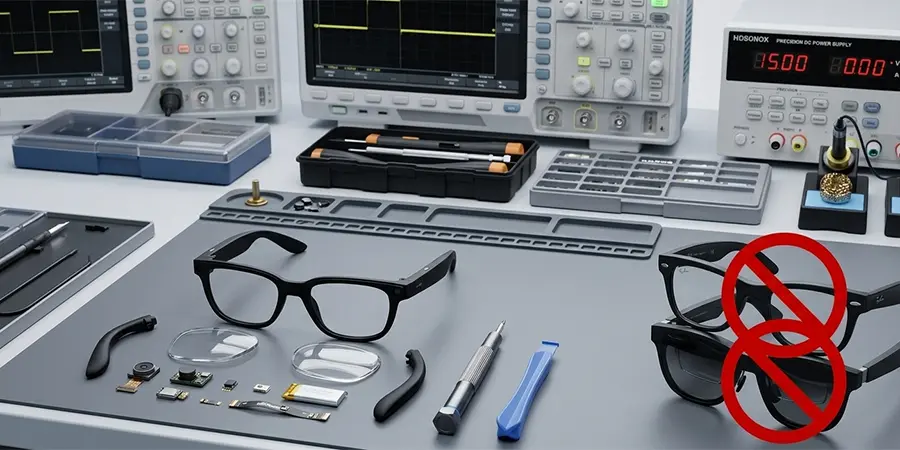
These repairs take 5-15 minutes and only require a few basic tools: a T5 Torx screwdriver, a plastic pry tool, cotton swabs, and 70% isopropyl alcohol. You can buy all of these tools for less than $10 on Amazon.
1. Cleaning Clogged Microphones (Works For All Brands)
This is the most common sensor failure, and it’s almost always easy to fix. Even if you own Ray-Ban Meta or XReal glasses, you should try this first before contacting support.
- Tools needed: Cotton swabs, 70% isopropyl alcohol
- Steps: 1. Turn off your glasses and disconnect them from your phone 2. Dip a cotton swab in isopropyl alcohol and squeeze out the excess (you don’t want it dripping—alcohol can damage the internal components if it gets inside) 3. Gently wipe the microphone holes on the temples. Don’t push the swab into the holes—you’ll damage the tiny mic diaphragm 4. Wait 5-10 minutes for the alcohol to completely evaporate 5. Turn on your glasses and test the microphone
2. Replacing a Scratched Camera Lens Cover (Only Works For SpeCiC)
If your camera is blurry but the sensor itself is fine, you can just replace the lens cover. SpeCiC sells replacement lens covers for $9 each, and they just pop off and on.
- Tools needed: Plastic pry tool, replacement lens cover
- Steps: 1. Turn off your glasses 2. Use the plastic pry tool to gently pop off the old lens cover (start at one corner and work your way around) 3. Clean the camera sensor with a soft microfiber cloth (don’t use isopropyl alcohol—you’ll damage the sensor coating) 4. Peel the adhesive backing off the new lens cover 5. Align the new lens cover with the camera hole and press it firmly into place
Moderate DIY Repairs (Some Technical Skill Required, No Soldering)
These repairs take 15-30 minutes and require a little more technical skill. You don’t need to solder, but you will be working with small parts and delicate cables. Only try these if you own SpeCiC glasses.
Repairs You Should Never Try Yourself (No Matter What)
These repairs require specialized tools, micro-soldering skills, and access to proprietary parts. Trying to do them yourself will almost certainly break your glasses beyond repair.
- - Any repair on Ray-Ban Meta, XReal, or Google Glass glasses - Replacing an IMU chip (soldered to the motherboard) - Replacing a Bluetooth module (soldered to the motherboard) - Any repair on AR display modules - Replacing a battery (most batteries are glued in place and require heat to remove—you could start a fire)
Third-Party Repair: Is It Worth It? (Only For SpeCiC)
If your glasses are out of warranty and the official repair cost is too high, you might be tempted to try a third-party repair shop. But is it worth it?
The short answer: only if you own SpeCiC glasses. For other brands, third-party repair is almost never worth the risk.
Pros of Third-Party Repair
- - **Cheaper than official repair**: Third-party shops usually charge 30-50% less than official service centers - **Faster turnaround**: Most third-party repairs are done in 1-2 days, compared to 2-3 weeks for official service - **They might fix things official shops won’t**: Some third-party shops will attempt repairs that official shops refuse to do
Cons of Third-Party Repair
- - **No warranty**: Most third-party repairs only come with a 30-day warranty, if any - **They might use cheap parts**: Many third-party shops use counterfeit or used parts that will break again quickly - **They might break your glasses more**: If the technician doesn’t know what they’re doing, they can cause permanent damage to your glasses - **You’ll lose your official warranty**: Any unauthorized repair will void your manufacturer’s warranty
You have a legal right to repair your own property. The “right to repair” movement is fighting for laws that require brands to sell replacement parts and provide repair guides to consumers—and you should support it.
How To Prevent Sensor Damage In The First Place (The Best Repair Is The One You Never Have To Do)
Okay, we’ve covered a lot of ground. We’ve talked about what sensors are in your glasses, how they break, how different brands handle repairs, and which repairs you can do yourself. But the best repair is the one you never have to do.
Here are 10 simple, actionable tips to prevent sensor damage and make your smart glasses last as long as possible:
- 1. Use a hard shell case: Always store your glasses in a hard shell case when you’re not wearing them. This will protect them from drops, scratches, and dust.
- 2. Avoid sweat and moisture: Don’t wear your glasses while exercising, showering, or swimming. Sweat and moisture are the #1 cause of sensor failure.
- 3. Clean them regularly: Clean the microphone holes, camera lens, and touch sensor with a soft microfiber cloth and isopropyl alcohol every week.
- 4. Don’t drop them: This seems obvious, but most sensor damage is caused by drops. Be careful when you’re wearing your glasses, especially when you’re walking or running.
- 5. Don’t leave them in extreme temperatures: Don’t leave your glasses in a hot car or in the cold for long periods of time. Extreme temperatures can damage the sensors and battery.
- 6. Don’t overcharge them: Unplug your glasses as soon as they’re fully charged. Overcharging can damage the battery and cause it to swell, which can damage the sensors.
- 7. Update the firmware regularly: Brands release firmware updates that fix bugs and improve sensor performance. Make sure you update your glasses regularly.
- 8. Don’t use sharp objects to clean them: Never use a pin, needle, or other sharp object to clean the microphone holes or camera lens. You’ll damage the internal components.
- 9. Don’t bend the frames: Bending the frames can damage the wiring and sensors inside the temples.
- 10. Buy repairable smart glasses: The best way to avoid expensive repairs is to buy a brand that actually lets you repair your glasses.
Conclusion: So, Can You Repair A Broken Internal Sensor?
Okay, we’ve covered everything. Let’s wrap it up with a clear, no-BS answer to the question we started with:
Can you repair a broken internal sensor on smart glasses? It depends almost entirely on what brand you own.
If you own SpeCiC glasses, yes—most sensor failures are easy and affordable to repair, either yourself using their free video guides and replacement parts, or through their fast, affordable official repair service. Even if your glasses are out of warranty, the total repair cost will almost never exceed $100.
If you own Ray-Ban Meta, XReal, or most other brands, no—you’ll have to buy a new pair. Most brands intentionally design their products to be unrepairable, using glue instead of screws, encrypting their motherboards, and refusing to sell replacement parts.
The smart glasses industry is at a crossroads. Most brands are still stuck in the disposable tech mindset, designing products that are meant to be thrown away after 2-3 years. But brands like SpeCiC are showing that there’s a better way. They’re proving that you can make high-tech, stylish smart glasses that are also repairable, affordable, and sustainable.
When you’re buying your next pair of smart glasses, don’t just look at the features and the price. Look at the repair policy. Ask yourself: if a sensor breaks, can I fix it? How much will it cost? Will the brand help me, or will they just tell me to buy a new pair?
At the end of the day, smart glasses are just tools. They should work for you, not against you. And if a brand doesn’t respect your right to repair your own property, you shouldn’t give them your money.
So the next time you drop your glasses and panic, take a deep breath. If you own SpeCiCs, you’re probably fine. If you own something else… well, maybe it’s time to switch.
What’s one thing you’re going to look for in your next pair of smart glasses? Drop it in the comments—I’d love to hear it!