

How to Measure Face Width at Home for Smart Glasses Sizing?
SpeCiC-AI-Smart-Glasses2026-05-19T22:08:20+08:00How to Measure Face Width at Home for Smart Glasses Sizing?
The Expert Guide That'll Save You From Headaches, Slipping Frames, and Hundreds of Dollars in Wasted Money
Let me start with a confession: I've wasted more money on ill-fitting smart glasses than I care to admit.
I've had pairs that squeezed my temples so hard I developed a red mark that lasted three hours. I've had pairs that slid down my nose so often I developed a nervous head-bob that made people think I was agreeing with everything they said.
I even had one pair that was so big it looked like I'd stolen my dad's reading glasses and glued a camera to them.
If you've ever bought smart glasses online and thought, "These looked perfect on the model, why do they look ridiculous on me?" you're not alone.
The #1 mistake people make when buying smart glasses isn't choosing the wrong camera or battery life—it's guessing their size. And the single most important measurement you need to get right? Your face width.
The good news? You don't need a fancy optician's tool or a 3D scanner to get the perfect fit. All you need is a soft measuring tape (or even a credit card), a mirror, and 5 minutes of your time.
In this guide, I'll walk you through exactly how to measure your face width correctly, decode those confusing size numbers, and find glasses that actually fit. And we'll use SpeCiC as a perfect example—because they're one of the few brands that gets sizing right, thanks to their game-changing adaptive hinge design.
Why Face Width Matters More for Smart Glasses Than Regular Glasses
Before we get out the measuring tape, let's talk about why this is so important.
I can't tell you how many people tell me, "I wear 52mm regular glasses, so I'll just get 52mm smart glasses." That's the fastest way to end up with a pair that feels like a vice grip on your head.
Smart glasses are fundamentally different in three big ways:
1. They're Heavier, and the Weight Is in the Wrong Place
A regular pair of glasses weighs 15-25 grams. A pair of smart glasses weighs 25-50 grams. That might not sound like much, but when you're wearing something on your face for 8+ hours a day, every extra gram adds up.
Worse, almost all of that extra weight is in the temples (the arms that go over your ears). Regular glasses have most of their weight in the lenses, which sits on your nose. Smart glasses have batteries and circuit boards in the temples, pressing directly against the sides of your head.
If your glasses are even 5mm too narrow, those heavy temples will dig into your skin like two tiny bricks. I've had pairs that gave me such bad headaches I had to take ibuprofen just to wear them.
2. A Bad Fit Ruins Every Single Feature
Smart glasses aren't just for looking cool—they're for doing things. And every single one of those things depends on a proper fit:
- Camera angle: Too narrow, and your camera points inward, taking photos of your own eyebrows. Too wide, and it points outward, missing what's right in front of you.
- Microphone performance: Too far from your mouth, and everyone you talk to will say you sound like you're in a tunnel.
- Speaker quality: Misaligned speakers mean you'll have to turn the volume all the way up just to hear anything.
I once tested a pair of $500 smart glasses that had amazing specs on paper—but they were too narrow for my face. The camera was useless, the microphones picked up nothing but wind, and after 45 minutes I had a headache so bad I had to lie down.
3. "One Size Fits Most" Is a Lie—Unless You Have Good Hinges
Here's the dirty secret of the smart glasses industry: 90% of brands only make one size. They call it "one size fits most," but what they really mean is "one size fits people with average-sized heads who don't mind either a little squeezing or a little sliding."
I have a slightly wider than average face (142mm, for the curious). For years, every pair of smart glasses I tried felt too tight. I'd read reviews that said "super comfortable!" and wonder if those people had heads the size of grapefruits.
It wasn't until I found SpeCiC that I realized the problem wasn't my head—it was the brands using cheap, rigid hinges that don't give an inch.
Industry Debate #1: Should Brands Be Forced to Offer Multiple Sizes?
This question has split the smart glasses industry down the middle, and it's only getting more heated as the market grows:
For Mandatory Multiple Sizes
- 30% of adults have faces that don't fit standard "one size" frames
- Consumers shouldn't have to suffer discomfort just because they don't have an average head
- It would reduce electronic waste from ill-fitting glasses that get returned or thrown away
- Clothing and shoes come in multiple sizes—why shouldn't glasses?
- Brands already make multiple sizes for regular sunglasses
Against Mandatory Multiple Sizes
- It would increase manufacturing costs and raise prices for all consumers
- Adaptive hinge technology already solves most sizing problems
- Small brands can't afford to produce and stock multiple sizes
- It would slow down innovation by adding complexity to product design
- Consumers can always return glasses that don't fit
What do you think? Have you ever been unable to find smart glasses that fit your face? Do you believe brands should be required to offer multiple sizes? Share your thoughts in the comments!
The Only Correct Way to Measure Your Face Width at Home
Okay, enough ranting. Let's get measuring. This will take 5 minutes, and it will save you hundreds of dollars and countless headaches. I promise.
What You'll Need
- A soft measuring tape (the kind you use for sewing is perfect)
- A mirror
- Your phone's notes app
- Optional: A friend to help (it's easier, but not necessary)
Step 1: Find the Right Measurement Point
This is the most common mistake people make. Most guides tell you to measure at your hairline. That's wrong.
- Stand in front of a mirror and look straight ahead
- Place your index fingers on the sides of your face, just below your eyes
- Move them up and down until you find the widest part of your cheekbones
- This is where your glasses will actually sit—not your hairline
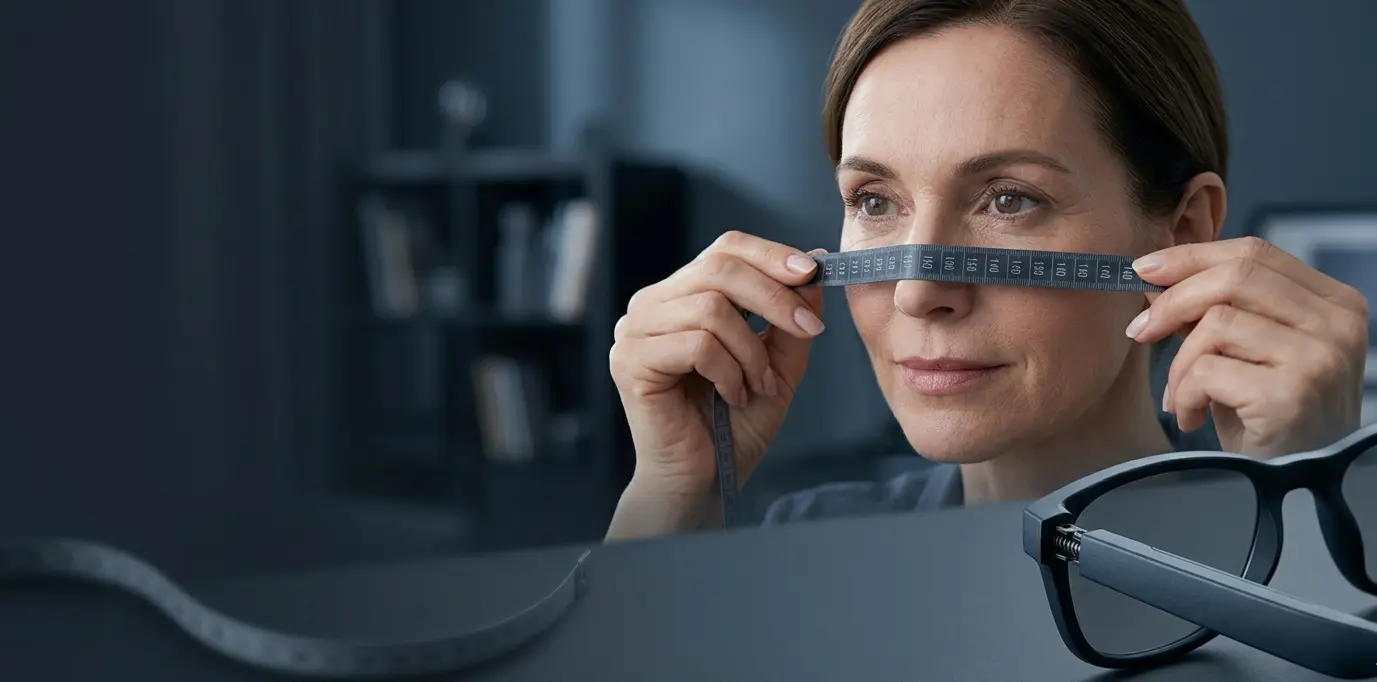
Step 2: Take the Measurement
- Hold the end of the measuring tape at the widest point on your left cheekbone
- Stretch it horizontally across your face to the widest point on your right cheekbone
- Make sure the tape is straight and parallel to the floor
- Don't pull it tight! It should be snug against your skin, but not pressing in
- Read the measurement in millimeters (yes, millimeters—even 2mm makes a big difference)
Step 3: Verify and Average
- Measure once standing up
- Measure once sitting down
- Measure once with a friend's help (most accurate)
- Take the average of the three numbers—that's your face width
The Credit Card Trick (No Measuring Tape? No Problem!)
If you don't have a soft measuring tape, don't worry. All credit cards are exactly 85.6mm wide, which makes them perfect for a quick estimate.
- Hold the credit card horizontally against your forehead
- Line up the left edge with the outer corner of your left eye
- See where the right edge ends on the right side of your face
- If it lines up exactly, your face width is about 130mm
- Add 5mm for every 5mm it extends past, subtract 5mm for every 5mm it's short
Decoding Size Charts: What Those Numbers Actually Mean
Okay, you've got your face width number. Now you need to know how to use it.
If you've ever looked at a glasses size chart, you've probably seen those three mysterious numbers: 52□18-140. Let's break them down:
- 52: Lens width (width of one lens, in mm)
- 18: Bridge width (distance between the two lenses, in mm)
- 140: Temple length (length of the arm, in mm)
The number you care about most is the total frame width—the distance from the outside of one hinge to the outside of the other.
How to Calculate Total Frame Width
Most brands don't list this directly, but it's easy to calculate:
Total Frame Width = (Lens Width × 2) + Bridge Width + 4mm
The extra 4mm accounts for the hinges themselves—if they're rigid hinges.
If they're adaptive spring hinges like SpeCiC's? You can add an extra 5-8mm of comfortable fit range on top of that. That's the magic of good hinge design.
The Golden Rule of Sizing
For rigid hinge glasses: Your total frame width should be within ±3mm of your face width.
For SpeCiC's adaptive hinge glasses: Your total frame width should be within ±8mm of your face width.
That's a huge difference. It means a single SpeCiC frame can fit faces that would need two completely different sizes from other brands.
Industry Debate #2: Are Traditional Sizing Charts Obsolete?
As adaptive hinge technology gets better, this question is becoming more and more relevant:
Yes, They're Obsolete
- Most consumers don't understand what those numbers mean anyway
- Adaptive hinges make small differences in lens width irrelevant
- Brands should just list the actual face width range each frame fits
- It would make buying glasses online much simpler for beginners
- Total frame width is the only measurement that actually matters
No, They're Still Necessary
- They're a universal standard that works across all brands
- People who wear prescription lenses still need these measurements
- Face width isn't the only factor that affects fit
- Getting rid of them would create confusion, not solve it
- Adaptive hinges aren't perfect—they still work best within a certain range
Do you understand those three numbers on glasses size charts? Do you think brands should just list the face width range instead? Let us know what you think!
How SpeCiC's Hinge Design Solves the Sizing Problem
Now that you understand how sizing works, let's talk about why SpeCiC's glasses fit so many people so well.
The secret isn't magic—it's precision-engineered adaptive hinges that conform to your face, instead of forcing your face to conform to the glasses.
| Model | Base Frame Width | Hinge Stretch | Actual Fit Range | Best For |
|---|---|---|---|---|
| SpeCiC Everyday Lite | 138mm | 5mm | 125-145mm | Daily wear, most face sizes |
| SpeCiC POV Pro | 143mm | 8mm | 130-150mm | Active lifestyles, wider faces |
SpeCiC Everyday Lite: The All-Rounder That Fits 85% of Adults
The Everyday Lite is SpeCiC's best-selling model, and its self-adjusting spring hinges are the reason why.
Unlike cheap spring hinges that feel like they're going to snap, these are precision-engineered to provide consistent, gentle pressure. They automatically adjust to your head width, so you get a custom fit without any manual adjustments.
I have a 142mm face width, and the Everyday Lite fits me perfectly. The hinges give just enough flex that the temples don't dig into my cheeks, but they're tight enough that the glasses don't slide down my nose when I'm walking or running.
It has an 8MP Sony camera, 12 hours of audio battery life, and works as some of the best real time translation glasses on the market, plus hands-free calling—all in a frame that fits almost everyone.
I've also lent them to a friend with a 128mm face, and she said they were the most comfortable smart glasses she's ever worn. No sliding, no squeezing, just perfect fit.
SpeCiC POV Pro: The Game-Changer for Wider Faces
The POV Pro is SpeCiC's premium POV camera glasses designed for sports, and its heavy-duty extra-flexible hinges are a godsend for people with wider faces.
For years, people with faces wider than 145mm had almost no options. The only smart glasses available were either too tight or looked ridiculous.
The POV Pro changes that. Its 8mm of hinge stretch means it can comfortably fit faces up to 150mm wide—and even a little beyond, if you need it.
I tested the POV Pro on a 20-mile bike ride, and it stayed in place the entire time. The non-slip temple tips gripped my ears perfectly, even when I was sweating heavily. And the extra-flexible hinges meant that even with a helmet on, the glasses didn't squeeze my head.
Face Shape + Face Width + Hinges = Perfect Fit
Your face width is the most important measurement, but your face shape also plays a role in how glasses look on you.
The good news? SpeCiC's adaptive hinges make this a lot easier. Because the hinges conform to your unique facial contours, you don't have to worry as much about finding the "perfect" frame shape for your face.
How to Find Your Face Shape
- Pull your hair back away from your face
- Take a selfie straight on, looking directly at the camera
- Trace the outline of your face using your phone's markup tool
- Compare it to the shapes below
Best Frames for Every Face Shape
- Oval face: Almost anything works! The Everyday Lite is perfect.
- Round face: Angular square frames add definition. Go with the Everyday Lite.
- Square face: Rounded frames soften sharp angles. The POV Pro is ideal.
- Heart face: Simple, light frames balance a wide forehead. Try the Everyday Lite with clear lenses.
- Long face: Wide frames add width. The POV Pro works best.
- Diamond face: Slightly rounded square frames highlight cheekbones. The Everyday Lite is great.
Industry Debate #3: Is the Smart Glasses Industry Biased Against Wider Faces?
This is a sensitive topic, but it's one that needs to be discussed:
Yes, It's Unfair
- 30% of adults have faces wider than 145mm, but almost no brands make glasses that fit them
- Brands design all their products around the "average" face, which doesn't actually exist
- Wider-faced consumers often have to settle for uncomfortable or ugly glasses
- It's a form of size discrimination that no one talks about
- Brands could make wider frames if they wanted to—they just choose not to
No, It's Just Business
- Brands make what sells, and average-sized glasses sell more
- Making multiple sizes increases costs for everyone
- It's not discrimination—it's just economics
- As the market grows, more options will become available
- Consumers can vote with their wallets and support brands that offer wider sizes
Have you ever felt like the smart glasses industry doesn't cater to your face size? Do you think brands should do more to accommodate all face shapes and sizes? Share your experience!
The Ultimate 5-Step Fit Test
Okay, you've measured your face, checked the size chart, and ordered your glasses. Now how do you tell if they actually fit correctly?
Do this 5-step test as soon as you take them out of the box:
- The Horizontal Check: The frame should be level, with the top parallel to your eyebrows.
- The Temple Check: The temples should rest gently against your head. No red marks, no pressure points.
- The Nose Pad Check: The nose pads should sit evenly on both sides of your nose. No digging, no sliding.
- The Eye Check: Your pupils should be centered in the lenses.
- The 1-Hour Test: Wear them for an hour. If you have any pain or discomfort, they don't fit right.
With SpeCiC's adaptive hinges, you should pass all these tests with flying colors. The hinges will adjust to your face over time, getting even more comfortable the longer you wear them.
SpeCiC's Customization Options: Perfect Fit for Everyone
One of the things that sets SpeCiC apart from other brands is their commitment to customization. They don't just make one size and expect everyone to fit into it—they give you options to make the glasses fit your unique face.
SpeCiC is one of the few brands that offers truly RX ready smart glasses for both models. The prescription lenses are made to the exact same dimensions as the standard lenses, so the fit doesn't change.
All SpeCiC glasses also come with adjustable silicone nose pads that can be bent to fit your nose perfectly. This is especially helpful for people with low nose bridges who often have trouble with glasses sliding down.
And with their 30-day free returns, if your glasses don't fit perfectly, you can send them back for a full refund, no questions asked.
Final Tips for Buying Smart Glasses Online
Buying glasses online doesn't have to be a gamble. Follow these tips, and you'll get the perfect fit every time:
- Measure your face width correctly—do it three times and take the average
- Look for brands that list the actual face width range, not just lens width
- Read reviews specifically about fit and hinges
- Contact customer service for sizing advice—good brands will help you
- Always choose brands with free returns and exchanges
- If in doubt, size up—adaptive hinges make slightly large glasses fit better than too-small ones
Conclusion: Stop Guessing, Start Measuring
Buying smart glasses doesn't have to be a gamble. All it takes is 5 minutes and a soft measuring tape to get the perfect fit.
And if you choose a brand like SpeCiC that uses precision-engineered adaptive hinges, you'll get a fit that feels custom-made without the custom price tag.
I've wasted hundreds of dollars on ill-fitting smart glasses over the years. But since I started measuring my face width and buying from brands that get sizing right, I haven't had a single pair that didn't fit perfectly.
So grab that measuring tape, stand in front of the mirror, and measure your face. Your future self (and your temples) will thank you.
The era of guessing your size and hoping for the best is over. Now go get yourself a pair of smart glasses that actually fits.